PickRV Mega Guide
BLM dispersed camping — water + power budgets
Free camping on public land, 7-day water budgets, solar sizing, the rules that get you fined, and the dispersed spots no guidebook…
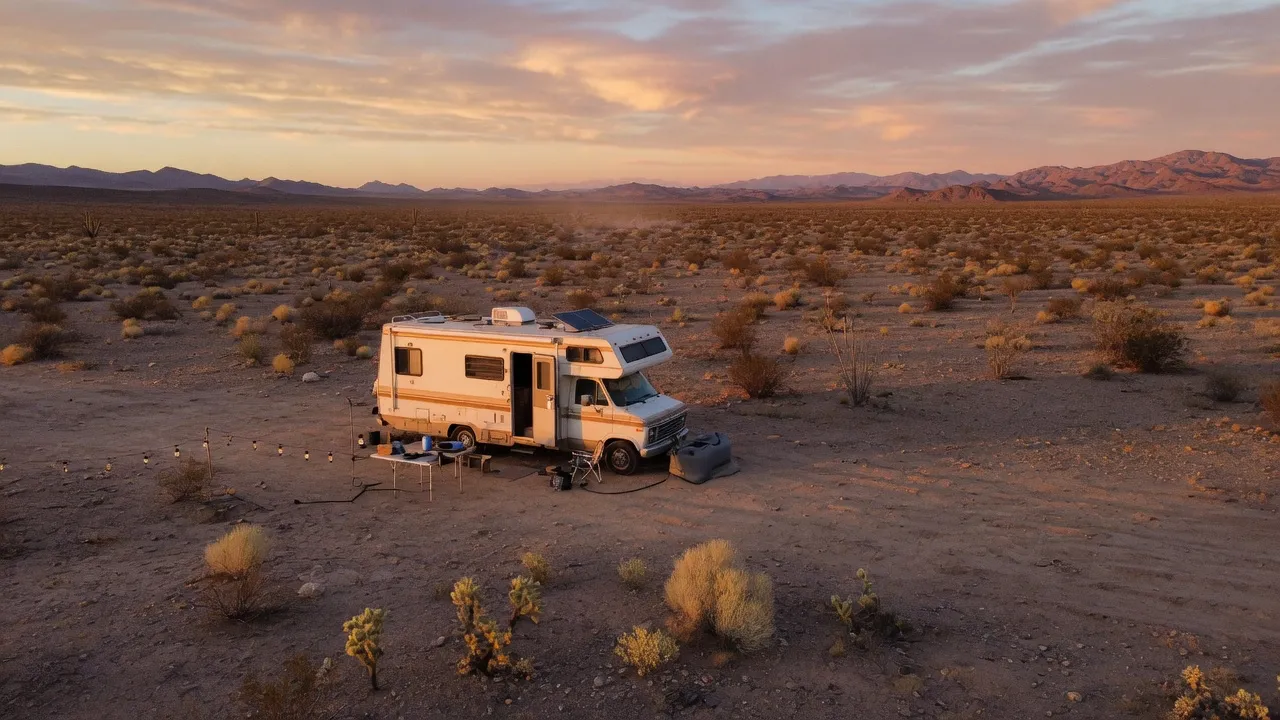
Boondocking — also called dispersed camping, dry camping, or just 'free' — is the practice of camping outside developed campgrounds with no hookups. Done right, it's the most affordable + scenic way to RV: a Class B campervan on BLM land costs $0/night vs $80/night at a private RV park, with views no campground can match. Done wrong, it's a $300 'illegal camping' citation from a ranger, a dry water tank at 11pm, or a dead battery with the food in the fridge spoiling. This guide covers where you can legally boondock (BLM, National Forest), the 5-day water/power budget math, solar sizing rules-of-thumb, and the spots most guidebooks won't print.
PickRV
Published by PickRV
PickRV is a marketplace. Editorial content is informational only — confirm road status, weather, wildlife, and host policies before you travel.
What does the PickRV rv boondocking guide cover?
Free camping on public land, 7-day water budgets, solar sizing, the rules that get you fined, and the dispersed spots no guidebook publishes. We walk through it section by section — what to check, what it costs, and the details most listings leave out.
- Where boondocking is legal
- Water
- Power
- Finding boondock spots
- Leave No Trace
- Weather + safety
- Best rigs for boondocking

Overview · ≈1 min
Where boondocking is legal — and where it isn't
Legal dispersed camping in the US falls into 4 main buckets: (1) BLM (Bureau of Land Management) — 245 million acres, mostly West, 14-day stay limit per area; (2) National Forests — 193 million acres, similar 14-day rules, more rules than BLM; (3) state-trust land (varies by state, often requires permit); (4) private land with owner permission (Boondockers Welcome, Harvest Hosts). Illegal: most National Park backcountry without permit, state parks (except designated sites), highway shoulders, retail parking lots without permission.
PickRV editor · what manufacturers + manuals gloss over
BLM rules are surprisingly relaxed — 14 days per location, then move 25 miles. National Forest rules are tighter — some districts limit to 7 days. State trust land in AZ/NV/NM requires an annual permit ($15-30/year) that 90% of boondockers don't realize exists; rangers cite for it. Walmart parking lots are the MYTH — corporate policy used to allow overnight but is now store-manager discretion (50%+ won't let you anymore); always ask the manager. Cracker Barrel is consistently friendlier, but only 1 night. Cabela's + Bass Pro: usually OK. Casinos: often OK, especially older ones.
- BLM = 245M acres, mostly West, 14-day limit per location
- National Forest = stricter (some 7-day) — verify district
- State trust land needs annual permit in AZ/NV/NM — $15-30/year
- Walmart is myth-status; Cracker Barrel + Cabela's friendlier
Chapter 2 · How-to · 5 steps · ≈1 min
Water — 7-day budget for a family of 4

Fresh water is your boondocking ceiling. Typical Class B holds 22-30 gal; Class C 40-60 gal; 5th wheel 65-90 gal. Without restraint, a family of 4 burns 15-20 gal/day. With discipline, you can drop that to 5-7 gal/day — making a 30-gal Class B last 4-5 days off-grid.
- 1
Limit showers to 90-second 'navy showers'
Wet down (10 sec), turn water off, soap up, rinse (60 sec). Saves 5-8 gal vs a normal shower. Practice at home before the trip.
- 2
Catch greywater for toilet flushes
Place a bucket in the kitchen sink to catch rinse water. Use it to bucket-flush the toilet instead of fresh tank water. Saves 1-2 gal/day per person.
- 3
Use paper plates + plastic utensils
Eliminates dishwashing water entirely. Compost where allowed, trash where not.
- 4
Keep a 5-gal jug for drinking only
Reserves your tank water for hygiene. Refill the jug at any potable water source.
- 5
Carry a 5-gal collapsible jerry can
Top off tank from a nearby campground spigot before tank goes empty. $25 at Walmart. Extends boondock window 2-3 days.
PickRV editor
RV manufacturers spec fresh tanks generously to sell the rig — they assume hookups. Reality boondocking: a 30-gal tank is 4-5 days for an undisciplined family of 4, OR 8-12 days for a disciplined couple. The single biggest water hog is the SHOWER — limit to every 2-3 days OR navy-shower style.
Second: never EVER use shower water from a campground 'hose' for drinking; campground spigots are non-potable unless explicitly labeled.
Third: 'water bandits' (RV slang for siphoning water from a friend's tank when yours runs out) are a real boondocker tradition; carry a 12V transfer pump ($60) + 20 ft of hose to make this fast.
Comparison · 4 options · ≈1 min
Power — solar, batteries, generators
Boondock power = battery storage × renewable input vs daily draw. A family of 4 typically draws 60-100 Ah/day. A 200Ah lithium bank handles 2-3 days alone; with 400W solar input, it can sustain indefinitely under sunny conditions.
Off-grid power source comparison
100W solar + 200Ah AGM (entry)
$700
total install. 30-40 Ah/day input under sun. Sustains light usage (12V LED + water pump + small fan). NOT enough for residential fridge or AC. Best for weekend trips.
400W solar + 200Ah lithium (mid-range)
$2,400
total install. 100-150 Ah/day input. Sustains 12V fridge + lights + water pump + occasional inverter use. Recharges in 1 day of sun. Best for 1-2 week trips.
800W solar + 400Ah lithium + 2000W inverter
$5,500
total install. 250-350 Ah/day input. Sustains residential fridge + occasional AC (1-2 hours). Best for full-time off-grid.
Honda EU2200i generator (no solar)
$1,100
retail. 2.2 kW. Runs 4-8 hours on a tank. Quiet (~57 dB). Pairs with smaller solar for full coverage.
| Option | Cost | What it covers |
|---|---|---|
| 100W solar + 200Ah AGM (entry) | $700 | total install. 30-40 Ah/day input under sun. Sustains light usage (12V LED + water pump + small fan). NOT enough for residential fridge or AC. Best for weekend trips. |
| 400W solar + 200Ah lithium (mid-range) | $2,400 | total install. 100-150 Ah/day input. Sustains 12V fridge + lights + water pump + occasional inverter use. Recharges in 1 day of sun. Best for 1-2 week trips. |
| 800W solar + 400Ah lithium + 2000W inverter | $5,500 | total install. 250-350 Ah/day input. Sustains residential fridge + occasional AC (1-2 hours). Best for full-time off-grid. |
| Honda EU2200i generator (no solar) | $1,100 | retail. 2.2 kW. Runs 4-8 hours on a tank. Quiet (~57 dB). Pairs with smaller solar for full coverage. |
PickRV editor
Solar marketing emphasizes peak-watt ratings; reality is the system delivers 60-75% of peak under typical conditions. A 'rated 400W' panel array realistically generates 240-300W average.
Second: AGM batteries are HEAVY and only discharge safely to 50%. Lithium gives you ~90% AND charges 3x faster — but costs 2-3x more. For 5+ year ownership, lithium pays back.
Third: the biggest boondocking power mistake is running the AC off battery — even with 2,000W inverter + 400Ah lithium, AC drains the bank in 2-3 hours. AC = generator job, not battery job.
- Solar delivers 60-75% of peak rating in real conditions
- AGM: 50% usable; lithium: 90% usable + 3x faster charge
- AC is a generator job; battery + solar handles lights + fridge
Chapter 4 · Overview · ≈1 min
Finding boondock spots — apps, maps, the secret tier
Public-facing tools: FreeRoam app, Campendium, iOverlander, FreeCampsites.net. Each has 10K+ user-reported sites with reviews. BLM maps: blm.gov publishes interactive maps. Forest Service MVUM: downloadable PDFs of every National Forest district showing which roads allow dispersed camping. The 'secret tier': boondock spots locals + repeat visitors guard.
PickRV editor
FreeRoam + Campendium are great for first-timer confidence — verified sites with reviews. BUT the same sites get hammered by 50+ rigs in peak season. To find genuinely quiet spots: (1) download the Forest Service MVUM for your destination district, (2) look for spur roads off the main FS route, (3) cross-check with satellite view — flat clearings near forest roads but not next to campgrounds are the unicorns. The 25-mile rule (BLM 14-day, then move 25 miles) is what creates the rotation; locals know which roads each forest district has historically permitted. Ask at the local FS ranger station — they'll often draw you a map. Second pro tip: 'Boondockers Welcome' ($85/year membership) lists private property owners across the US who host RVers in driveways or fields for free.

FAQ · 5 questions · ≈1 min
Leave No Trace — the boondocker code
Boondocking is a privilege that depends on the next RVer finding the site as clean (or cleaner) than you left it. Every BLM closure of a popular boondock area in the last 10 years traces back to abuse.
Can I dump greywater on the ground?
BLM regulations vary by district. Some allow casual greywater dumping 200+ ft from water sources; most National Forests prohibit it. Default: collect greywater in a portable tote ($120) + dump at the nearest sanitary dump station. Never dump black, ever — it's a federal-level violation.
Can I have a campfire?
Depends on state/local fire restrictions (Stage I/II/III bans common in fire season), site rules (some BLM areas prohibit fires regardless), fire ring presence (use existing rings, don't make new). Always have a shovel + water + extinguisher.
Can I run my generator at night?
Most BLM areas have a 'reasonable hour' guideline — generally 8am-9pm. National Forests usually mirror this. In quiet boondock areas, even quiet generators carry 1/4 mile. Best practice: shut down by 8pm.
Where do I poop?
If you have an RV toilet, use it. If not: pack out (WAG bag) OR bury 6+ inches deep, 200+ ft from water, away from trails. Toilet paper goes with you, NEVER buried.
Can I bring my dog off-leash?
Most BLM allows off-leash if controllable. National Parks + Forests vary — many require leash. Wildlife encounters can KILL your dog (cougars, bears). Default to leash unless you know the area.
PickRV editor
The boondocker community polices itself harder than any government agency could. Sites with chronic abuse get reported on FreeRoam/Campendium with 1-star reviews and warning notes — those sites then get fewer visitors, and the area's tolerance for boondocking declines. Pay it forward: pack out 1 piece of trash that wasn't yours every visit. The cumulative effect of 100,000 boondockers each picking up 1 extra piece is millions of pieces of trash off public land per year.
Chapter 6 · Troubleshooting · 5 steps · ≈1 min
Weather + safety — what kills boondockers
Off-grid = far from emergency services. The dangers are real but mostly preventable with planning.
- 1
Flash floods in slot canyons / dry washes
Never camp in a dry wash, no matter how flat. Distant rainstorms can send 6-ft walls of water down dry creeks in minutes. Always camp 100+ ft above the obvious flood plain. Death Valley + AZ + UT flash flood deaths are 80% RVers/hikers in washes.
- 2
Wildfires + smoke
Check inciweb.nwcg.gov before any trip. Active fires close roads + closures expand fast. Smoke from 100+ mi away can trigger asthma + heart events. Always have N95 masks.
- 3
Hypothermia / heat
Boondock = no AC unless generator running. In summer, valley floors hit 110°F+; in winter, mountain elevations drop to 0°F at night. Match elevation to season — go up in summer, down in winter.
- 4
Wildlife encounters
Black bear: lock food, hang or use bear-can. Mountain lion: rare but real in West. Always have a first-aid kit + know route to nearest ER.
- 5
Vehicle stuck / breakdown
Tell someone your plan + ETA. Bring recovery boards + 2 way radios + at least 3-day water reserve. An RV-specific third-party roadside membership typically covers towing from a boondock site; basic roadside plans often do not.
PickRV editor
Verizon coverage map is 80% accurate — but 'covered' often means 1 bar of LTE that streams nothing. Garmin inReach Mini 2 ($400 + $15/mo subscription) gives global SOS + texting via Iridium satellite anywhere. For 2+ week boondock trips with kids, it's the cheapest insurance you'll buy.
Second: 'always tell someone' rule — give 2 people your itinerary + check-in date. If you don't check in by then, they call the relevant ranger station. Search-and-rescue starts 24 hours late if no one knows you're missing.

Comparison · 5 options · ≈1 min
Best rigs for boondocking — by category
Not all RVs boondock equally. The geometry + power systems + holding tanks shape your off-grid range.
Boondock-friendly rig comparison
Class B campervan
BEST for stealth + access. Fits anywhere a van fits. 20-30 gal water, small holding tanks, but easy to refill + dump frequently. Most boondock-converted vans have lithium + solar built in. Range: 4-7 days solo/couple.
Teardrop / small TT
EXCELLENT for couples + small trucks. No need for hookups. Sleeps 2 comfortably. Range: 2-4 days. Cheap entry point ($8K-$20K used).
Class C motorhome (22-28ft)
GOOD for families. 30-50 gal water, 30-40 gal holding tanks. Standard solar setup gives 3-5 day range. Avoid 30+ ft Class C — they're too long for many BLM access roads.
Class A motorhome (30-40ft)
FAIR — large holding tanks help, but 35+ ft can't access many BLM/Forest roads. Best for destination boondocks.
5th wheel + truck
POOR for most boondock — pin weight + length limits roads access. Some 25-32 ft units work on improved BLM. Bring the truck disconnect for day-trips.
| Option | What it covers |
|---|---|
| Class B campervan | BEST for stealth + access. Fits anywhere a van fits. 20-30 gal water, small holding tanks, but easy to refill + dump frequently. Most boondock-converted vans have lithium + solar built in. Range: 4-7 days solo/couple. |
| Teardrop / small TT | EXCELLENT for couples + small trucks. No need for hookups. Sleeps 2 comfortably. Range: 2-4 days. Cheap entry point ($8K-$20K used). |
| Class C motorhome (22-28ft) | GOOD for families. 30-50 gal water, 30-40 gal holding tanks. Standard solar setup gives 3-5 day range. Avoid 30+ ft Class C — they're too long for many BLM access roads. |
| Class A motorhome (30-40ft) | FAIR — large holding tanks help, but 35+ ft can't access many BLM/Forest roads. Best for destination boondocks. |
| 5th wheel + truck | POOR for most boondock — pin weight + length limits roads access. Some 25-32 ft units work on improved BLM. Bring the truck disconnect for day-trips. |
PickRV editor
The single biggest boondock-readiness upgrade for any rig is converting to lithium batteries + adding 400W+ of solar. Total: $2,000-$3,500 retrofit. The result: a Class C that used to last 1-2 days now lasts 7+ days off-grid. Pays for itself in saved campground fees within ~25 boondock-nights.
Second: '4WD overland-style' boondocking is a separate world — requires AT/MT tires, recovery boards, 2x ground clearance, and a willingness to scratch the rig. Class B campervans on 4WD chassis are the only mainstream RVs built for this.
Continue reading
More trips like this · 6
Similar terrain, seasons, and rigs from across PickRV.
Was this guide helpful?