Yes, they are located at Black Rock Campground (near campsite 6) and at Cottonwood (between the visitor center and the campground). They cost $5 to use.nps.gov, read Sep 24, 2026
While reservation campgrounds are typically open year-round, partial or full closures may occur during the summer months.nps.gov, read Sep 24, 2026
Official park page confirmed live on July 25, 2026.
More on Joshua Tree National ParkField notes, rig limits by loop, seasons, what to do, quiet spots
Joshua Tree National Park covers 1,235 sq mi where the Mojave + Colorado Deserts meet, 2.5 hours east of LA. Nine campgrounds, all primitive — NO water at any of them, NO dump stations inside the park. Bring everything in, take everything out. Rent rate: free entry (with park pass), $20-25/site. Some sites are first-come-first-served (Belle, White Tank, Hidden Valley); reservations open 6 months out via Recreation.gov for the rest. Adjacent BLM land south of the park (Joshua Tree South + Chuckwalla Bench) offers free dispersed camping with similar landscape — the savviest RVers basecamp on BLM and day-trip into the park.
The notes below are PickRV's editorial record. Only the figures in the strip at the top of the page, each with its link and date, were re-read on the park's own pages.
What Joshua Tree National Park's own pages say
When can a generator run in a Joshua Tree campground?
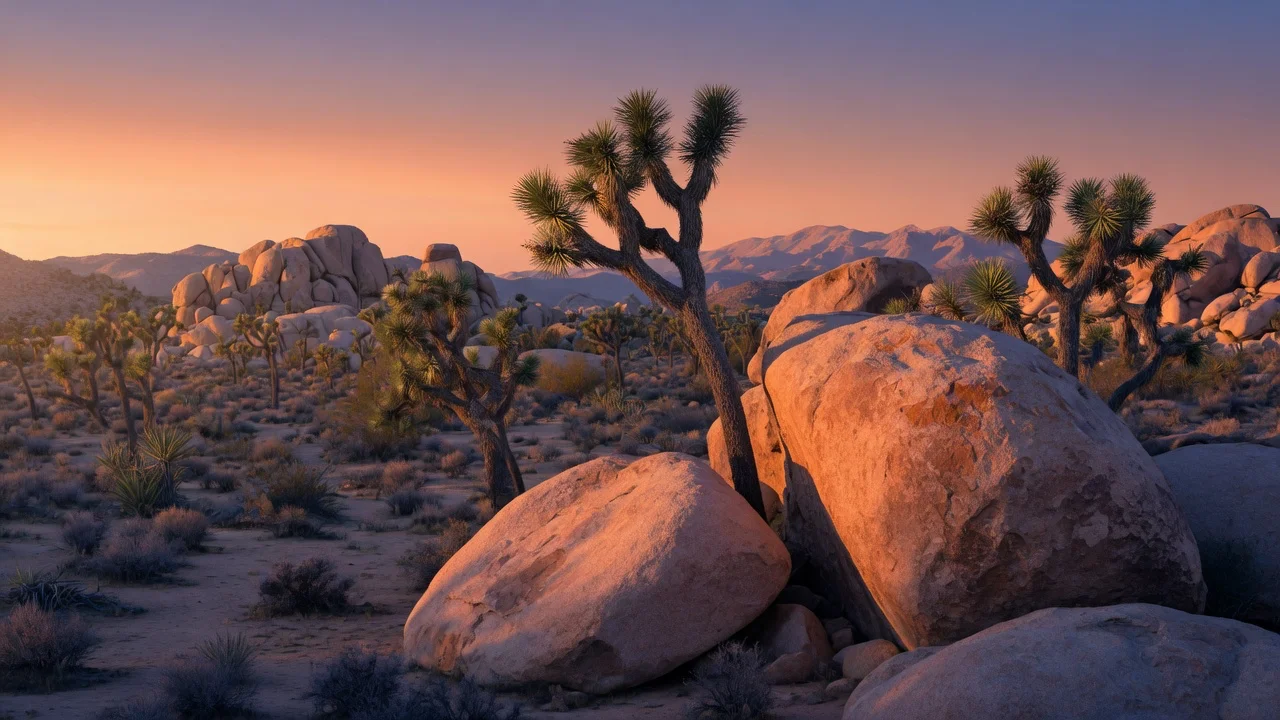
Joshua Tree marks the seam between the higher, cooler Mojave Desert and the lower, hotter Colorado Desert in southeastern California. The Mojave side carries the namesake Joshua trees and rounded quartz monzonite boulders that draw climbers and night-sky watchers; the southern Colorado side trades them for ocotillo, cholla, and palm oases.
When to visit
October through April brings comfortable daytime temperatures; spring wildflower blooms (most often late February through April) follow wet winters and are never guaranteed.
RV access notes
Most park campgrounds — including Jumbo Rocks, Belle, and White Tank — accept RVs but offer no hookups and limited dump-station access; Cottonwood Campground at the southern end allows RVs up to about 35 ft.
Source —
What the official site doesn't tell you
PickRV editor's field notes
NPS.gov mentions primitive camping but doesn't drive home: with NO water + NO dump in 7 of 9 campgrounds, your 35-gallon fresh-water tank is your CEILING. A family of 4 burns through that in 2-3 days. Two practical hacks: (1) bring 5+ collapsible 5-gallon water jugs as backup; (2) the gas station at the Cottonwood (south) entrance has a non-potable spigot for $0.25/gal — fill jugs there, NOT the park drinking water. Second: BLM Joshua Tree South is the SECRET — free dispersed camping, same desert landscape, 10-min drive to the park's south entrance, 30-day max stay. Park your big rig there, drive a smaller vehicle into the park during the day. Third: the most-overlooked sunset spot is Keys View — stunning vista of the Coachella Valley + San Andreas Fault; watch the smog burn off as the sun drops. Fourth: cell signal is dead inside the park except at Black Rock + Cottonwood entrances — download offline maps before. Fifth: 'Joshua tree' is technically a Yucca brevifolia, not a tree — the name is from Mormon settlers comparing it to the biblical figure; the park's namesake is dying off in the southern half due to climate-shifted rainfall, so see it now while the iconic groves remain.
Rig limits by loop and road
Length + clearance
·Park-wide, our record: 35 ft
·Hidden Valley Campground: 25 ft — Tight rock-bordered sites; 25ft realistic max
·Jumbo Rocks Campground: 30 ft — More open; 30ft handles
·Black Rock Campground: 35 ft — Northern entrance; only park CG with water + dump
·Park roads have no tunnels; rocks at Hidden Valley CG can scrape tall awnings
Dump + generator
·Dump station: Black Rock Campground (near campsite 6) and Cottonwood (between the visitor center and the campground) ($5 to use)
0.5mi loop; native palm oasis; great kid-friendly intro
California scenery around Joshua Tree National Park
Landscapes from around California — the country you cross on a Joshua Tree National Park RV trip.
Weather, air, sky and park alerts right nowLive for Joshua Tree National Park. Open-Meteo, sunrise-sunset.org, National Park Service alerts.Will my rig fit? Try your lengthChecks a length against the park caps in our record.
This guide is provided for general informational purposes only. PickRV is not an insurer, legal advisor, or vehicle-safety authority. Trip planning, route selection, rig suitability, weather, and emergency decisions are the renter's responsibility. Always consult the rig manufacturer's owner's manual, your insurance provider, the U.S. National Park Service (nps.gov), NOAA / NWS weather alerts (weather.gov), state and local emergency-management agencies, and current local regulations before and during travel. Cost figures, season windows, road conditions, and fee references on this page are estimates as of May 2026 and vary by season, location, rig, carrier, and operator. Mentions of brand names, state-tourism marks, national-park feature names, or third-party programs are informational only and do not imply affiliation, sponsorship, or endorsement.
California rules to know before you rent
Per-state legal callout · CA
Before you rent in California — key local rules
Noncommercial Class B for motorhomes > 40 ft or > 3 axles
California requires a noncommercial Class B license for housecars over 40 ft OR with more than 3 axles. Standard Class C covers most rental motorhomes under that threshold (CA VC §12804.9, §12804.10). Out-of-state visitors must meet the same standard.
California Boater Card mandatory by 2025 (all ages)
As of January 1, 2025, all motorized-vessel operators must carry the California Boater Card. The card is issued for life after passing a NASBLA-approved course administered by California State Parks Division of Boating and Waterways.
Green sticker / red sticker required for OHV use on public land
California OHVs must display a current OHV registration sticker (green = year-round, red = restricted seasons for 2003-and-earlier 2-stroke) on any state-managed riding area. Issued by DMV; renewed every 2 years.
0.08% BAC limit; open container prohibited in passenger area
Standard 0.08% BAC for drivers (0.04% for commercial). California enforces the federal open-container framework: alcoholic beverages must be sealed or stored in a non-passenger area (e.g., RV living-quarters separator closed) while the vehicle is on a public roadway.