PickRV Mega Guide
EV RV market 2026 — Winnebago eRV2, Thor Vision, realistic adoption timeline
Real EV RV production status, charging infrastructure reality, range expectations, and the honest 2026-2030 adoption timeline.
Electric vehicle RVs (EV RVs) have been promised since 2019 with prototypes shown at every RVIA Open House + CES. Production reality has lagged announcements by 3-5 years in every case. As of 2026, the Winnebago eRV2 + Thor Vision are the only US-market production EV RVs available — both built on Ford eTransit chassis (~110 mi loaded range). Below is the honest 2026 market status, charging infrastructure reality, and the realistic 2026-2030 adoption timeline based on US DOE + NREL + chassis-manufacturer published data.
PickRV
Published by PickRV
PickRV is a marketplace. Editorial content is informational only — confirm road status, weather, wildlife, and host policies before you travel.
What does the PickRV ev rv market 2026 adoption timeline guide cover?
Real EV RV production status, charging infrastructure reality, range expectations, and the honest 2026-2030 adoption timeline. We walk through it section by section — what to check, what it costs, and the details most listings leave out.
- What's actually in production (2026)
- Range reality
- RV charging infrastructure (2026 status)
- Charge time math
- Cost analysis
- Realistic 2026-2030 adoption timeline
- EV RV FAQ (honest answers)

Overview · ≈1 min
What's actually in production (2026)
Per RVIA + manufacturer-published 2026 production data, only two US-market production EV RVs are available to buy or rent.
PickRV editor · what manufacturers + manuals gloss over
What EV RV announcements don't tell you: 'concept', 'prototype', and 'production' are very different words. Winnebago eRV2 first shown 2022, production started 2024 at limited volume (~50/yr). Thor Vision shown 2023, production started 2025 at limited volume. Most other manufacturer 'EV RV announcements' are still in concept stage in 2026 with no production timeline.
- Winnebago eRV2: Ford eTransit chassis, ~110 mi loaded range, $200K+ MSRP
- Thor Vision: Ford eTransit chassis, similar specs, similar price
- Both Class B camper vans (small, 22 ft)
- Production volume: ~50-150/year combined as of 2026
Chapter 2 · Comparison · 5 options · ≈1 min
Range reality — published vs real-world loaded

EV RV range estimates assume empty vehicle + flat terrain + 65°F + no headwind + no climate control. Real-world loaded RV operation typically delivers 60-70% of published range.
EV RV range: published vs real-world loaded
Winnebago eRV2 published
108-126 mi range per EPA estimate
Winnebago eRV2 real-world (loaded, climate control on)
70-95 mi typical real-world loaded driving
Winnebago eRV2 cold-weather range
55-75 mi at 30°F (battery capacity drops in cold)
Thor Vision published
Similar to eRV2 (~110 mi)
Thor Vision real-world loaded
Similar to eRV2 (70-95 mi)
| Option | What it covers |
|---|---|
| Winnebago eRV2 published | 108-126 mi range per EPA estimate |
| Winnebago eRV2 real-world (loaded, climate control on) | 70-95 mi typical real-world loaded driving |
| Winnebago eRV2 cold-weather range | 55-75 mi at 30°F (battery capacity drops in cold) |
| Thor Vision published | Similar to eRV2 (~110 mi) |
| Thor Vision real-world loaded | Similar to eRV2 (70-95 mi) |
PickRV editor
What manufacturer marketing doesn't say: 70-95 mi real-world range = 60-80 min of highway driving before recharge. That's a coffee + bathroom stop range, not a road-trip range. Most RV trips involve 200-500 mi/day driving — current EV RVs cannot do this without 2-4 charge stops per day adding 4-8 hours to each travel day.

Overview · ≈1 min
RV charging infrastructure (2026 status)
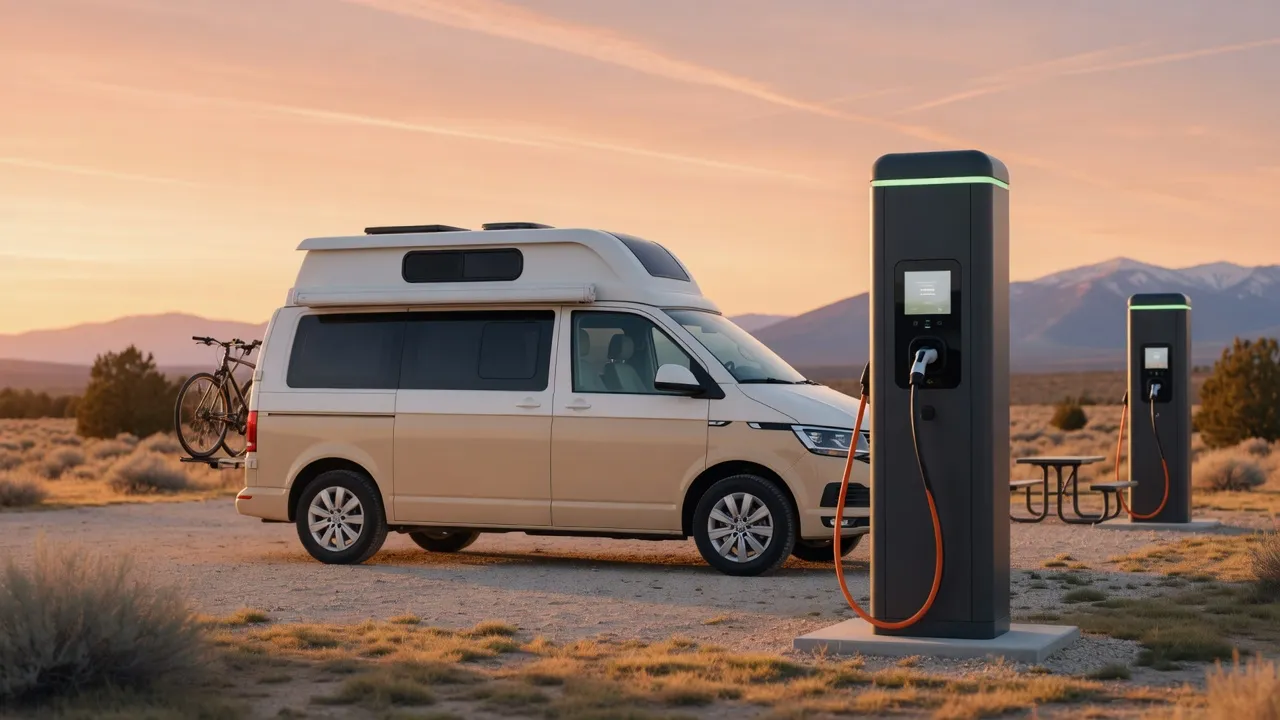
EV RV charging needs differ from passenger EV charging: requires high-amperage DC fast charging (DCFC) for road-trip use, but most chargers are blocked by parked Class B/larger RVs that don't fit charging station geometry.
PickRV editor
What EV RV adoption blog posts don't tell you: most DC fast charger stations have parking spaces designed for passenger cars (16-18 ft). Class B RVs (22 ft) fit awkwardly. Class C RVs (28+ ft) don't fit at all. Practical charging requires special 'RV-accessible' DCFC stations — Electrify America announced these in 2024 but rollout has been minimal. As of 2026, fewer than 500 EV RV-accessible DCFC stations exist in continental US (vs ~50,000 passenger EV DCFC).
- EV RV needs DCFC (DC fast charging) for road trips
- Most DCFC stations not RV-accessible (parking geometry)
- <500 RV-accessible DCFC stations in continental US (2026)
- Tesla Superchargers v4 (in rollout): bigger bays, may accommodate RVs
Chapter 4 · Comparison · 4 options · ≈1 min
Charge time math — DCFC vs Level 2
EV RV charging time depends on charger type + battery state. Per Ford eTransit chassis specs.
EV RV charging time (Ford eTransit chassis ~68 kWh battery)
DCFC 150 kW (Electrify America, EVgo)
10-80% in ~32 min · adds ~85 mi range
DCFC 50 kW (older fast charger)
10-80% in ~95 min · adds ~85 mi range
Level 2 240V 32A (RV park 50A pedestal)
10-80% in ~7 hours · adds ~85 mi range
Level 1 120V 16A (household outlet)
10-80% in ~22 hours · adds ~85 mi range
| Option | What it covers |
|---|---|
| DCFC 150 kW (Electrify America, EVgo) | 10-80% in ~32 min · adds ~85 mi range |
| DCFC 50 kW (older fast charger) | 10-80% in ~95 min · adds ~85 mi range |
| Level 2 240V 32A (RV park 50A pedestal) | 10-80% in ~7 hours · adds ~85 mi range |
| Level 1 120V 16A (household outlet) | 10-80% in ~22 hours · adds ~85 mi range |
PickRV editor
What charging-station maps show vs reality: Level 2 charging at RV parks works but takes 6-8 hours for a partial charge. Most RV parks DON'T have Level 2 EVSE — they have 30A or 50A pedestals designed for RV appliances. Plugging your EV RV into a 50A pedestal works as 240V/32A charging (slow). RV parks adding dedicated EVSE: <5% of US RV parks as of 2026.

Comparison · 4 options · ≈1 min
Cost analysis — EV RV vs gas Class B (5-year)
Per US DOE Vehicle Cost Calculator + RVIA fuel data, 5-year total cost of ownership comparison.
5-year total cost of ownership (Class B, 15,000 mi/yr)
Winnebago eRV2 (EV)
$200K MSRP · $0 fuel (charge at home) · 5-yr ~$202K · 0 maintenance vs gas
Ford Transit gas (similar size)
$70K MSRP · $0.30/mi fuel (Class B gas 18 MPG) · 5-yr ~$92K total
Winnebago Solis (popular gas Class B)
$130K MSRP · $0.30/mi fuel · 5-yr ~$152K total
Premium EV credit (federal + state)
Up to $7,500 federal + state varies (NJ, CO, OR up to $4,000 additional)
| Option | What it covers |
|---|---|
| Winnebago eRV2 (EV) | $200K MSRP · $0 fuel (charge at home) · 5-yr ~$202K · 0 maintenance vs gas |
| Ford Transit gas (similar size) | $70K MSRP · $0.30/mi fuel (Class B gas 18 MPG) · 5-yr ~$92K total |
| Winnebago Solis (popular gas Class B) | $130K MSRP · $0.30/mi fuel · 5-yr ~$152K total |
| Premium EV credit (federal + state) | Up to $7,500 federal + state varies (NJ, CO, OR up to $4,000 additional) |
PickRV editor
What EV cost calculators don't capture: EV RV requires home Level 2 charger installation ($2,000-4,000 typical) for daily home use. Without it, public Level 2 is slow + DCFC is expensive ($0.50-0.80/kWh = $0.60-0.95/mi, near gas equivalence). The 'home charge for free' EV value prop requires home installation.
Chapter 6 · Overview · ≈1 min
Realistic 2026-2030 adoption timeline
Based on chassis manufacturer published roadmaps + RVIA industry forecasts + DOE charging infrastructure timelines.
PickRV editor
What industry analysts predict vs reality: 2026 → continued Class B EV RV growth (Winnebago + Thor, small volume), zero Class A EV RV production. 2027-2028 → larger Class C EV RV options emerge (Ford E-Transit Cargo expanded, Mercedes eSprinter chassis available). 2029-2030 → Class A EV RV production starts at low volume from boutique manufacturers (Renogy, Wallaby, possibly Winnebago partnership). Mainstream Class A EV RV (full Tiffin/Newmar/Entegra adoption): NOT expected before 2032-2035 per industry data.
- 2026: Class B EV RVs only, low volume, ~110 mi range
- 2027-2028: Class C EV RVs emerge, similar range
- 2029-2030: Class A EV RV production starts at low volume
- 2032+: Mainstream Class A EV RV adoption (Tiffin, Newmar, Entegra)
FAQ · 4 questions · ≈1 min
EV RV FAQ (honest answers)
Common questions about EV RV practicality in 2026.
Can I road-trip cross-country in an EV RV in 2026?
Technically yes, practically no. Charging infrastructure inadequate. Range 70-95 mi loaded = 2-4 charge stops per day adding 4-8 hours/day. Most renters quickly abandon EV RV for road trips, use for local 1-3 day trips only.
Should I buy an EV RV in 2026?
Only if: (1) you have home Level 2 charging installed, (2) you primarily do 1-3 day local trips within 60-80 mi range, (3) you're willing to plan around RV-accessible DCFC stations. Otherwise: gas Class B/C delivers better real-world experience for current RV use patterns.
When will EV Class A motorhomes be available?
2029-2030 boutique low-volume production. Mainstream (Tiffin, Newmar, Entegra, Winnebago Class A): 2032-2035 per industry data. Battery weight + range limitations make Class A EV RVs particularly challenging.
Does PickRV have EV RVs?
Not yet — no production EV RV currently suits the typical 200-500 mi/day rental trip. When production rigs with realistic range ship, hosts will be able to list them.
PickRV editor
What's the honest 2026 truth: EV RV technology is not ready for the typical RV use pattern (200-500 mi/day road trips). Current EV RVs serve local-trip + commuter use cases well. Mainstream RV use cases require 2-3 more years of charging infrastructure + 5-7 years of vehicle technology evolution. Be patient — early adoption of EV RVs in 2026 = lots of frustration + minimal trip flexibility.
Continue reading
More trips like this · 6
Similar terrain, seasons, and rigs from across PickRV.
Was this guide helpful?