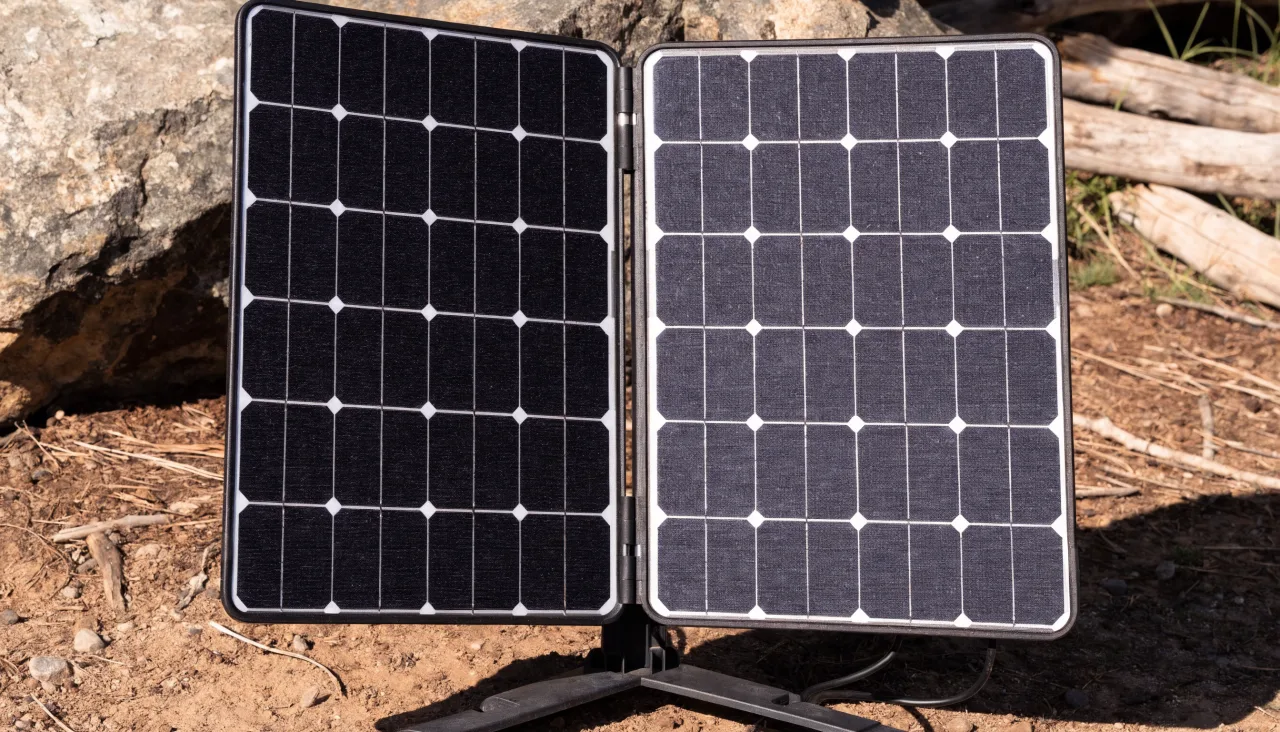
200W kit vs 800W system. Lead-acid vs AGM vs lithium. Inverter sizing math. The real boondocking power-budget formula.
The three components of an RV solar system
(1) Solar panels: convert sunlight to DC electricity. Sized in watts (W). RV-typical: 100-1,200W total.
(2) Charge controller: regulates panel output to safely charge batteries. MPPT (maximum power point tracking) controllers are 95%+ efficient; PWM controllers are 70-80%. MPPT is the modern default.
(3) House battery bank: stores DC electricity. Sized in amp-hours (Ah) at 12V. RV-typical: 100-400Ah.
(4) Inverter: converts 12V DC battery power to 120V AC for household appliances. Sized in watts (W). RV-typical: 1,000-3,000W.
- Solar panels: 100-1,200W typical · convert sun to DC
- MPPT charge controller: 95%+ efficient · modern standard
- House battery bank: 100-400Ah at 12V typical
- Inverter: 1,000-3,000W typical · converts DC to AC
Battery chemistries (the most important decision)
Flooded lead-acid: cheapest ($150-250 for 100Ah Group 31), 3-5 yr life with proper care, only 50% usable depth-of-discharge (DOD) — a 100Ah battery effectively delivers 50Ah. Requires monthly water top-off.
AGM (absorbed glass mat) lead-acid: middle cost ($250-400 for 100Ah), 5-7 yr life, 60-70% usable DOD, maintenance-free.
LiFePO4 (lithium iron phosphate): most expensive upfront ($600-1,200 for 100Ah), 8-15 yr life, 90-95% usable DOD, half the weight, recharges 3x faster. Standard for new boondocking-optimized rigs.
- Flooded lead-acid 100Ah: $150-250 · 3-5 yr · 50% DOD = 50Ah usable
- AGM 100Ah: $250-400 · 5-7 yr · 60-70% DOD = 60-70Ah usable
- LiFePO4 100Ah: $600-1,200 · 8-15 yr · 90-95% DOD = 90-95Ah usable
- Lithium pays back in ~3-5 yr of moderate boondocking use
Power budget math (the foundation of system sizing)
Step 1: list every DC load + estimated daily run-time. Refrigerator (12V compressor): ~50Ah/day. LED lights: 5-10Ah/day. Water pump: 2-5Ah/day. Phone/laptop charging: 5-10Ah/day. Furnace fan: 5-20Ah/day in cold weather.
Step 2: list every AC load (through inverter) + run-time. Microwave (1,000W × 0.1 hr = 100Wh ÷ 12V = ~9Ah per use). TV (~5-10Ah/hr). Coffee maker (1,500W × 0.1 hr = ~13Ah per use). CPAP machine (~3-6Ah/night).
Step 3: sum daily consumption. Typical boondocker: 50-120Ah/day (fridge dominates).
Step 4: size battery bank to 2x daily consumption (one day's reserve + DOD margin).
Step 5: size solar to recover daily consumption in 4-5 peak sun hours.
Solar panel sizing (per NREL solar irradiance data)
National Renewable Energy Laboratory (NREL) data: average US peak sun hours range from 3.5 (Pacific NW winter) to 6.5 (SW summer). Plan for 4-5 peak sun hours as conservative average.
Math: 200W panel × 4 peak hours = 800Wh/day = 67Ah/day at 12V (rough). Real-world: derate 20-25% for inefficiency = 50Ah/day delivered.
Match: 200W solar matches ~50Ah/day load (just barely). 400W solar comfortably handles 100Ah/day. 800W handles 150-200Ah/day (full-time boondocker territory).
- 100W solar: 25Ah/day delivered (light loads only)
- 200W solar: 50Ah/day delivered (matches fridge + lights)
- 400W solar: 100Ah/day delivered (typical boondocker)
- 800W solar: 200Ah/day delivered (full-timer with residential fridge)
Inverter sizing + the 'pure sine wave' requirement
Continuous wattage: the load you'll run for hours (microwave, residential fridge, coffee maker). Inverter must be rated above the largest continuous load.
Surge wattage: the peak load at appliance start-up (compressor motors, microwave magnetron). Most inverters surge 2x continuous rating for ~3 seconds.
Pure sine wave: required for sensitive electronics (CPAP, modern TVs, microwave). Modified sine wave inverters (cheaper) can damage these. Stick with pure sine wave.
- 1,000W inverter: phone chargers, TV, laptop, small appliances
- 2,000W inverter: microwave, coffee maker, residential fridge
- 3,000W inverter: rooftop AC with soft-start kit, hair dryer, multiple appliances
- Always pure sine wave; modified sine wave damages CPAP/medical/sensitive electronics
Three real-world system examples
Weekend warrior (1-3 night trips, occasional dry camping): 100W solar + 1x 100Ah AGM + 1,000W inverter = $700-1,000 install. Handles fridge + lights + phone charging for 2-3 days dry. Most rental rigs ship at or below this configuration.
Boondocker (1-2 week trips): 400W solar + 200-300Ah lithium + 2,000W inverter = $2,500-4,000 install. Handles fridge + lights + microwave + occasional TV for 1-2 weeks dry. The sweet-spot configuration for the rental host who wants to advertise 'boondocking-capable' honestly.
Full-timer (off-grid living): 800-1,200W solar + 400-600Ah lithium + 3,000W inverter + soft-start AC = $6,000-12,000 install. Handles all appliances + AC for off-grid living indefinitely.
Generator pairing (the backup the influencers underrate)
Per DOE + EPA EnergyStar comparisons + manufacturer specs, even a top-tier solar setup benefits from a small inverter generator as backup. Three days of cloud cover during a winter boondocking trip will drain any battery bank below safe DOD, and shore-power options may not exist within 50+ miles in true wilderness.
Honda EU2200i ($1,200, 47-57 dB at 25 ft, 2.2 kW continuous): the boondocker gold standard. Quiet enough to run during posted quiet hours at most state campgrounds, fuel-efficient enough to charge a 200 Ah lithium bank from 30% to 90% on ~1 gal of gas in 2 hours. Yamaha EF2200iS and the Champion 2500W dual-fuel are comparable alternatives at lower price points.
Critical pairing detail: most rental rigs do NOT have an automatic generator start (AGS) circuit. The renter physically starts the generator outside. AGS retrofit costs $500-900 installed and is the single feature that transforms multi-day boondocking from 'managing the battery' to 'forget about it.' Worth specifying as a search filter on rental marketplaces if available.
Real-world appliance load reference (the table that makes power budgeting tractable)
Per US Department of Energy Energy Saver appliance data + manufacturer-published specs (Norcold, Dometic, Honeywell, ResMed), here are the actual amp-hour draws for the appliances that dominate RV power budgets. The figures assume 12V DC measurement; AC appliances are run through an inverter at ~90% efficiency, so add 10% to the listed Ah for the battery-side draw.
The eye-opener for most renters: the rooftop air conditioner. A standard 13,500 BTU rooftop AC draws ~13 A at 120V AC (1,560 W). Through an inverter, that's ~145 A at 12V — enough to drain a 200 Ah lithium bank in 90 minutes of continuous run. Solar input during peak sun (400 W panels) only generates ~30 A at 12V, so AC use during the day still net-discharges the battery; AC use overnight is not viable without a generator or shore power. This is why no boondocker uses rooftop AC seriously without a 3,000W+ inverter, 600 Ah+ lithium, and a generator backup.
- 12V compressor fridge (8 cu ft): 4-6 Ah/hr running · 50-70 Ah/day
- Absorption (propane) fridge: 1-2 Ah/hr (control board only) · 25-40 Ah/day
- LED interior lights: 1-2 Ah/hr each · 5-10 Ah/day total
- Water pump (intermittent): 5-8 A peak · 2-5 Ah/day
- Furnace fan blower (intermittent): 5-7 A · 5-25 Ah/day cold weather
- CPAP (humidifier off): 3-6 Ah/night · double if humidifier on
- Laptop charging: 4-6 Ah per full charge cycle
- Phone charging: 1-2 Ah per full charge cycle
- Microwave (100 sec on 1,000W): ~9 Ah per use through inverter
- Coffee maker (4 min on 1,500W): ~13 Ah per pot through inverter
- Rooftop AC (13,500 BTU, 1 hr): ~145 Ah through inverter
- Residential refrigerator: 80-120 Ah/day through inverter
Charge controller sizing (the silent failure point)
Per NEC Article 690 + UL 1741, the charge controller must be sized to handle the full panel array short-circuit current (Isc) with a 1.25x safety margin. A 400W array of four 100W panels at 18 Vmp pulls ~22 A — meaning a 30 A MPPT charge controller is the correct minimum. Undersized controllers throttle output to protect themselves, silently capping system performance below the panels' actual capacity.
MPPT (Maximum Power Point Tracking) vs PWM (Pulse Width Modulation): MPPT controllers convert excess panel voltage into additional charging current, delivering 20-30% more daily energy than PWM in mixed cloud/sun conditions. Quality MPPT controllers (Victron SmartSolar, Renogy Rover, EPEVER Tracer) cost $80-300 for the 30-60 A range. PWM controllers are obsolete for any system over 200W; the 2026 cost differential is no longer meaningful.
Two parameters to verify before purchase: (1) input voltage maximum — must exceed panel Voc (open-circuit voltage) accounting for cold-temperature multiplier (panels output ~25% higher Voc at 0°F than rated); (2) output amperage maximum — must exceed expected Isc × 1.25 safety factor per NEC.
What solar installers + RV magazines don't tell you
Under-shared truth #1: panel manufacturer wattage ratings assume Standard Test Conditions (25°C, 1000W/m² irradiance). Real-world panel temp on a roof in summer reaches 60-70°C — output drops 15-20% from rated. A '200W' panel typically delivers 160-170W peak on a hot summer day. Size up accordingly.
Under-shared truth #2: lithium battery management systems (BMS) shut down at low temperatures. Most LiFePO4 batteries refuse to charge below 0°C / 32°F (manufacturer-protective behavior to prevent plating damage). Winter boondockers need self-heating lithium (Battle Born, RELiON, Renogy with built-in heater) or external warming.
Under-shared truth #3: 'expandable' solar kits are usually a trap. Most RV roof real estate fits 2-4 panels max. Buy the size you need upfront from a quality brand (Renogy, Battle Born Solar, Go Power) rather than starting small + adding panels later. Multiple charge controllers + complex wiring = installation cost overrun.
Frequently asked questions
How much solar do I need for full-time boondocking?›
400-800W of panels + 200-400Ah of LiFePO4 lithium + 2,000-3,000W inverter. Total install: $2,500-6,000. Handles fridge + lights + microwave + occasional TV indefinitely. AC use requires 800W+ solar + soft-start kit.
Is lithium worth the upfront cost vs lead-acid?›
Yes for moderate-to-heavy use. LiFePO4 lithium: $600-1,200 for 100Ah, 8-15 yr life, 90-95% usable depth-of-discharge. Lead-acid: $150-400, 3-7 yr life, 50-70% usable DOD. Lithium pays back in 3-5 yr of moderate boondocking use, half the weight, recharges 3x faster.
Do I need a pure sine wave inverter?›
Yes. Modified sine wave inverters (cheaper) can damage sensitive electronics including CPAP machines, modern TVs, microwave magnetrons, residential refrigerators, and most medical equipment. Always pure sine wave for any modern RV.
How long do RV solar panels last?›
Monocrystalline panels are warranted for 25 years at 80% rated output (Renogy, Battle Born Solar, Go Power, REC). Real-world life often exceeds 30 years. The first component to fail is typically the charge controller (5-10 yr) or inverter (8-15 yr), not the panels themselves.
Can I run a rooftop air conditioner from solar?›
Not realistically for sustained use. A 13,500 BTU rooftop AC draws ~145 Ah at 12V through an inverter; a 400W solar array generates only ~30 A in peak sun. Sustained AC requires shore power, a 3,000W+ inverter on a 600+ Ah lithium bank with 800W+ solar, or generator backup. Most boondockers accept AC as a hookup-only feature.
MPPT or PWM charge controller?›
Always MPPT for systems over 200W. MPPT (Maximum Power Point Tracking) converts excess panel voltage into additional charging current, delivering 20-30% more daily energy. Quality MPPT controllers cost $80-300 for 30-60A. PWM is obsolete; the 2026 price differential no longer justifies the efficiency loss.
Continue your research on PickRV
Sources
- 1.NREL National Solar Radiation DatabaseUS DOE NRELgovernment or university source
- 2.DOE Energy Efficiency RV solarUS Department of Energygovernment or university source
- 3.IEC 61215 solar panel performance standardInternational Electrotechnical Commissioncompany or industry source
- 4.UL 1741 inverter safety standardUnderwriters Laboratoriescompany or industry source
- 5.DOE solar PV efficiency basicsUS DOEgovernment or university source
- 6.NEC Article 690 solar PV systemsNFPA / NECcompany or industry source
- 7.DOE Energy Saver appliance referenceUS DOEgovernment or university source
Sources are a mix of government and university publications and the company or industry documentation for the specific equipment, store policy or standard discussed — each row above says which one it is, so you can weigh it yourself. Last verified 2026-05-25. Report broken links to support@pickrv.com.
Ready to roll?
Pick a rig. Write the road.
Complete nightly price on every listing — your exact total itemized before you pay · 48h full rental refund. Every rig near you, one checkout.
Related reads

Plan around this guide · 3
Hub anchors · mega-guides · cost calculator — one click each.
Related on PickRV
Tell us when you want to travel.
Owners list their own rigs on PickRV. Add your dates and we'll email you when one is listed for them — nothing else, no spam.
Was this guide helpful?