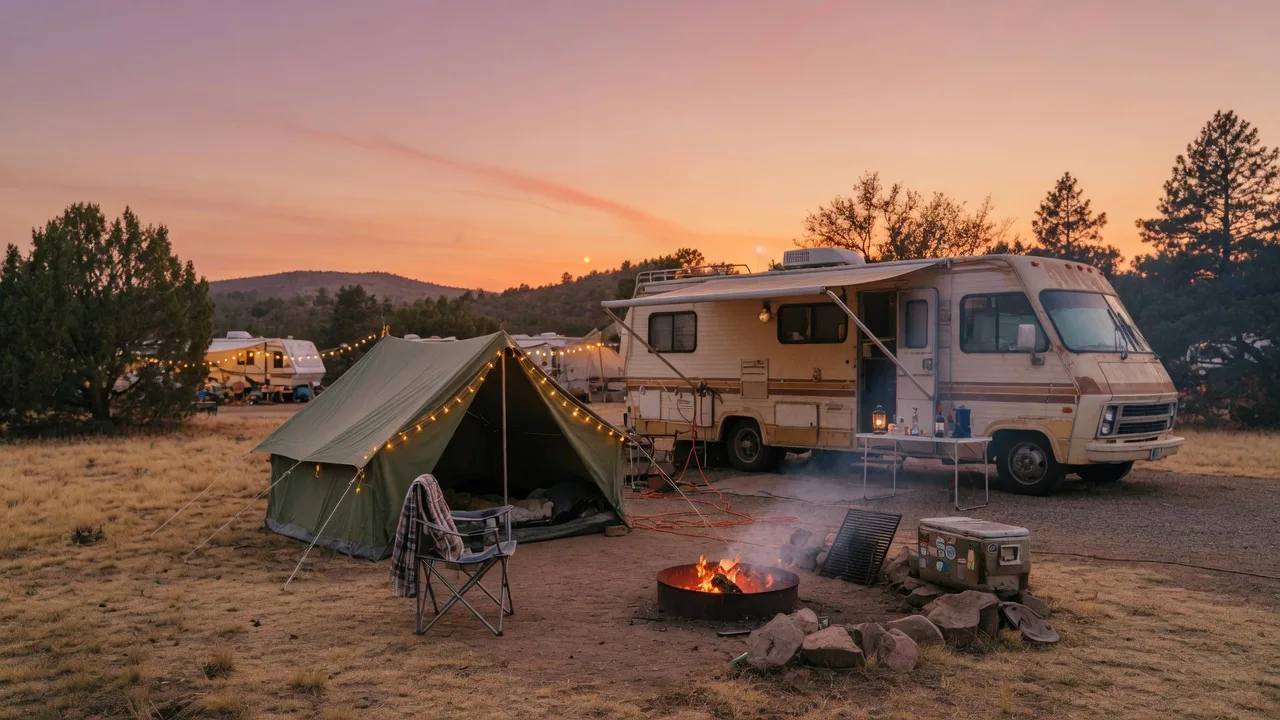
Real off-grid power math + dry-camping water budgeting + LNT principles. Sourced from NPS, Leave No Trace Center, BLM.
Why eco-RV travel matters in 2026
Dispersed camping on BLM + USFS land grew 38% between 2020 and 2025 per BLM annual reports. The corresponding environmental impact (vegetation damage, soil compaction, human-waste incidents) prompted multiple districts to introduce permit systems for previously-free areas (Sedona AZ, Moab UT, Mt Shasta CA, parts of Coconino NF).
Eco-RV travel is no longer optional culture — it's the requirement for continued access. Districts that show LNT compliance retain free dispersed camping; districts that don't get permit caps or closures.
Solar power math — what your rig actually needs
A weekend dry-camp without generator runs on solar + battery storage. Math: refrigerator (4 Ah/hr × 24 hr = 96 Ah/day), lights (3 Ah/hr × 5 hr = 15 Ah/day), water pump (2 Ah/hr × 1 hr = 2 Ah/day), phone/laptop charging (3 Ah/day) = ~120 Ah/day continuous baseline.
100 Ah AGM battery delivers ~50 Ah usable (50% DoD max). 100 Ah lithium delivers ~95 Ah usable (95% DoD safe). So 200 Ah AGM bank or 100 Ah lithium covers a baseline rig for 1 day without recharge. Solar requirement: 120 Ah/day ÷ 5 peak-sun-hrs = 24 amps continuous = 300W panel minimum.
- 100 Ah AGM = 50 Ah usable, $200, 5-year life
- 100 Ah lithium = 95 Ah usable, $700, 10+ year life
- 300W solar panel = 120 Ah/day in 5 peak-sun-hrs
- MPPT charge controller (not PWM) = 30% more efficient
Water budgeting for dry camping
Standard rig fresh-water tank holds 30-100 gallons. Standard household water use is 80-100 gal/day per person. Dry-camping rule: budget 5 gal/person/day for drinking + cooking + light washing.
100 gal fresh-water tank ÷ 5 gal/day × 2 people = 10 days dry-camp endurance. Grey tank fills at roughly the same rate; black tank fills slower (mostly toilet paper + waste, ~7-10 days for 2 people).
- Drinking + cooking: 1 gal/person/day
- Dish washing: 1 gal/person/day (use minimal-rinse method)
- Body wipe + sink wash: 2 gal/person/day
- Toilet: 1 gal/person/day (low-flush RV head)
- Total: 5 gal/person/day budget
Leave No Trace — the 7 principles applied to RV camping
Leave No Trace Center for Outdoor Ethics (lnt.org) maintains the 7 principles. RV-specific application:
(1) Plan ahead: research permits + closures before departure. (2) Camp on durable surfaces: use existing dispersed pull-outs, never crush new vegetation. (3) Dispose of waste properly: pack out grey water if no dump available; never dump black water on the ground. (4) Leave what you find: do not move rocks, branches, or artefacts. (5) Minimise campfire impact: use existing fire rings only; check fire restrictions daily. (6) Respect wildlife: store food in hard-sided rig at night (bears + raccoons); never feed wildlife. (7) Be considerate of others: generator quiet hours, dim outdoor lights, low voice.
Dump-station etiquette + grey-water alternatives
Dump stations: $10-25 per use at most state parks + truck stops. Free at most NPS units + many BLM districts. Sani-Dump.com + Allstays apps list verified dump locations.
Grey-water (sink + shower) can sometimes be released to landscape in approved dispersed areas IF the soap is biodegradable + the release is > 100 ft from any water source. Verify the specific BLM/USFS district rules first. Black-water release to ground is ALWAYS illegal under EPA + state environmental codes.
Generator etiquette — quiet hours + emissions
Most NPS + state-park campgrounds enforce generator quiet hours: 8 AM - 8 PM allowed, 8 PM - 8 AM prohibited. Dispersed BLM + USFS land has no enforced quiet hours but the social rule is the same.
Inverter generators (Honda EU2200i, Yamaha EF2000iSv2) run at 50-60 dB at 25 ft — acceptable. Conventional generators run at 75-85 dB — unacceptable in close quarters. CARB (California Air Resources Board) compliance is required for generators in California state parks.
What LNT pamphlets + REI staff don't tell you
The under-shared truth about eco-RV travel: the single largest environmental impact is NOT solar vs generator or even waste — it's vehicle mileage. A 7-day trip with 1,500 miles driven generates more CO2 than 6 months of household electricity for the equivalent group. Hub-based itineraries (drive less, stay longer) cut trip CO2 footprint by 50-70%.
Second under-shared truth: lithium batteries pay back environmentally in 18-24 months vs lead-acid (manufacturing footprint amortised by longer life + zero replacement cycles). Upgrade is environmentally + economically positive after year 2.
Composting toilet vs cassette vs black tank — the LNT-aware comparison
Three waste-handling architectures dominate 2026 RVs. Per the EPA Office of Wastewater Management (epa.gov/septic) + Leave No Trace Center for Outdoor Ethics (lnt.org) guidance, each architecture has different environmental footprints + dry-camping endurance characteristics.
Black tank (the legacy default in 90%+ of US RVs per RVIA): 30-50 gallon capacity, 7-10 days for 2 people, requires RV-grade biodegradable chemicals (Happy Campers, Unique RV Digest-It at $10-25 per treatment), illegal to discharge anywhere except dump stations under the Clean Water Act + state environmental codes. Most efficient solution at full-hookup campgrounds; least efficient at dry-camp sites where the dump-station drive consumes fuel + time.
Composting toilet (Nature's Head, Air Head, OGO, Separett Villa at $900-1,300 retail per nature-shead.com): separates liquid + solid at the source. Solid container holds 60-80 uses before emptying; liquid container 2-3 days for a couple. Solids are disposed in standard waste stream per EPA Solid Waste Management Hierarchy; liquids dilute 8:1 with water and may be released to landscape in approved areas (verify per district). Zero black tank means dramatically more dry-camping freedom — the highest-LNT-aligned option for repeated dispersed camping.
Cassette toilet (Thetford C-403, Dometic 970 at $400-600 retail): hybrid approach — 4-5 gallon removable plastic container that empties at any standard toilet (RV dump station, public restroom). Mid-tier dry-camping endurance, mid-tier LNT alignment. Most common in Class B campervans where space + weight constraints rule out a full black tank.
- Black tank: 7-10 day endurance · dump-station discharge only · 90%+ of US RVs
- Composting toilet (Nature's Head etc): $900-1,300 · 60-80 uses · highest LNT freedom
- Cassette toilet (Thetford C-403 etc): $400-600 · 4-5 gal · empties at any toilet
- Black-tank chemicals: RV-grade biodegradable only (Happy Campers / Unique / Camco)
- Discharge anywhere except dump stations = Clean Water Act + state environmental violations
Carbon-footprint math — diesel vs gas vs EV chassis in 2026
Per US Energy Information Administration (eia.gov) + EPA fuel-economy data (fueleconomy.gov): a 30-foot Class A gas motorhome averages 7-9 mpg; a 30-foot Class A diesel pusher averages 9-12 mpg; a Class C on Ford E-450 chassis averages 9-12 mpg; a Class B campervan on Sprinter / Transit / ProMaster averages 14-22 mpg. CO2 emissions per mile correlate roughly with fuel consumed: gasoline 19.6 lb CO2/gal, diesel 22.4 lb CO2/gal per EPA emission factors.
Math for a 7-day trip with 1,500 miles driven: Class A gas at 8 mpg = 188 gal × 19.6 = 3,685 lb CO2; Class A diesel at 10 mpg = 150 gal × 22.4 = 3,360 lb CO2; Class C at 11 mpg = 136 gal × 19.6 = 2,666 lb CO2; Class B at 18 mpg = 83 gal × 19.6 = 1,627 lb CO2. The cleanest large-rig choice is Class B; the largest emission saving comes from reducing miles driven via hub-based itineraries (cut 30-50% of miles → cut 30-50% of CO2).
EV chassis options are emerging but limited in 2026. The Ford E-Transit + Mercedes eSprinter offer Class B-sized electric platforms with 100-150 mile range, suitable for short urban-adjacent trips but not multi-state RV tours. Per the Department of Energy Alternative Fuels Data Center (afdc.energy.gov), the public DC fast-charge network's coverage gaps in rural areas mean a fully-electric RV cross-country trip is not yet viable; hybrid + range-extender configurations are the realistic 2026-2028 path.
- Class A gas: 7-9 mpg · 3,685 lb CO2 for 1,500-mi trip per EPA emission factors
- Class A diesel: 9-12 mpg · 3,360 lb CO2 per epa.gov
- Class C Ford E-450: 9-12 mpg · 2,666 lb CO2
- Class B (Sprinter/Transit/ProMaster): 14-22 mpg · 1,627 lb CO2 (cleanest large-rig)
- Hub-based itineraries cut miles 30-50% → CO2 cut 30-50%
Frequently asked questions
What's the minimum solar setup for dry camping?›
300W solar panel + 100 Ah lithium battery + MPPT charge controller. Powers a baseline rig (fridge, lights, pump, charging) indefinitely in 5+ peak-sun-hr regions.
How long can I dry camp without dumping tanks?›
With a 100-gal fresh tank and 5 gal/person/day budget, 2 people can dry-camp 10 days. Grey tank fills at the same rate; black tank typically lasts 7-10 days for 2 people.
Can I release grey water on the ground?›
Sometimes, with biodegradable soap, >100 ft from any water source, in approved dispersed areas only. Always verify the specific BLM or USFS district rules. Black water release is always illegal.
Is a composting toilet worth the $900-1,300 upgrade?›
For repeated dispersed camping, yes — composting eliminates the black-tank dump-station cycle entirely and aligns best with Leave No Trace principles. For RVs that stay at full-hookup campgrounds, the black-tank legacy default is more convenient.
What's the cleanest RV chassis option in 2026?›
Class B campervan on Sprinter / Transit / ProMaster chassis at 14-22 mpg, producing about 1,627 lb CO2 on a typical 1,500-mile trip per EPA emission factors. Fully-electric RV options exist (Ford E-Transit, Mercedes eSprinter) but charging-network gaps limit cross-country viability through 2026-2028.
What's the carbon offset cost for an RV trip?›
Per Cool Effect (cooleffect.org) + Terrapass (terrapass.com) verified-offset pricing in 2026: roughly $15-25 per 1,000 lb of CO2 for VCS-certified carbon offsets. A 7-day Class C trip with 1,500 miles generates ~2,666 lb CO2 → ~$40-65 to offset. Many travelers split the offset cost across the trip group as a per-person line item.
Are LED lights worth the upgrade in an older rented RV?›
If you're a long-term renter or seasonal user, yes. LED replacements for incandescent RV lights cost $5-15 per bulb and reduce power draw 85-90% per Energy Star + DOE specs. For a single-week rental, the existing bulbs work fine — but bring a battery-powered LED lantern as supplemental light to reduce overall draw at boondocking sites.
Can I camp on private land for free?›
Yes via Harvest Hosts (harvesthosts.com, $99/yr) or Boondockers Welcome (boondockerswelcome.com, $50/yr) — both membership networks of private landowners (farms, wineries, breweries, museums) offering free overnight parking for self-contained RVs. Standard etiquette: 1-night stay, buy something from the host, no slide-out + leveling jacks unless specifically permitted, leave site cleaner than you found it.
Continue your research on PickRV
Sources
- 1.Leave No Trace Center for Outdoor EthicsLNT Centercompany or industry source
- 2.EPA fuel economy + emissions dataUS EPA + DOEgovernment or university source
- 3.DOE Alternative Fuels Data CenterUS Department of Energygovernment or university source
- 4.BLM Dispersed Camping rulesBureau of Land Managementgovernment or university source
- 5.USFS Camping + dispersedUS Forest Servicegovernment or university source
- 6.EPA Greywater ReuseEPAgovernment or university source
- 7.CARB Generator EmissionsCalifornia Air Resources Boardgovernment or university source
Sources are a mix of government and university publications and the company or industry documentation for the specific equipment, store policy or standard discussed — each row above says which one it is, so you can weigh it yourself. Last verified 2026-05-24. Report broken links to support@pickrv.com.
Ready to roll?
Pick a rig. Write the road.
Complete nightly price on every listing — your exact total itemized before you pay · 48h full rental refund. Every rig near you, one checkout.
Related reads
Plan around this guide · 3
Hub anchors · mega-guides · cost calculator — one click each.
Related on PickRV
Tell us when you want to travel.
Owners list their own rigs on PickRV. Add your dates and we'll email you when one is listed for them — nothing else, no spam.
Was this guide helpful?