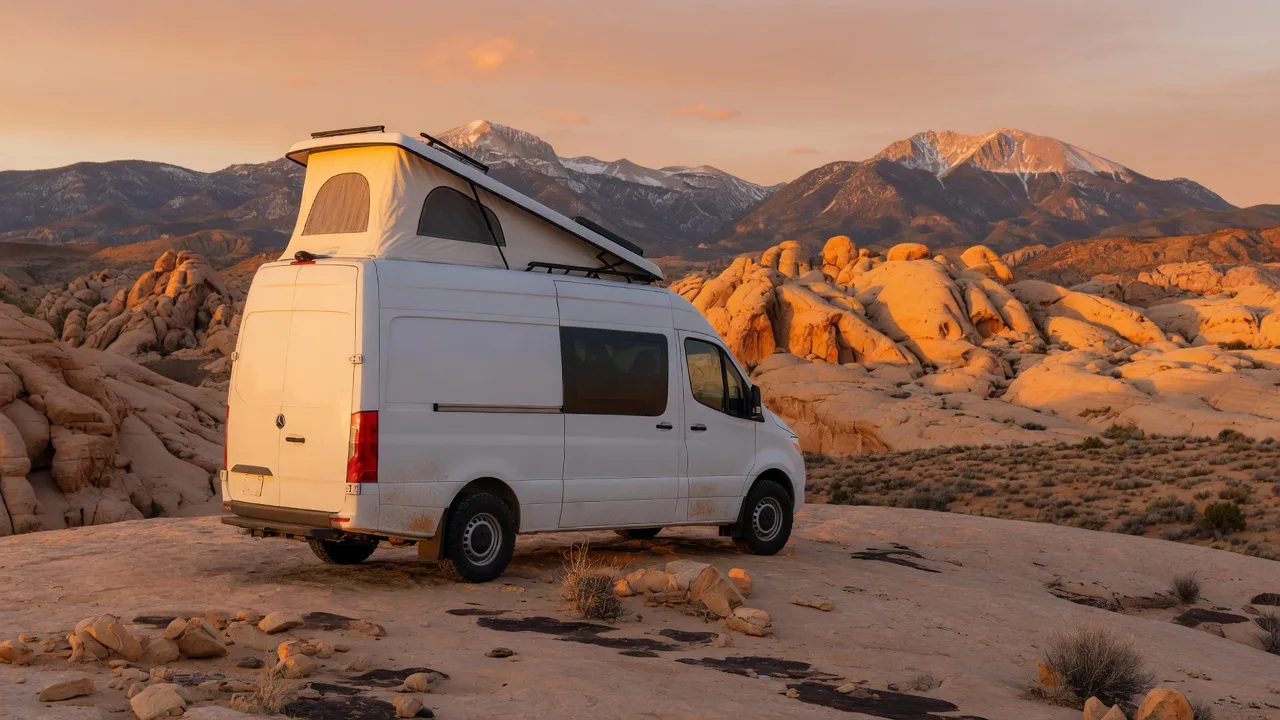
Free dispersed camping vs full-hookup RV park. The real trade-offs in water, power, waste, and what your stay actually costs.
The two camping paradigms
Boondocking (also: dry camping, dispersed camping, dispersed-area recreation): camping on public land WITHOUT hookups for water, power, or sewer. Typically free or low-cost ($0-15/night). Locations: Bureau of Land Management (BLM) lands, US Forest Service (USFS) National Forests, some state lands.
Full hookups: campsite has electric (30A or 50A), water spigot, and sewer connection. Typical $35-85/night at state parks, $60-115/night at private RV parks (KOA, Jellystone, Sun RV Resorts).
- Boondocking: $0-15/night · no hookups · public land
- Full hookups: $35-115/night · electric + water + sewer
- Hybrid (partial hookups): $25-55/night · electric + water, no sewer
- Dry sites at developed campgrounds: $20-40/night · no hookups · has bathrooms/water spigots nearby
Where you can legally boondock (US federal lands)
Bureau of Land Management (BLM): 245+ million acres in 11 western states. Per BLM 43 CFR §8365.1-2, dispersed camping is allowed for up to 14 days within any 28-day period on most BLM land. No reservations, no fees. Search: blm.gov/visit.
US Forest Service: 193+ million acres across all US states. Per USFS 36 CFR §261, dispersed camping is allowed in most National Forests (verify per-forest rules — some have closures, some require permits). Stay limit typically 14-16 days. Search: fs.usda.gov.
USACE (US Army Corps of Engineers): managed lakeshores + recreation areas. Most require developed-campground stays only; verify per-site.
State trust land: some western states (Arizona, New Mexico, Montana, Utah) permit camping with an inexpensive permit ($15-30/yr).
Boondocking cost math (real 7-day trip)
7-day boondocking trip in Arizona BLM:
Campground fees: $0
Water (filled tank pre-trip): $0-3 at typical fill station
Propane (for fridge + heat): $25-40 for 30-lb refill (lasts ~7 days moderate use)
Generator fuel (gas for 2 hrs/day): $10-15 total
Battery wear (if no solar): negligible (lithium 10-yr life)
Total: ~$45-75 for 7 nights · vs $245-595 at developed campgrounds
- Boondocking 7 nights: $45-75 total
- State park hookups 7 nights: $245-385 (avg $40-55/night)
- Private RV park 7 nights: $420-595 (avg $60-85/night)
- Savings vs private park: $375-520 per week
Boondocking infrastructure requirements
Solar + battery: a 200W solar panel + 100Ah lithium battery handles fridge + LED lights + phone charging for 2-4 days dry without sun. 400W solar + 200Ah lithium handles a week of moderate use including some 12V appliance operation.
Fresh water: 40-100 gal fresh tank typical. Drinking + cooking + dishes + brief showers use ~3-5 gal/person/day. 80-gal tank lasts 4-7 days for 2 people.
Holding tanks: grey tank fills first (sink + shower). Plan to dump every 3-5 days for 2 people. Locate dump stations via Sanidumps or AllStays apps.
Generator: backup for cloudy days + AC use. Honda EU2200i (2.2 kW) handles non-AC loads; for AC need 3-4 kW with soft-start kit.
Full hookup amenities — what you pay for
Electric: 30A (3,600 W) or 50A (12,000 W). 30A handles one rooftop AC + most appliances; 50A handles two ACs + microwave simultaneously. Surge protector ($150-300, Progressive Industries EMS or Hughes Power Watchdog) recommended — pedestal voltage spikes + miswired pedestals damage RV electronics, and most rental hosts decline to cover pedestal-caused damage as a renter responsibility.
Water: continuous fresh water from spigot (no tank-fill needed during stay). Inline pressure regulator ($15-40) prevents the 80-120 PSI city water from blowing the RV's 40-60 PSI rated plumbing — a common rental-return claim is split pipes from skipping the regulator.
Sewer: continuous waste drain (no holding-tank dump runs). Best practice: keep BOTH black and gray valves CLOSED until ready to dump (open black → close → open gray → close), even on full hookups. Leaving black open continuously causes the 'pyramid of doom' solids buildup.
WiFi: typical at private parks (variable quality, often shared bandwidth with 100+ rigs, evening speeds 2-5 Mbps common). Cellular boost: typical at premium parks; weBoost Drive Reach RV ($400-650) adds an independent backup.
Pool/playground/laundry: typical at private parks. Per KOA + Jellystone + Sun RV Resorts amenity lists, on-site amenities are the primary justification for the $60-115/night premium over state parks.
Hybrid strategy (the working playbook for most renters)
Most experienced renters mix boondocking + developed camping based on trip needs:
Day 1-2 (settling in): developed campground with hookups. Full battery charge, full water, full empty tanks.
Day 3-5 (exploration): boondocking nearby (BLM/USFS within 60 min of attractions).
Day 6-7 (recovery): developed campground for shower/laundry/dump before return.
Result: 40-60% cost savings vs all-hookups, full comfort 2-3 days, exploration freedom 3-4 days.
This hybrid model also reduces the infrastructure burden on the rental rig. Battery wear, water-pump duty cycles, and propane consumption all spike during boondocking days; the hookup nights let the systems recover and lower the cumulative wear that the host eventually charges for in long-term depreciation models.
Leave No Trace + the seven principles that keep public land open
Per the Leave No Trace Center for Outdoor Ethics (formally adopted by NPS, USFS, BLM, and most state land management agencies), seven principles govern responsible dispersed camping. Ignored at scale, they drive the campground closures + permit-zone designations that have already eliminated thousands of free-camping sites in popular areas like Sedona AZ, Moab UT, and the Eastern Sierra CA over the past decade.
(1) Plan ahead + prepare — research stay limits, permit zones, fire restrictions BEFORE arriving. (2) Travel + camp on durable surfaces — established sites, existing fire rings, gravel pads. Never park on vegetation or soft ground that retains the tire compression for years. (3) Dispose of waste properly — pack out ALL trash, use existing pit toilets or pack out solid human waste using WAG bags in alpine + desert zones (NPS issues specific WAG-bag-required orders for popular routes). (4) Leave what you find — no rock cairns, no carved trees, no removed artifacts (Antiquities Act of 1906 makes artifact removal a federal felony). (5) Minimize campfire impact — most BLM/USFS lands restrict fires May-October; verify per-area fire orders at the local ranger station. (6) Respect wildlife — store food in vehicle, never feed any animal. (7) Be considerate of other visitors — generator quiet hours, voice levels, dog leashing per local rules.
Per BLM enforcement data, the violations that trigger the most citations + the most area closures are: dumping black tank contents on the ground (felony under EPA wastewater regs), exceeding 14-day stay limits, parking off existing two-track on virgin desert, and human waste left exposed. Any of these can convert a free-access area to a permit-required or completely-closed area within a single season.
- Black-tank dumping on ground: federal EPA violation · $5,000-25,000 + restoration costs
- Exceed 14-day stay: $100-1,000 per BLM 43 CFR §8365.1-2
- Off-road driving (off designated two-track): $100-500 + vehicle impound
- Human waste left exposed: $250-500 + area-wide closure risk
- WAG bag pack-out: required by NPS order in many alpine + desert areas
Where to find legal boondocking — the tool stack that actually works
BLM-managed lands are concentrated west of the 100th meridian. The 11 states with significant BLM acreage (Alaska, Arizona, California, Colorado, Idaho, Montana, Nevada, New Mexico, Oregon, Utah, Wyoming) collectively contain 96% of the agency's land. East of that line, free dispersed camping options narrow dramatically — USFS National Forests in the Appalachians + Ozarks + Northeast cover the gap with smaller, often busier areas.
Apps + databases that pull from federal data sources: iOverlander (free, crowdsourced, includes campsites + dump stations + water fills), FreeRoam (free, layers BLM/USFS boundaries on satellite imagery, shows cell coverage + elevation), Campendium (free + paid tiers, mixes paid + free sites with reviews), The Dyrt PRO (paid, includes offline maps), Allstays (paid, comprehensive overlay).
For verification: the official agency sources are blm.gov/visit (BLM field office maps), fs.usda.gov (USFS Motor Vehicle Use Maps), and recreation.gov (cross-agency reservation portal for permitted sites). Always cross-reference an app result against the official agency MVUM before driving in — apps occasionally show abandoned access roads that have been gated since the data was crowdsourced.
What boondocking influencers don't tell you
Under-shared truth #1: 'free' boondocking isn't free if you didn't invest $1,500-3,000 in solar + lithium + inverter upfront. Without that infrastructure, you're running a noisy generator OR running down standard lead-acid batteries that fail in 2-3 years from deep discharge. Cost-neutral break-even with developed camping: typically 30-40 nights of boondocking before solar pays back.
Under-shared truth #2: BLM 14-day stay limits are ACTIVELY enforced in popular areas (Quartzsite AZ, southwest UT, southern CA). Rangers patrol + ticket. Per 43 CFR §8365.1-2 violations: $100-1,000 fine. Move every 14 days within a 28-day period to stay legal.
Under-shared truth #3: most rental RVs DO NOT have boondocking-optimized power systems. Stock house batteries (typically 1x 100Ah lead-acid) and 100-200W solar are designed for 1-2 night dry stays, not week-long boondocking. Ask the host explicitly: 'how many days can this rig boondock without generator?' If under 2 days, this isn't a true boondocking rental.
Frequently asked questions
Is boondocking legal on US public lands?›
Yes on most BLM land (245M acres, 11 western states, 14-day stay limit per 43 CFR §8365.1-2) and most USFS National Forests (193M acres, varies by forest). National Parks generally prohibit dispersed camping — only designated campgrounds.
How long can I stay at one boondocking site?›
BLM: 14 days within any 28-day period (43 CFR §8365.1-2). USFS: typically 14-16 days per site per stay (verify per forest). Move to a different site after the limit to stay legal. Rangers actively enforce in popular areas.
What's the real cost of a week of boondocking vs hookups?›
Boondocking 7 nights: $45-75 total (propane + generator fuel + dump fees). Private RV park 7 nights: $420-595 (avg $60-85/night). Savings: $375-520 per week, before initial solar/battery infrastructure costs.
Can I boondock in any rental RV?›
Technically yes for 1-2 nights. For week-long boondocking you need 200W+ solar, 100Ah+ lithium battery, propane appliances. Most stock rental rigs handle 1-2 nights dry; ask the host about house battery capacity + solar wattage before booking.
What are the Leave No Trace principles for RV camping?›
Seven principles formally adopted by NPS, USFS, and BLM: (1) Plan ahead + prepare, (2) Travel + camp on durable surfaces, (3) Dispose of waste properly (no tank dumping on ground — federal EPA felony), (4) Leave what you find (Antiquities Act protects artifacts), (5) Minimize campfire impact, (6) Respect wildlife, (7) Be considerate of other visitors. Violations drive area closures.
What apps actually work for finding boondocking sites?›
Free: iOverlander (crowdsourced campsites + dump stations + water fills), FreeRoam (BLM/USFS boundary layers on satellite + cell coverage), Campendium. Paid: The Dyrt PRO ($35/yr, offline maps), Allstays ($10 one-time). Always cross-reference against the official BLM field office map or USFS Motor Vehicle Use Map before driving in — apps occasionally show gated roads.
Continue your research on PickRV
Sources
- 1.BLM dispersed camping 43 CFR §8365.1-2US BLMgovernment or university source
- 2.USFS dispersed camping 36 CFR §261US Forest Servicegovernment or university source
- 3.Recreation.gov campground reservationsUS Federal Landsgovernment or university source
- 4.NPS camping policiesNPSgovernment or university source
- 5.BLM lands open to campingUS BLMgovernment or university source
- 6.Leave No Trace Center for Outdoor EthicsLNT (non-profit, NPS-endorsed)company or industry source
- 7.EPA wastewater + sanitation regulationsUS EPAgovernment or university source
Sources are a mix of government and university publications and the company or industry documentation for the specific equipment, store policy or standard discussed — each row above says which one it is, so you can weigh it yourself. Last verified 2026-05-25. Report broken links to support@pickrv.com.
Ready to roll?
Pick a rig. Write the road.
Complete nightly price on every listing — your exact total itemized before you pay · 48h full rental refund. Every rig near you, one checkout.
Related reads
Plan around this guide · 3
Hub anchors · mega-guides · cost calculator — one click each.
Related on PickRV
Tell us when you want to travel.
Owners list their own rigs on PickRV. Add your dates and we'll email you when one is listed for them — nothing else, no spam.
Was this guide helpful?