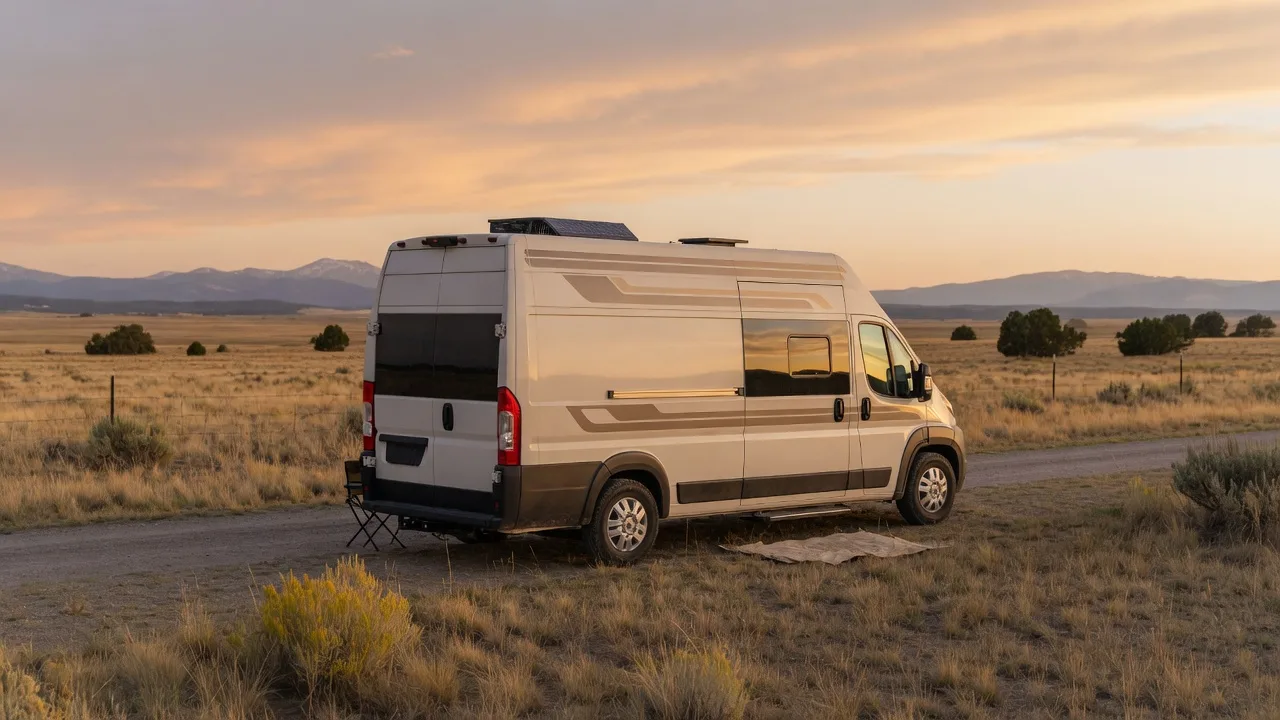
BLM off-road camping legal framework. 43 CFR 8365, MVUM maps, trail-rating systems, OHV permits state-by-state.
BLM 43 CFR 8365 — the legal framework for dispersed camping
43 CFR (Code of Federal Regulations) Part 8365 is the legal framework governing camping on BLM-administered public land. The default: dispersed camping is permitted unless specifically posted otherwise.
Key provisions: 14-day stay limit within any 28-day period at a single site (extends to 90 days total per calendar year on most districts). Move 25-50 miles to a new dispersed location after 14 days (district-specific). Camp at least 100 feet from any surface water source. Camp at least 0.25 mile from any developed campground.
- Default: dispersed camping permitted on BLM land unless posted
- 14-day limit within 28-day period at single site
- 100 ft minimum from surface water
- 0.25 mi minimum from developed campground
- Move 25-50 mi to new dispersed location after 14 days
MVUM (Motor Vehicle Use Map) — the authoritative source
USFS publishes free Motor Vehicle Use Maps (MVUM) per National Forest, showing every legal motorized-access road plus dispersed-camping corridors. BLM publishes equivalent Surface Management Status (SMS) maps showing land status + camping permissions.
Download from USFS website (search 'MVUM' + forest name) or pick up at any district office. Crowdsourced apps (iOverlander, Campendium, Allstays, FreeRoam, OnX Off-Road) supplement but do NOT replace the MVUM. Districts close roads or trails via order without app updates.
- USFS MVUM: free download per National Forest
- BLM SMS maps: free download per district
- OnX Off-Road: paid app with MVUM overlay + private-land detection
- iOverlander: free crowdsourced campsite database
Trail rating systems — Easy / Moderate / Difficult / Extreme
Off-road trails use one of several rating systems. The most common: Easy (passable in stock 2WD SUV), Moderate (4WD + 8 in clearance required), Difficult (4WD + locking diff + 10+ in clearance + skid plates), Extreme (rock-crawler / aftermarket buggy).
BLM + USFS routes use a parallel system: Class 1 (street-legal vehicles only), Class 2 (4WD recommended), Class 3 (high-clearance 4WD), Class 4 (modified rock-crawler).
- Easy: stock 2WD SUV, gravel forest road, mild ruts
- Moderate: 4WD + 8 in clearance, mud + rocks 6-12 in
- Difficult: 4WD + locking diff + 10+ in clearance + skid plates, rocks 12-18 in
- Extreme: rock-crawler / buggy, custom build, rocks 18+ in + obstacles
OHV permits — California Green/Red Sticker + other state systems
California requires OHV registration ($60-115/year, biennial) for off-road vehicles operated on public OHV areas. Green Sticker = year-round operation in OHV areas. Red Sticker = seasonal operation, year-round in 'unrestricted' areas (older vehicles per CARB emissions tier).
Other state systems: Arizona OHV decal ($25/year), Colorado OHV permit ($25.25/year), Idaho OHV registration ($12/year), Nevada OHV (no separate permit, but trail-system specific passes).
Iconic BLM + USFS off-road destinations
Top BLM + USFS off-road dispersed-camping destinations: Moab Sand Flats (BLM, $10/night designated, 138 sites + dispersed); Imperial Sand Dunes (BLM, $50/week or $190/year permit); Anza-Borrego (state park, free dispersed camping); Pismo Beach SVRA (state park, $10-15/night beach camping); Big Bear Lake (San Bernardino NF, dispersed); Tahoe Basin (Tahoe NF, dispersed).
Safety + tow recovery basics
Off-road camping requires self-rescue capability. Mandatory gear: traction boards (Maxtrax, ARB, Bunker), tow strap (kinetic recovery rope, 1.5x vehicle weight), shovel, jack-extender, tire-deflation tool, air compressor.
Travel in pairs when possible. Solo off-road trips require satellite communicator (Garmin inReach, ZOLEO, SPOT X) for SOS access in cell-dead zones. Most off-road areas are cell-dead.
What off-road influencers + adventure-marketing don't tell you
The under-shared truth: most off-road influencer trips happen in 2-vehicle convoys with $5,000+ recovery kits. Solo first-time off-road campers WILL get stuck on Moderate-rated trails without backup. Start with Easy-rated routes near population centres until you've built rescue confidence.
Second under-shared truth: BLM enforcement of the 14-day rule has tightened in 2024-2026. Stay tracking via Garmin Drive (location-stamp every night) is the simplest compliance log. Rangers DO check + ticket repeat offenders.
Wildfire + fire-restriction calendar — when dispersed camping bans hit
Per the National Wildfire Coordinating Group (nwcg.gov) + the National Interagency Fire Center (nifc.gov), BLM + USFS districts implement fire restrictions on a 5-stage scale during the wildfire season. Stage 1 prohibits campfires outside developed campgrounds; Stage 2 prohibits all open flames including charcoal grills and propane fire pits without on-off valves; Stage 3 closes specific districts entirely. Restrictions are typically announced 24-72 hours before taking effect on the InciWeb federal incident management site (inciweb.nwcg.gov) + each district's BLM/USFS website.
Western dispersed-camping windows are increasingly compressed by fire season. The traditional April-October camping window now routinely sees July-October fire-restriction Stage 2+ across Arizona, California, Colorado, Nevada, New Mexico, Oregon, Utah, and Washington. Plan generator-only cooking + LED-only lighting for any summer dispersed trip in the western US; verify district-specific fire restrictions at the regional BLM office website within 24 hours of arrival.
Per BLM enforcement guidance, violations of fire restrictions carry fines $500-5,000 + potential federal misdemeanor charges if the violation contributes to a wildfire. The 2022 BLM Wildfire Source Apportionment Report (blm.gov) attributed 85% of human-caused wildfires on BLM land to campfire mistakes (not extinguished + abandoned). Stage 1+ compliance is the single most important LNT obligation during summer dispersed camping.
- Stage 1 fire restriction: no campfires outside developed campgrounds
- Stage 2: no open flames including charcoal + propane fire pits without on-off
- Stage 3: specific district closures (entire campgrounds + dispersed areas)
- InciWeb (inciweb.nwcg.gov) + district BLM/USFS sites publish current status
- Violation fines: $500-5,000 + federal misdemeanor if contributing to wildfire
Recovery gear minimum kit + when to call SAR
Per the Tread Lightly! (treadlightly.org) education program + the Overland Bound community-recovery standards, a minimum off-road dispersed-camping recovery kit should include: (1) traction boards (Maxtrax / ARB / Bunker Indust at $200-350/pair) — restores traction in sand, mud, snow; (2) kinetic recovery rope rated 30,000-50,000 lb (per Bubba Rope / Yankum specifications) — uses elastic stretch to extract stuck vehicles without snatching damage; (3) D-shackles + soft shackles rated higher than the rope MBS; (4) shovel + jack-base plate + heavy work gloves.
Total minimum kit cost: $500-1,000. For solo off-road trips, add a satellite communicator (Garmin inReach Mini $350 hardware + $15-50/month subscription per garmin.com) — the only reliable SOS option in cell-dead off-road areas. Most BLM + USFS off-road areas have zero cell coverage; without satellite SOS, plan to be self-rescuing for 24-72 hours minimum.
Search and Rescue (SAR) call protocol: if stuck or injured beyond self-rescue capability, use the satellite communicator's SOS button to trigger Garmin's 24/7 IERCC coordination center. IERCC contacts the appropriate county sheriff's SAR team (sheriff jurisdiction has primary SAR authority on BLM land per 43 USC 1733). Per the National Association for Search and Rescue (nasar.org), most western US SAR calls are billed to the victim if 'gross negligence' is documented (no MVUM consultation, no recovery gear, exceeding trail rating). Carry the recovery kit AND know when to use SOS to avoid billed rescues.
- Traction boards: Maxtrax / ARB / Bunker at $200-350/pair
- Kinetic recovery rope: 30,000-50,000 lb rating per Bubba Rope / Yankum specs
- Min kit cost: $500-1,000 including shovel + shackles + gloves
- Satellite SOS: Garmin inReach Mini $350 + $15-50/mo (only reliable comm)
- Sheriff jurisdiction has SAR primary authority on BLM land per 43 USC 1733
Frequently asked questions
Is dispersed camping legal on BLM land?›
Yes, per 43 CFR 8365, dispersed camping is permitted on BLM land unless specifically posted otherwise. 14-day limit per site within 28-day period; 100 ft from water; 0.25 mi from developed campgrounds.
What's the most important off-road navigation tool?›
USFS MVUM (Motor Vehicle Use Map) — free per National Forest, shows every legal motorized road. Crowdsourced apps (iOverlander, OnX) supplement but do not replace the official MVUM.
Do I need a permit for OHV use in California?›
Yes. California Green Sticker = year-round OHV operation. Red Sticker = seasonal (older vehicles per CARB tier). $60-115/year, biennial registration.
How do I know what stage of fire restriction is currently in effect?›
Check InciWeb (inciweb.nwcg.gov) for federal incident-level updates, plus the regional BLM or USFS district website for the specific area you're visiting. Restrictions update on 24-72 hour notice. Stage 1 prohibits campfires outside developed campgrounds; Stage 2 prohibits all open flames including charcoal + propane fire pits without on-off; Stage 3 closes specific areas entirely.
What's the minimum recovery gear for solo off-road trips?›
Traction boards (Maxtrax/ARB at $200-350/pair), kinetic recovery rope rated 30,000-50,000 lb, D-shackles, shovel, jack-base plate, work gloves. Total $500-1,000. Add a satellite communicator (Garmin inReach Mini at $350 + $15-50/month) — the only reliable SOS option in cell-dead off-road areas.
What's a Tread Lightly! tag and do I need one?›
Tread Lightly! (treadlightly.org) is the leading off-road ethics education program in the US, complementary to Leave No Trace. The Tread Lightly! Pledge is a free online sign-up; many off-road events + clubs require members to take the pledge. Not legally required for dispersed-camping access but increasingly socially-required at organized off-road gatherings + critical for community access in 2026.
Can I camp anywhere in Sand Flats Recreation Area?›
No — Sand Flats has 138 designated dispersed campsites per blm.gov/visit/sand-flats. Camping outside designated sites is prohibited and rangers ticket repeat offenders. $10/vehicle/night fee + 7-night limit per site within any 30-day period. Sites are first-come-first-served; arrive early afternoon Thursday for weekend slots.
What state has the most BLM dispersed camping?›
Nevada and Arizona lead BLM land area for dispersed camping (per blm.gov state pages). Nevada has 48 million acres of BLM land (67% of state); Arizona 12 million acres. Most BLM acreage allows dispersed camping with the standard 14-day stay limit, 100-foot water setback, and 0.25-mile developed-campground setback rules.
Can I run my generator at night on BLM dispersed sites?›
Per BLM dispersed-camping etiquette + local district orders, generator quiet hours typically run 10 PM - 7 AM (some districts 8 PM - 8 AM). Inverter generators (Honda EU2200i at 50-60 dB) are socially acceptable during permitted hours; conventional generators (75-85 dB) are not. Off-grid solar + lithium battery setups eliminate the etiquette concern entirely.
Do I need a US Forest Service free recreation pass?›
Yes for many USFS day-use sites, trailheads, + developed campgrounds in Region 5 (California) per the USFS recreation pass program (fs.usda.gov/passespermits). Adventure Pass costs $5/day or $30/year. Annual America the Beautiful interagency pass ($80, free for seniors over 62) covers all NPS + USFS + BLM + USFWS + BOR fee sites nationwide; usually the best value for any multi-park trip.
Continue your research on PickRV
Sources
- 1.43 CFR 8365 dispersed campingBLMgovernment or university source
- 2.InciWeb federal fire incident managementNWCGgovernment or university source
- 3.National Interagency Fire CenterNIFCgovernment or university source
- 4.USFS MVUM infoUS Forest Servicegovernment or university source
- 5.California OHV registrationCalifornia State Parks OHMVRgovernment or university source
- 6.BLM dispersed camping rulesBLMgovernment or university source
Sources are a mix of government and university publications and the company or industry documentation for the specific equipment, store policy or standard discussed — each row above says which one it is, so you can weigh it yourself. Last verified 2026-05-24. Report broken links to support@pickrv.com.
Ready to roll?
Pick a rig. Write the road.
Complete nightly price on every listing — your exact total itemized before you pay · 48h full rental refund. Every rig near you, one checkout.
Related reads
Plan around this guide · 4
Hub anchors · mega-guides · cost calculator — one click each.
Related on PickRV
Tell us when you want to travel.
Owners list their own rigs on PickRV. Add your dates and we'll email you when one is listed for them — nothing else, no spam.
Was this guide helpful?