PickRV Mega Guide
The PickRV RV systems mega-guide — every system, every gotcha
Black tank to generator: how every RV system actually works, what breaks, and what manuals don't tell you. PickRV editor field-tested.
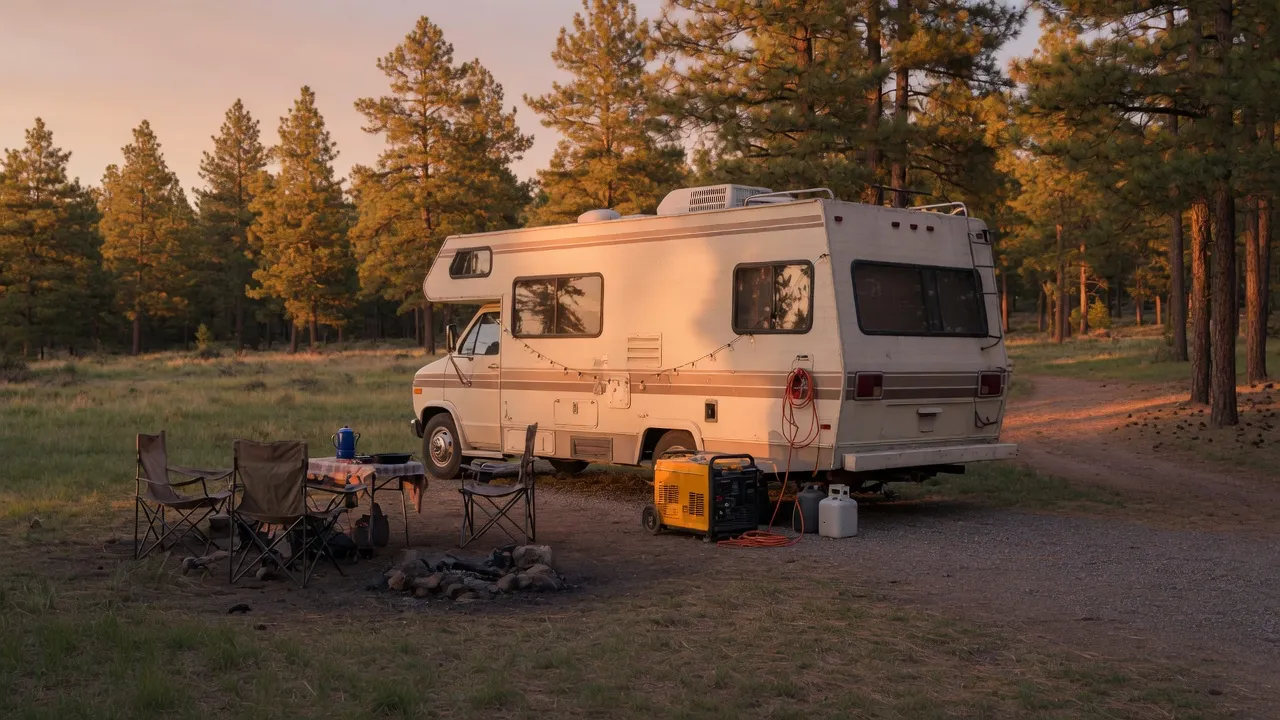
Every RV — Class A, Class B, travel trailer, 5th wheel, teardrop — runs on the same 8 core systems: black tank, fresh + greywater, refrigerator, air conditioning, awning, propane, water filter, and generator. Manuals describe each in isolation; PickRV editors describe how they fail in the real world. This guide replaces the dozens of generic '10 tips for X' articles cluttering RV blogs with a single definitive resource — organized system by system, focused on the real-world failure modes the manuals skip.
PickRV
Published by PickRV
PickRV is a marketplace. Editorial content is informational only — confirm road status, weather, wildlife, and host policies before you travel.
What does the PickRV rv systems guide cover?
Black tank to generator: how every RV system actually works, what breaks, and what manuals don't tell you. PickRV editor field-tested. We walk through it section by section — what to check, what it costs, and the details most listings leave out.
- Black tank
- Fresh water + greywater
- Refrigerator
- AC
- Awning
- Propane
- Water filter
- Generator
How-to · 5 steps · ≈2 min
Black tank — the system you ignore until it's too late
The black tank holds toilet waste — solids + liquids + toilet paper + (in some rigs) macerator output. Typical capacity: 30-50 gallons in Class A/C, 15-25 gallons in Class B / small TT, 8-12 gallons in pop-ups. Sensor failures are the #1 misery: build-up coats the internal probes and your gauge reads 'full' when the tank is half-empty (or vice-versa). The rule that beats every gimmick: never close the gray valve until you dump black + flush + dump again.
- 1
Always dump with the proper sequence
Hook up the sewer hose to the dump fitting, then open the BLACK valve first (high pressure), wait until flow stops, close it. Open GRAY valve second — gray-water rinses your hose. Close gray. Disconnect.
- 2
Flush with the built-in rinse (if equipped)
Most 2018+ rigs have a black-tank rinse port — separate water inlet near the dump valve. Connect a dedicated rinse hose (NEVER the drinking-water hose). Let it run 5 minutes with the black valve open after each dump.
- 3
Use real RV-grade tank chemicals
Avoid 'green' enzyme-only treatments — they don't dissolve TP fast enough in cold weather. Geo Method (1 cup Calgon water softener + 1 cup dish soap per dump cycle) outperforms most commercial chemicals for $0.40/dump.
- 4
Keep the black valve CLOSED during travel
Leaving black open while connected to a sewer hookup defeats the system: liquids drain off and solids pile up. Wait until 2/3 full, then dump for proper flow.
- 5
Sensor reset trick
If sensors read 'full' but you know the tank is empty: fill it half with water, drive 30 mi (sloshing dislodges build-up), then dump + flush. Works ~70% of the time before you need a tank-scrubber tool.
PickRV editor · what manufacturers + manuals gloss over
Every RV YouTube channel pushes their favorite tank chemical. Real RVer truth: the chemical matters far less than the SEQUENCE. The Geo Method (cheap softener + dish soap) outperforms 90% of $20/bottle commercial products in side-by-side testing by RV Travel magazine 2024.
Second: never use Rid-X or septic-tank enzymes in an RV black tank — they're designed for full septic systems that operate continuously; in an RV's intermittent-use tank, they generate hydrogen sulfide gas (rotten-egg smell) instead of breaking down waste.
Third: dump-station etiquette nobody publishes — bring your OWN rubber gloves + paper towels + hand sanitizer; many dump stations have no soap or water, and station shutoffs from norovirus outbreaks happen 2-3x/year in popular boondocking areas (look up Quartzsite Jan 2024).
- Black valve OPENED FIRST when dumping; GRAY second to rinse hose
- Geo Method (softener + dish soap) beats most $20 commercial treatments
- NEVER use Rid-X or septic enzymes — generates rotten-egg gas
- Black valve CLOSED during travel + while hooked up
Chapter 2 · Overview · ≈1 min
Fresh water + greywater — the cleaner of the two will surprise you

Fresh water comes in three flavors: (1) tank-stored (40-100 gal), (2) campground hookup, (3) gravity-fill jug. Greywater is sink + shower runoff — typically 30-60 gallons, dumped after black. Surprise reality: greywater in a heavily-used RV is often DIRTIER than blackwater per gram, because shampoo + cooking grease + soap create a bacterial soup that nothing breaks down. RVers who never clean their greywater tank discover this when the smell rivals the black tank by season end.
PickRV editor
Manufacturer marketing emphasizes black-tank odor; reality is most RVer 'mystery smells' come from the GREY tank. Pour 1 cup white vinegar + 1 gallon hot water down the kitchen sink every 2 weeks for a Class B/C or every week for full-time usage. Also non-obvious: fresh-water tanks degrade FASTER than holding tanks because they're often plastic (not the heavier polyethylene used for waste). Test fresh water annually for bacteria — coliforms grow in 'rarely-used' RV tanks even with chlorinated city water input, because chlorine dissipates within 48 hours of being captured. The fix: 'pink antifreeze' isn't just for winter — sanitize annually with 1 cup bleach to full fresh tank, run through all taps until you smell it, let sit 4 hours, drain + refill 2x. Camping World won't tell you this because they sell expensive 'tank cleaners' that are 90% the same dilute bleach.
- Greywater is often DIRTIER than black after long usage — vinegar flushes help
- Sanitize fresh-water tank annually with 1 cup bleach + full flush
- Plastic fresh tanks degrade in 7-12 years — inspect for cracks at fittings

Comparison · 3 options · ≈1 min
Refrigerator — propane / 12V / residential, and why they fail
RV fridges come in three architectures: (1) absorption (propane + 12V/120V, no compressor), (2) 12V compressor (DC-only), (3) residential (120V, compressor, looks like a kitchen fridge). Each fails in a unique way that the brochure doesn't show. Absorption fridges are 80% of all factory-installed RV refrigerators because they run on propane when no electricity is available — but they LIVE TO TILT.
RV refrigerator type comparison
Absorption (Dometic/Norcold)
Runs on propane OR 120V; 0 moving parts in cooling unit; fails when tilted >3° for >2 hours (cooling coil flame-out); cool-down 6-8 hours; runs on $40/season of propane in summer.
12V compressor (Iceco/Dometic CFX)
Runs on house batteries only; 90% more efficient than absorption; cools in 30 min; needs 50-60Ah/day so a 100Ah AGM battery lasts ~1.5 days; ideal for boondocking with solar.
Residential (Samsung/LG 120V)
Largest capacity (16-22 cu ft); requires inverter or hookup; pulls 1.2-2.5 kWh/day; cannot run on propane; the choice for full-time RVing with shore power.
| Option | What it covers |
|---|---|
| Absorption (Dometic/Norcold) | Runs on propane OR 120V; 0 moving parts in cooling unit; fails when tilted >3° for >2 hours (cooling coil flame-out); cool-down 6-8 hours; runs on $40/season of propane in summer. |
| 12V compressor (Iceco/Dometic CFX) | Runs on house batteries only; 90% more efficient than absorption; cools in 30 min; needs 50-60Ah/day so a 100Ah AGM battery lasts ~1.5 days; ideal for boondocking with solar. |
| Residential (Samsung/LG 120V) | Largest capacity (16-22 cu ft); requires inverter or hookup; pulls 1.2-2.5 kWh/day; cannot run on propane; the choice for full-time RVing with shore power. |
PickRV editor
What Dometic + Norcold won't headline: their absorption fridges WILL FAIL if you park even slightly off-level overnight. The cooling coil works by ammonia rising through a vertical tube — tilt the rig and the ammonia pools, the coil overheats, and the unit shuts down (sometimes permanently). RVer field rule: level within 3° before going to sleep, period. Second non-obvious: a 2010-2018 Norcold cooling unit failure is the #1 most-expensive RV repair ($1,800-$2,400 dealer install) — and the OEM coils failure rate is so high that aftermarket re-cores ($800) are now the industry-default fix.
Third: residential fridges DO work on a 2,000W inverter + 200Ah battery bank for 8-12 hours — popular boondocker upgrade, but you must add a soft-start kit ($150) or the inrush current trips most inverters.
- Absorption fridges fail if tilted >3° for >2 hours — LEVEL the rig
- 12V compressor is best for boondocking with solar (40-60Ah/day)
- Residential needs 2000W inverter + soft-start kit on battery power
Chapter 4 · Troubleshooting · 5 steps · ≈2 min
AC — rooftop is dumb, ducted is smart, both eat power
RV AC units are split between non-ducted (single vent at unit) and ducted (vents in ceiling throughout rig). Both eat 13-16 amps at 120V (1,500-1,900W running). Generator math: a 4kW generator can run ONE AC OR microwave, not both. A 5.5kW generator can run two ACs but not while cooking. Most failures aren't from the AC unit itself but from voltage, capacitor, or coolant-line issues that the dealer charges $400 to diagnose.
- 1
Symptom: AC blows but doesn't cool
First check the capacitor. AC capacitors fail every 8-12 years and look like dented Coke cans on the rooftop unit. $25 part, 20-min swap. 70% of 'AC won't cool' is just this.
- 2
Symptom: AC runs then trips breaker
Voltage drop. Many parks deliver 105-110V during peak load. Plug in a $30 voltage meter (Progressive Industries EMS-PT30X) at the pedestal. Below 108V, do NOT run the AC — your compressor will burn out.
- 3
Symptom: AC freezes up
Restricted airflow. Pull the filter, clean the cooling coil with a soft brush, and check the air return path. Filter buildup is the #1 cause of frozen coil.
- 4
Symptom: water dripping from ceiling vent
Drain line is clogged. Roof unit has a small drain that runs to the outside; squirrels + leaves block it. Climb up, snake with stiff wire.
- 5
Preventive: lubricate fan motor annually
Most RV ACs have a sealed bearing — but if you hear squeaking, it's terminal. Sealed-bearing units cost $200+ to swap; a $40 fan-only replacement is the workaround.
PickRV editor
Camping World will quote you $1,200 to replace a 'failed' rooftop AC. Real failure rate of the AC itself is <15% — the unit is built like a tank. The other 85% is capacitor ($25), thermostat ($40), or low voltage (free to diagnose).
Second: 'soft-start' kits — Micro-Air EasyStart, $250-$350 — let you run a 13K-15K BTU AC on a 2,000W inverter or a 30A pedestal. This is the upgrade that lets you boondock with AC for ~4-6 hours on a 400Ah lithium bank.
Third: rooftop AC condensate dripping inside the rig is almost ALWAYS the drain hose disconnected at the seal — fixable with $5 of butyl tape + plumber's putty, NOT a $400 dealer 'inspection.'
Overview · ≈1 min
Awning — and why every RVer pays the wind tax exactly once
RV awnings come in manual (crank, $150-$400 to replace fabric), power (electric motor, $800-$1,500), and slide-out toppers (mini-awnings over slides, $200-$400 each). The single rule: WIND > 15 MPH = AWNING IN. Period. Industry RV claims data (RVIA aggregated; rvia.org · accessed 2026-05-25) shows that awning damage from gusts is the #1 covered claim — average payout $2,800, average cause: 'left out overnight, sudden gust at 3am.' Most rigs are totaled in this scenario because the gust rips the awning AND bends the awning arms AND tears the rooftop mounting flange.
PickRV editor
What dealers don't volunteer: most factory awnings have a 'wind sensor' option (Carefree of Colorado AutoAwn, ~$300 retro-fit). It auto-retracts at 15+ mph. Pays for itself the FIRST close call. Second non-obvious: rain pooling. Even moderate rain can pool 5+ gallons on a sagging awning (8 ft × 12 ft × 1 inch depth = ~5 gallons). The water weight then SNAPS the support arms inward in seconds. The fix: install a $20 awning de-flapper or pitch one side down by adjusting the support pole — but only if you're under the rig watching the weather.
Third: 'never leave the awning out unattended' applies to bug-out trips too. A common new-RVer mistake is leaving for a day hike with the awning out — return 8 hours later to find an afternoon thunderstorm has wrecked it. Roll it up if leaving for more than 2 hours.
- Wind >15 mph = awning IN (no exceptions)
- Rain pools 5+ gallons on a flat awning — pitch a corner down
- Add a $300 wind-sensor retrofit — pays for itself the first close call
- Don't leave awning out when leaving the rig for 2+ hours
Chapter 6 · FAQ · 5 questions · ≈2 min
Propane — your fridge + stove + water heater + furnace + generator
Propane (LP gas) powers most RV systems by default: stove, water heater, furnace, refrigerator (in absorption mode), and sometimes the generator. A 30lb DOT tank holds about 7 gallons of liquid propane — roughly 1.5M BTU. Burn rates: stove 9K BTU/burner, water heater 10K BTU/hr, furnace 25-30K BTU/hr in cold weather. That means a full 30lb tank lasts ~1 week of full-time cold-weather use, or 2-3 weeks in warm weather.
How often should I leak-check the propane system?
Every 6 months MINIMUM — DOT regulations require certified propane techs to recertify cylinders every 12 years. The 'every-6-months' soap test (spray soapy water on connections, watch for bubbles) catches 95% of leaks. RV fires from propane leaks are rare but devastating — one in 8,000 RVs annually per NFPA data.
Can I refill DOT tanks myself?
Legally, no — only certified propane stations can refill DOT tanks. But you CAN buy refurbished tanks at exchanges (Blue Rhino, Amerigas) for ~$25 + $25 swap fee = $50 total. Note: exchange tanks are typically filled to only 15 lbs of 20-lb capacity (75% by weight). Refilling at a station gives you the full 20 lb for usually 30% less per pound.
Why does my regulator have two stages?
RV propane systems use two-stage regulators: first stage drops tank pressure (~200 PSI) to 10 PSI, second stage drops to 11 inches water column (the appliance operating pressure). Both stages need to be in spec for appliances to work right — a partially clogged regulator causes 'yellow flame' issues on the stove + furnace short-cycling.
Can I use propane indoors with the windows closed?
Briefly, yes (cooking on the stove). For extended use (running propane heater at night), you NEED ventilation — propane combustion produces carbon monoxide. Every RV should have a working CO detector (test monthly, replace every 5-7 years). Buddy heater portable propane units MUST have a window cracked.
What's the lifespan of a propane fridge?
The COOLING UNIT (the welded ammonia-coil assembly) lasts 12-18 years in normal use. The control board often fails first (5-10 years). Replacement cooling units are $800-$1,200 + install — at year 12+ of an RV, consider replacing the whole fridge with a 12V compressor model for $1,400-$1,800.
PickRV editor
Propane salespeople won't tell you that the cheapest gas source for full-timers is NOT exchanges OR refill stations — it's having a SECOND tank you switch to when primary runs out (cheap $90 30-lb tank), then refilling at U-Haul or Tractor Supply ($0.60-$0.80/gal less than Amerigas). The double-tank rig also means you never run out mid-shower. Second non-obvious: RV refrigerators on propane mode use MORE propane in summer than winter — counterintuitive but true, because absorption cooling depends on temperature differential. A 30-lb tank powers a fridge for ~30 days in fall, only ~21 days in 95°F summer.

Overview · ≈1 min
Water filter — the $30 tax most RVers overlook
Campground water quality varies WILDLY. Some sites deliver crystal-clear municipal water; others deliver iron-rich well water that stains your fixtures rust-brown in a week. A basic inline filter (Camco TastePURE, $40) blocks chlorine + sediment + most off-tastes. A two-stage canister system ($120-$180) adds bacterial filtration. A reverse-osmosis (RO) unit ($450-$800) removes nearly everything — but wastes 3 gallons of water for every gallon filtered.
PickRV editor
What manufacturers don't say: a $40 inline filter degrades FAST in heavy mineral water — replace every 3 months in places like Arizona / New Mexico / parts of Texas where water hardness exceeds 200 ppm. RVers report filter clogging after 3-4 weeks vs the marketed '6 months.' Second tip: install BOTH an inline (at the hose) AND an under-sink polishing filter ($40) — the inline catches sediment + chlorine, the under-sink handles taste + final polish. Total cost: $80, vs $450 for an RO that wastes 3:1 water. Third non-obvious: 'softener' filters are different from sediment filters — a portable water softener ($180-$250, Watts) is what you need for HARD-water states; sediment filters don't reduce hardness, they remove dirt. Iron-stained sinks + crusty showerheads come from hardness, not sediment.
- Replace $40 inline filters every 3 months in hard-water states
- Two-stage: inline + under-sink polishing beats single RO for 90% of needs
- Hard water requires a softener, not a sediment filter
Chapter 8 · Comparison · 3 options · ≈1 min
Generator — Onan, Cummins, Honda, or none?
RV generators come in factory-installed (Onan, mounted in the rig, 3.6-7 kW typical) or portable (Honda EU2200i, Champion 2500w, etc). Factory units burn the rig's house fuel (propane or diesel); portables run on gasoline (and sometimes propane). Power output determines what you can run — a 4kW unit handles ONE AC or microwave; a 5.5kW handles two ACs; a 7kW handles 'most things at once' but burns a gallon of fuel per hour.
Onboard vs portable generator comparison
Onan onboard (Class A/C)
3.6-7 kW; runs off rig's propane or diesel; quiet (~63 dB at 23ft); $4,500-$8,000 install; service life 3,000+ hrs; mounted under-rig — vibration + heat issues over time.
Honda EU2200i portable
2.2 kW inverter; gasoline only; ultra-quiet (~48-57 dB); $1,100 retail; service life 1,500-2,000 hrs; can parallel two units for 3.8 kW; popular boondocker choice.
Champion 2500w (lower-cost portable)
2.5 kW inverter; gas or LP dual-fuel; quiet (~53 dB); $700 retail; less refined than Honda; common as backup unit.
| Option | What it covers |
|---|---|
| Onan onboard (Class A/C) | 3.6-7 kW; runs off rig's propane or diesel; quiet (~63 dB at 23ft); $4,500-$8,000 install; service life 3,000+ hrs; mounted under-rig — vibration + heat issues over time. |
| Honda EU2200i portable | 2.2 kW inverter; gasoline only; ultra-quiet (~48-57 dB); $1,100 retail; service life 1,500-2,000 hrs; can parallel two units for 3.8 kW; popular boondocker choice. |
| Champion 2500w (lower-cost portable) | 2.5 kW inverter; gas or LP dual-fuel; quiet (~53 dB); $700 retail; less refined than Honda; common as backup unit. |
PickRV editor
Most RVer wisdom about generators is wrong. Truth #1: Onan onboard generators on rented RVs are FREQUENTLY undermaintained — the prior renter ran it for 10 hours, but the oil hasn't been changed in 200+ hours. ALWAYS check the dipstick before first use of a rental's generator. Truth #2: the 4kW Onan in most Class C rentals will NOT run the AC and microwave together — period. Burner-management circuits trip. Truth #3: Honda EU2200i portables are nearly indestructible BUT the gasoline carburetor varnishes shut if stored 6+ weeks with fuel. Always run dry before storage, or add Sta-Bil. Truth #4: 'inverter' generators (Honda, Champion, Yamaha) produce 'clean' power suitable for sensitive electronics (TVs, residential fridges); conventional generators (Champion 4000w 'open frame') do NOT — they can damage your residential fridge over time.
- Always check generator oil + run-hours BEFORE first use on a rental
- 4kW Onan = ONE AC at a time (or one major appliance)
- Inverter generators produce 'clean' power; open-frame generators don't
- Honda EU2200i carburetor varnishes in 6+ weeks of stored fuel — drain it
Continue reading
More trips like this · 6
Similar terrain, seasons, and rigs from across PickRV.
Was this guide helpful?