The range still runs free
Wild Horses & Burros for RV Travelers
Real US places to watch free-roaming wild horses and burros — where the bands range on BLM, National Park, Forest Service, and state land, how to watch respectfully, and how to find a rig nearby. Facts come from official sources.
These are protected wild animals: keep your distance, never feed or approach, and confirm current access on the official site before you go — many ranges sit at the end of seasonal roads.
- 15
- Field guides
- 10
- States covered
- 4
- Managing agencies
The ranges
Every viewing area in the guide
Maryland & Virginia
Assateague Island Wild Ponies: Free-Roaming Horses of the Atlantic Barrier Coast
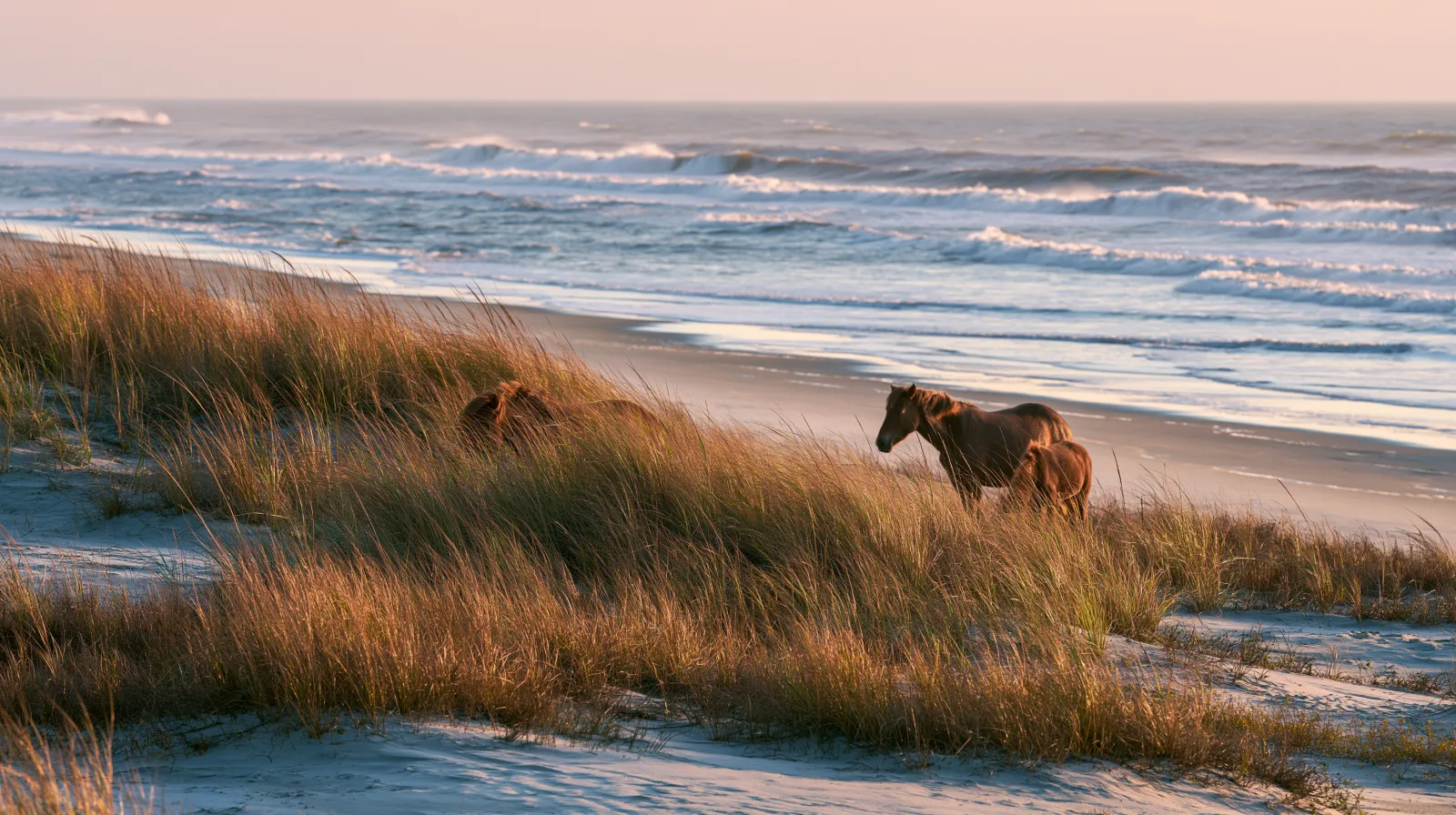
Assateague Island National Seashore (MD/VA) is home to free-roaming feral ponies managed by the National Park Service on the Maryland end. The herds are wild descendants of domestic horses; the Park Service stresses giving them space and never feeding or petting them. It's a classic, fully public place to view wild horses from a respectful distance.
Read the field guideVirginia
Chincoteague Wild Ponies
Virginia
Chincoteague Wild Ponies: Virginia's Famous Refuge Herd
Chincoteague National Wildlife Refuge in Virginia, managed by the U.S. Fish & Wildlife Service, is the home of the famous Chincoteague ponies along with the historic Assateague Lighthouse. The refuge is fully open to the public for wildlife viewing, and the ponies are best appreciated from a respectful distance as the wild animals they are.
Read the field guideNorth Carolina
Corolla Wild Horses
North Carolina
Corolla Wild Horses: Spanish Mustangs of North Carolina's Northern Outer Banks
The Corolla wild horses roam free on the northern Currituck Outer Banks of North Carolina, where the paved road ends and the 4x4 beach begins. They are Banker horses descended from Spanish Colonial mustangs, designated the official State Horse and a cultural treasure of North Carolina, and cared for by the Corolla Wild Horse Fund. A Currituck County ordinance requires people to stay at least 50 feet away, and feeding the horses is illegal and can be fatal.
Read the field guideGeorgia
Cumberland Island Wild Horses
Georgia
Cumberland Island Wild Horses: Georgia's Unmanaged Atlantic Herd
Cumberland Island National Seashore in Georgia, managed by the National Park Service, hosts the only completely unmanaged feral-horse herd on the Atlantic coast — no food, water, veterinary care, or population control. Visitors must maintain a distance of at least 50 feet and never feed or pet the horses, which are genuinely wild and have injured people in the past.
Read the field guideArizona
Heber Wild Horse Territory
Arizona
Heber Wild Horse Territory: An RV Traveler's Guide
A federally designated wild-horse territory in Arizona's Apache-Sitgreaves National Forests, in the high pine forest along the Mogollon Rim near Heber-Overgaard. The Forest Service manages the herd to a set population level; these are wild animals best viewed quietly from a distance.
Read the field guideNevada
Marietta Wild Burro Range
Nevada
Marietta Wild Burro Range: An RV Traveler's Guide
A BLM herd management area about 45 miles south of Hawthorne in Mineral County, Nevada, covering roughly 66,000 acres and managed mainly for wild burros. The burros are protected under federal law and are wild animals — view them from a distance and never feed them.
Read the field guideWyoming
McCullough Peaks Wild Horses
Wyoming
McCullough Peaks Wild Horses: An RV Traveler's Guide
The McCullough Peaks wild horses roam 109,000+ acres of BLM land east of Cody, Wyoming, near Yellowstone. Famous for their color variety, they are wild animals best viewed quietly from a distance, often with binoculars.
Read the field guideUtah
Onaqui Mountain Wild Horses
Utah
Onaqui Mountain Wild Horses: An RV Traveler's Guide
The Onaqui Mountain wild horses roam open BLM rangeland southwest of Salt Lake City, Utah, near Simpson Springs and the Pony Express Road. They are wild animals protected under federal law and are best enjoyed quietly from a distance.
Read the field guideNevada
Pine Nut Mountains Wild Horses
Nevada
Pine Nut Mountains Wild Horses: An RV Traveler's Guide
A BLM Herd Management Area in the Pine Nut Mountains about five miles east of Carson City, Nevada, covering roughly 104,000 acres. Free-roaming wild horses are protected here under the 1971 Wild Free-Roaming Horses and Burros Act. They are wild animals — view from a distance and never feed them.
Read the field guideMontana & Wyoming
Pryor Mountain Wild Horse Range
Montana & Wyoming
Pryor Mountain Wild Horse Range: An RV Traveler's Guide
The Pryor Mountain Wild Horse Range spans BLM land in Montana and Wyoming, about 50 miles south of Billings. Established in 1968, it is one of the country's designated wild-horse ranges and is best enjoyed from a respectful distance.
Read the field guideArizona
Salt River Wild Horses
Arizona
Salt River Wild Horses: An RV Traveler's Guide
Free-roaming horses along the Lower Salt River in Arizona's Tonto National Forest, near Mesa and the Bush Highway recreation sites. They are protected under Arizona state law and are best enjoyed from a respectful distance — they are wild, unpredictable animals, and feeding them is prohibited.
Read the field guideColorado
Sand Wash Basin Wild Horses
Colorado
Sand Wash Basin Wild Horses: An RV Traveler's Guide
The Sand Wash Basin wild horses roam a 157,000-acre BLM basin in northwest Colorado, about 45 miles west of Craig near Maybell. They are wild, federally protected animals best viewed quietly from a distance.
Read the field guideNorth Carolina
Shackleford Banks Wild Horses
North Carolina
Shackleford Banks Wild Horses: North Carolina's Cape Lookout Herd
Shackleford Banks, part of Cape Lookout National Seashore in North Carolina, is home to more than 100 wild horses that live without human help. The herd is co-managed by the National Park Service and the non-profit Foundation for Shackleford Horses, protected by federal law, and visitors are asked to stay at least 50 feet away. Feeding, touching, or disturbing the horses is illegal.
Read the field guideColorado
Spring Creek Basin Wild Horses
Colorado
Spring Creek Basin Wild Horses: An RV Traveler's Guide
The Spring Creek Basin wild horses roam BLM land in Disappointment Valley, southwest Colorado, between Norwood and Dove Creek. The small herd of free-roaming, federally protected horses is best enjoyed quietly from a distance.
Read the field guideNevada
Virginia Range Horses
Nevada
Virginia Range Horses: An RV Traveler's Guide
Free-roaming horses on the Virginia Range of western Nevada, between Reno, Carson City and Virginia City. Legally they are estray (feral) livestock managed by the Nevada Department of Agriculture under state law, not federally protected wild horses. They are wild and unpredictable — keep your distance and never feed them.
Read the field guide
Where the bands roam
Wild-horse country, state by state
Free-roaming herds hold the open West — high-desert basins and sage flats where the range stays wild. Pick a state to see RV rentals and what else is along the road.
Planning a dawn drive out to watch the herd?