PickRV Mega Guide
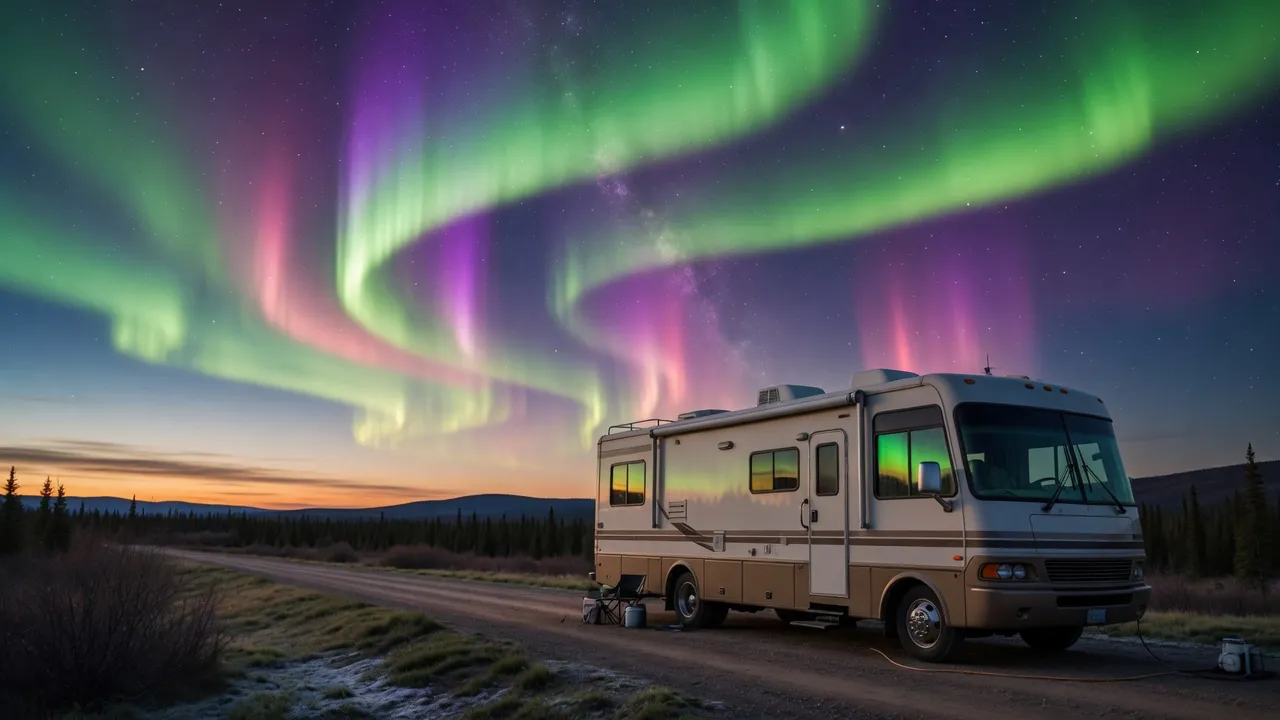
Aurora viewing RV trips — Fairbanks vs Yellowknife vs Iceland route comparison
Real aurora forecasting, optimal viewing windows, RV access (Fairbanks + Yellowknife), and the honest Iceland route limitations.
Northern lights (aurora borealis) viewing has become a bucket-list RV trip for many travelers. Three primary destinations: Fairbanks AK (US-accessible by RV), Yellowknife NWT Canada (drivable by RV via Yellowhead + Hwy 3), and Iceland (NOT RV-rentable directly, but campervan options). Each has distinct trade-offs in access, season, viewing probability. Below is the honest comparison based on NOAA + NASA Space Weather Prediction Center data + tourism board statistics.
PickRV
Published by PickRV
PickRV is a marketplace. Editorial content is informational only — confirm road status, weather, wildlife, and host policies before you travel.
What does the PickRV aurora viewing rv fairbanks yellowknife iceland guide cover?
Real aurora forecasting, optimal viewing windows, RV access (Fairbanks + Yellowknife), and the honest Iceland route limitations. We walk through it section by section — what to check, what it costs, and the details most listings leave out.
- Aurora science
- Fairbanks AK
- Yellowknife NWT Canada
- Iceland
- Side-by-side comparison
- Aurora viewing strategy (regardless of destination)
- RV selection for aurora trips (winter capability)
- Aurora RV trip FAQ
Overview · ≈1 min
Aurora science — what causes it + when it's visible
Per NASA + NOAA Space Weather Prediction Center: aurora caused by solar wind particles interacting with Earth's magnetic field. Visibility highest near magnetic poles + during high geomagnetic activity (KP index).
PickRV editor · what manufacturers + manuals gloss over
What aurora prediction sites don't always emphasize: (1) Aurora season is October through March in northern hemisphere (long winter nights required). (2) Best viewing 10 PM - 2 AM local time. (3) Solar maximum cycle (every ~11 years) brings more frequent aurora. Solar maximum 2024-2025 was peak; 2026 still strong but declining. (4) KP index 4+ needed for visible aurora at popular viewing locations. (5) Clear sky absolutely critical (aurora hidden behind clouds = no viewing).
- Season: October through March (long winter nights)
- Best time: 10 PM - 2 AM local time
- KP index 4+ for visible aurora at popular locations
- Solar maximum 2024-2025 was peak; 2026 still strong
- Clear sky absolutely required (clouds = no viewing)
Chapter 2 · Overview · ≈1 min
Fairbanks AK — the US-accessible aurora destination

Fairbanks Alaska sits under the 'aurora oval' — the band of highest aurora frequency. Accessible by RV via Alaska Highway from Lower 48 OR Alaska Marine Highway System ferry.
PickRV editor
What Fairbanks aurora tourism doesn't always disclose: RV access requires Alaska Highway drive (~2,200 mi from Seattle, 4-7 days each way) OR ferry to Skagway + drive (~750 mi from Skagway). Total trip: minimum 3 weeks for round-trip with reasonable aurora viewing time. Winter access: most Alaska Highway services close November-March; check accessibility before planning. Fairbanks aurora viewing probability: ~80% on clear nights September-March per Univ. Alaska Fairbanks Geophysical Institute data.
- Access: Alaska Highway from Lower 48 (~2,200 mi each way)
- Alternative: Alaska Marine Highway ferry to Skagway + drive
- Winter access: many highway services close Nov-Mar (verify)
- Aurora viewing probability: ~80% clear nights Sep-Mar
- Best viewing: Chena Hot Springs, Cleary Summit, Murphy Dome
Overview · ≈1 min
Yellowknife NWT Canada — the drivable Canadian aurora destination
Yellowknife sits 250 mi south of Arctic Circle, under aurora oval. Accessible by RV via Highway 3 from Edmonton AB (~900 mi).
PickRV editor
What Yellowknife aurora tourism emphasizes: world's best aurora viewing per multiple tourism rankings. What they don't always emphasize: RV access requires winter highway driving (Hwy 3 maintained year-round but plowed only). Best viewing: Aurora Village (north of city), Prelude Lake Territorial Park, Cameron Falls viewing area. Aurora viewing probability: ~75-85% clear nights September-April per Northwest Territories tourism data.
- Access: Highway 3 from Edmonton (~900 mi)
- Winter highway: maintained + plowed year-round
- Best viewing: Aurora Village, Prelude Lake, Cameron Falls
- Aurora probability: ~75-85% clear nights Sep-Apr
- Border crossing: US-Canada border required (passport + ArriveCAN app for some)
Chapter 4 · Overview · ≈1 min
Iceland — the campervan option (NOT RV-friendly)
Iceland is a popular aurora destination but presents unique constraints for traditional RV travel.
PickRV editor
What Iceland aurora marketing emphasizes: spectacular scenery + aurora. What they don't always emphasize: (1) NO traditional US RV rentals — US RVs cannot be shipped to Iceland economically. (2) Iceland campervan rentals exist but are SMALLER than US RVs (typically Class B equivalent or smaller — Honda CRV-sized to Sprinter-sized). (3) Iceland weather extremely variable; aurora viewing windows often cloudy. (4) Iceland Ring Road is well-maintained but winter sections close (Highland routes November-May). (5) Reykjavík aurora viewing probability: ~30-50% clear nights September-March per Icelandic Met Office data (lower than Fairbanks/Yellowknife due to maritime climate cloudiness).
- NO traditional US RV rentals in Iceland (campervan only)
- Iceland campervan: smaller than US RVs (Class B equivalent or smaller)
- Aurora probability: ~30-50% clear nights (lower due to maritime cloudiness)
- Winter: Highland routes closed Nov-May
- Best base: Reykjavík + drive Ring Road
Comparison · 6 options · ≈1 min
Side-by-side comparison — Fairbanks vs Yellowknife vs Iceland
Comparison framework for picking the right destination.
Aurora destination comparison
Fairbanks AK access
RV via Alaska Hwy (4-7 days each way from Seattle). Total trip: 3+ weeks. Cost: high (fuel + accommodations en route).
Yellowknife NWT access
RV via Hwy 3 from Edmonton (2-3 days each way). Total trip: 1-2 weeks. Cost: moderate.
Iceland access
Fly to Reykjavík + rent campervan. NOT US-RV-rentable. Total trip: 1-2 weeks. Cost: moderate-high.
Aurora viewing probability
Fairbanks ~80% / Yellowknife ~75-85% / Iceland ~30-50% clear nights
Season
All three: Sep-Mar (Iceland season extends to mid-April)
RV park infrastructure
Fairbanks: limited winter. Yellowknife: limited winter. Iceland: small campsites year-round
| Option | What it covers |
|---|---|
| Fairbanks AK access | RV via Alaska Hwy (4-7 days each way from Seattle). Total trip: 3+ weeks. Cost: high (fuel + accommodations en route). |
| Yellowknife NWT access | RV via Hwy 3 from Edmonton (2-3 days each way). Total trip: 1-2 weeks. Cost: moderate. |
| Iceland access | Fly to Reykjavík + rent campervan. NOT US-RV-rentable. Total trip: 1-2 weeks. Cost: moderate-high. |
| Aurora viewing probability | Fairbanks ~80% / Yellowknife ~75-85% / Iceland ~30-50% clear nights |
| Season | All three: Sep-Mar (Iceland season extends to mid-April) |
| RV park infrastructure | Fairbanks: limited winter. Yellowknife: limited winter. Iceland: small campsites year-round |
PickRV editor
What this comparison shows clearly: Yellowknife wins on RV accessibility + aurora viewing probability. Iceland wins on scenery + tourism infrastructure. Fairbanks wins on US-domestic access + US-rental availability. Pick by access vs viewing trade-off.
Chapter 6 · How-to · 6 steps · ≈1 min
Aurora viewing strategy (regardless of destination)
Maximize aurora viewing success regardless of destination.
- 1
Check NOAA + NASA Space Weather Prediction Center
Monitor KP index forecasts at spaceweather.gov. KP 4+ indicates likely aurora visibility at typical viewing locations.
- 2
Check local cloud forecast for viewing nights
Aurora hidden behind clouds = no viewing. Use local meteorological service (NWS for US, Environment Canada for Canada, Iceland Met for Iceland).
- 3
Time viewing window: 10 PM - 2 AM local
Aurora peaks during this window typically. Earlier (8-10 PM) and later (2-4 AM) windows possible but less reliable.
- 4
Find dark sky viewing location
Get away from city lights (Cleary Summit FAI, Aurora Village YZF, drive 30+ min from Reykjavík). Light pollution reduces visibility.
- 5
Prepare for cold
Sub-zero temperatures common. Dress for -20°F to -40°F windchill. Hand warmers + thermos of hot drink + multiple insulating layers + winter boots essential.
- 6
Camera setup (optional)
Long-exposure photography requires DSLR/mirrorless + tripod. Phone cameras struggle with aurora (low light). Recommended: 14-24mm wide lens, ISO 800-3200, 5-20 sec exposures.
Overview · ≈1 min
RV selection for aurora trips (winter capability)
Aurora trips happen in winter. RV must handle extreme cold + winter road conditions.
PickRV editor
What aurora trip RV requirements: (1) Furnace MUST work reliably (not propane-only — many older furnaces fail in -30°F+). (2) Winterized water system (or expect to use only bottled water). (3) Tank heaters (block tanks from freezing). (4) Heated underbelly (prevents pipe freeze). (5) Adequate house battery + heating capacity (cold drains batteries fast). (6) Snow tires + chains required on most aurora route highways. Most STANDARD rental RVs lack winter capability — many rental contracts EXCLUDE winter operation. Verify with host before booking aurora trip.
- Furnace must work reliably in -30°F+
- Winterized water system OR bottled water only
- Tank heaters + heated underbelly
- Adequate house battery (cold drains fast)
- Snow tires + chains required on most aurora routes
- Most standard rental RVs lack winter capability
Chapter 8 · FAQ · 4 questions · ≈1 min
Aurora RV trip FAQ
Common questions about aurora RV trips.
When is the best time to see aurora?
October through March in northern hemisphere. Best window: 10 PM - 2 AM local time. Higher activity during solar maximum (2024-2025 was peak; 2026 declining).
What's the most accessible aurora destination for US RVers?
Fairbanks AK (drive Alaska Highway, ~2,200 mi each way) is US-domestic but logistically intensive. Yellowknife NWT Canada (drive from Edmonton, ~900 mi) is more accessible. Iceland requires flying + renting a smaller campervan.
Can I rent a winter-capable RV?
Limited inventory. Most standard rental RVs lack winter capability + many rental contracts exclude winter operation. Check with host before booking. Alternative: rent in Anchorage AK / Whitehorse YT for local aurora trip.
How probable is aurora viewing?
Fairbanks ~80% clear nights Sep-Mar. Yellowknife ~75-85% clear nights. Iceland ~30-50% clear nights (maritime cloudiness reduces probability). Plan 3-5 nights minimum at each destination for high viewing probability.
PickRV editor
What this guide gives aurora-curious RVers: realistic expectations. Aurora viewing is weather-dependent + season-dependent + location-dependent. Plan 1-2 weeks minimum at viewing destination. Yellowknife delivers best access + viewing probability for North American RVers. Fairbanks is US-domestic but logistically intensive. Iceland is spectacular scenery but limited RV options.
Continue reading
More trips like this · 6
Similar terrain, seasons, and rigs from across PickRV.
Was this guide helpful?