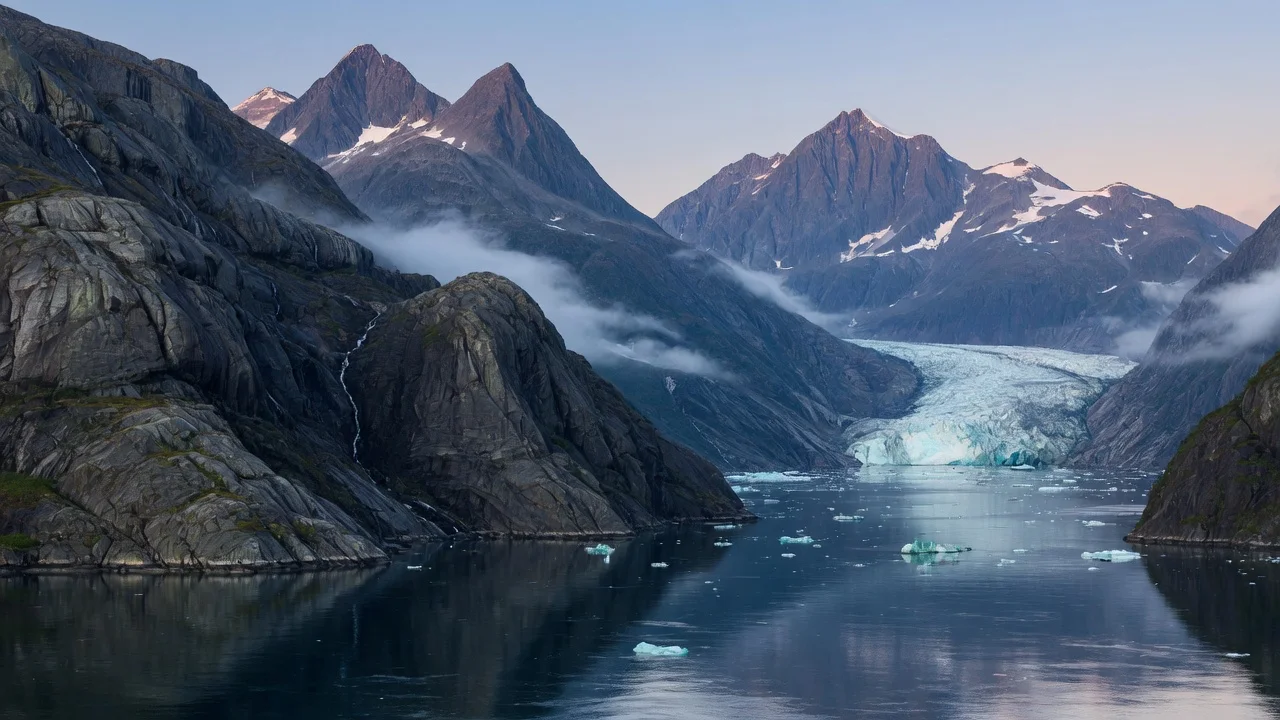
When to go for aurora, which ferry route saves $1,500, and the real bear-safety procedure for car-camping in grizzly country.
Aurora window planning — what the NOAA Space Weather data says
Aurora borealis is observable in Alaska roughly 200 nights per year, but viewing-quality nights (low cloud, low light pollution, Kp index ≥ 4) cluster in the autumn equinox (Aug 25 - Sep 25) and spring equinox (Mar 1 - Apr 15) windows. Per NOAA Space Weather Prediction Center, geomagnetic storms peak ±2 weeks of equinox dates due to the Russell-McPherron effect.
Fairbanks (64.8° N latitude) sits inside the auroral oval most clear nights September - April. Anchorage (61.2° N) is on the edge — visible during Kp ≥ 5 events only.
- Best window: Aug 25 - Sep 25 (autumn equinox)
- Second window: Mar 1 - Apr 15 (spring equinox)
- Fairbanks: inside auroral oval most clear nights
- Anchorage: visible during Kp ≥ 5 events only
- Check Kp forecast: spaceweather.gov, 3-day outlook
Alcan vs Marine Highway ferry — the real cost math
Two ways to get an RV to Alaska from the Lower 48: drive the Alaska Highway (Alcan) or load onto the Alaska Marine Highway System ferry. The choice depends on time + budget + risk tolerance.
Alcan drive (Seattle → Anchorage): 2,250 miles, 6-8 driving days, ~$1,200 fuel for Class C, 80% gravel-free since 2010 paving completion. Risk: 1 in 4 rigs gets a rock chip; 1 in 20 gets a tire failure on remote stretches.
Marine Highway (Bellingham WA → Whittier AK): 5-7 days at sea, $2,800-4,500 per Class C (30 ft) one-way per 2026 published fares, includes cabin + meals. Risk: weather delays add 1-2 days; sailings limited to 1-2/week peak season.
- Alcan: 2,250 mi × $0.55/mi all-in = $1,238 one-way
- Ferry one-way: $2,800-4,500 for Class C 30 ft + cabin
- Time: Alcan 7 days, Ferry 5-7 days (similar)
- Combo: drive one way, ferry back saves 6 days of return driving
Bear-safety protocol — grizzly + black bear country
Alaska has roughly 30,000 grizzly bears + 100,000 black bears + 3,500 polar bears (per Alaska Department of Fish & Game 2024 census). Most RV campers in Denali, Wrangell-St Elias, Lake Clark, and Katmai will share territory with grizzlies.
The protocol: store all food + scented items (toothpaste, sunscreen, deodorant) inside the rig at night, NEVER in a tent or external storage. Cook 100 yards downwind of the rig if possible. Carry bear spray (Counter Assault, Frontiersman — minimum 7.9 oz / 2-3 sec spray duration). Make noise on trails. Never approach within 100 yards.
- Store food + scented items inside hard-sided rig at night
- Cook 100 yards downwind, never inside rig
- Bear spray: Counter Assault 8.1 oz minimum
- Make noise on trails (singing, whistling, conversation)
- Never approach a bear within 100 yards (NPS rule)
- If charged: bear spray at 30 ft, NOT 10 ft
Denali NP RV access — the 92 mi road reality
Denali NP has one road (Park Road, 92 mi). Private vehicles allowed only first 15 mi to Savage River. Beyond Savage River: shuttle bus only (Tek Camper Bus or Wonder Lake Bus, $35-65/seat).
RV campgrounds inside Denali: Riley Creek (mile 0.25, full hookups not available, 30 ft max), Savage River (mile 13, no hookups, 30 ft max), Teklanika River (mile 29, no hookups, 30 ft max, 3-night minimum, no cars allowed beyond Savage River).
- Riley Creek: mile 0.25, 30 ft max, no hookups, $34/night
- Savage River: mile 13, 30 ft max, no hookups, $34/night
- Teklanika: mile 29, 30 ft max, 3-night min, $30/night
- Shuttle Bus required beyond mile 15
- Reserve all sites 6 months in advance on Recreation.gov
Kenai Fjords + Homer Spit — the southern Alaska Class A loop
From Anchorage, the Kenai Peninsula loop (Anchorage → Seward → Homer → Anchorage) is the highest-payoff Class A itinerary in Alaska: 600 mi total, 5-7 days, paved roads throughout, ferry-grade scenery without ferry costs.
Highlights: Exit Glacier (Kenai Fjords NP) hike-able from RV parking; Kenai Fjords NP boat tour from Seward harbour ($150-250/seat, half-day to full-day); Homer Spit RV parking + halibut fishing charters.
What Alaska tourism marketing doesn't tell you
The marketing focus is summer (May - Sep) for daylight + warm temps. The under-shared truth: late September is the highest-value window. Aurora is starting, mosquitoes have died, RV park rates drop 30-40%, leaf-peeping is at peak (yellow birch + red dwarf birch), road traffic drops 70%. The trade-off: 4-6 hours less daylight, possible early snow at high elevations.
Second under-shared truth: Class A rigs > 30 ft are NOT recommended for Alaska road trips. Many state-park sites cap at 30 ft. The McCarthy Road (60 mi gravel, single-lane in spots) is hostile to anything bigger. Rent a Class C 28 ft or smaller for maximum Alaska access.
Fuel + propane availability — the long-distance refuel map
Per the Alaska Department of Transportation + Public Facilities (dot.alaska.gov) road-services map + the Milepost reference guide (themilepost.com), fuel station spacing on Alaska highways averages every 75-150 miles in populated corridors and stretches to 200-300 miles in remote sections. The Dalton Highway (north of Fairbanks toward Prudhoe Bay) has fuel at only 3 locations across its 414 miles — Yukon River Camp, Coldfoot, Deadhorse. Plan refueling with a minimum 1/3-tank margin at every opportunity.
Propane availability is even sparser. Per the Alaska Propane Association + Milepost listings, propane refill stations cluster in Anchorage / Wasilla / Palmer / Fairbanks / Soldotna / Juneau. Outside these hubs, propane refills may require a 50-150 mile detour. Start a long trip with full 30-lb tanks topped off; Tractor Supply + U-Haul + most independent propane dealers in Anchorage + Fairbanks offer refills at $4-6/gallon as of 2026.
Diesel availability mirrors gas station spacing in most corridors, but biodiesel + ULSD (ultra-low-sulfur diesel) compliance varies. The Alaska EPA + ADEC diesel-fuel rules mandate ULSD year-round per Clean Air Act state implementation. Many remote stations supply only winterized #1-diesel during October-April; check the pump label before fueling a diesel pusher — #1 vs #2 viscosity differences can affect cold-start performance.
- Fuel spacing: 75-150 mi typical · 200-300 mi remote per dot.alaska.gov
- Dalton Highway: only 3 fuel stops in 414 miles (Yukon River / Coldfoot / Deadhorse)
- Propane hubs: Anchorage / Wasilla / Palmer / Fairbanks / Soldotna / Juneau
- Propane refill: $4-6/gal at Tractor Supply / U-Haul / independent dealers (2026)
- Winter diesel: #1 vs #2 ULSD varies by remote station per ADEC rules
Mosquito + insect protocol — DEET vs Picaridin vs permethrin
Per the Alaska Department of Health + Social Services (dhss.alaska.gov) + CDC mosquito-borne disease guidance (cdc.gov), Alaska's mosquito season peaks late May through mid-August in interior and southcentral regions. Densities reach >100 mosquitoes per minute per hand in wetland-adjacent campgrounds during peak weeks. Without effective repellent + clothing strategy, outdoor activity becomes physically difficult.
Repellent options per EPA + CDC published efficacy data: (1) DEET 25-30% (Off! Deep Woods, Ben's, Sawyer) — effective 6-8 hours, can damage some plastics + synthetics; (2) Picaridin 20% (Sawyer Picaridin, Natrapel) — comparable efficacy, lower irritation, no plastic damage; (3) Permethrin-treated clothing (Sawyer Permethrin spray $15-25 treats 1 outfit + lasts 6-8 washes per epa.gov label) — repels + kills on contact, used in combination with skin repellent.
Practical Alaska protocol: permethrin-treat all outer clothing 24-48 hours before departure, apply Picaridin 20% to exposed skin every 6-8 hours during outdoor activity, carry a head-net ($10-15 at any outdoor retailer) for peak-density situations, and confirm rig screens are intact + door seal closes flush. Most pre-2015 RVs have screen-mesh gaps that admit Alaska mosquitoes; inspect + patch before departure.
- Peak season: late May through mid-August interior + southcentral per dhss.alaska.gov
- DEET 25-30%: 6-8 hr efficacy · can damage plastics + synthetics
- Picaridin 20%: comparable efficacy · low irritation · no plastic damage
- Permethrin-treated clothing: $15-25 treats 1 outfit · 6-8 washes per epa.gov
- Head-net $10-15 + intact rig screens = peak-density survival
Frequently asked questions
When is the best time to see aurora in Alaska?›
Autumn equinox window (Aug 25 - Sep 25) or spring equinox (Mar 1 - Apr 15). Geomagnetic storms peak around equinoxes per NOAA Space Weather Prediction Center data.
Is it cheaper to drive the Alcan or take the ferry to Alaska?›
Driving the Alcan is cheaper one-way ($1,200 fuel for Class C vs $2,800-4,500 ferry per 2026 fares). Most travellers drive one direction and ferry the other to skip the return slog.
What's the bear-safety protocol for RV campers in Alaska?›
Store all food + scented items inside the hard-sided rig at night. Cook 100 yards downwind. Carry 8 oz bear spray. Never approach within 100 yards. Most attacks trace to food-storage violations.
Where can I refill propane in remote Alaska?›
Propane refill stations cluster in Anchorage, Wasilla, Palmer, Fairbanks, Soldotna, and Juneau. Outside these hubs, refills may require a 50-150 mile detour. Top off 30-lb tanks before leaving any hub at $4-6/gallon per 2026 Alaska Propane Association rates.
What's the best mosquito repellent for Alaska RV travel?›
Permethrin-treated outer clothing (Sawyer Permethrin $15-25 per outfit, 6-8 washes) combined with Picaridin 20% on exposed skin every 6-8 hours, plus a $10-15 head-net for peak-density situations. Permethrin-treat 24-48 hours before departure per EPA label.
Do I need a passport to drive the Alcan?›
Yes — the Alaska Highway passes through Canada (British Columbia + Yukon) for 1,400+ of its 2,250 miles. US + Canadian passports required at both border crossings. Per Canada Border Services Agency, additional documentation may include a notarized rental-agreement letter from the rental company authorizing Canada travel (most US RV rental companies require advance written approval for Canada travel).
Is there a cell signal in Denali NP?›
Very limited — Denali entrance area (mile 0-15) has some Verizon + AT&T signal near the visitor center. Beyond Savage River (mile 13), cell service drops to zero for the remaining 80 miles of Park Road. Carry a satellite communicator (Garmin inReach Mini) for any backcountry plans.
When does the Alaska Marine Highway open booking for next summer?›
Per dot.alaska.gov/amhs, the AMHS opens summer booking in December for the following May-September season. Inventory clears within weeks for popular sailings (Bellingham → Whittier especially). Set a December 1 calendar reminder if planning a summer ferry sailing.
Continue your research on PickRV
Sources
- 1.NOAA Space Weather Prediction CenterNOAAgovernment or university source
- 2.Alaska Marine Highway SystemAlaska DOTgovernment or university source
- 3.Alaska DOT + Public Facilities road servicesAlaska DOT&PFgovernment or university source
- 4.Alaska DHSS — mosquito-borne disease guidanceAlaska DHSSgovernment or university source
- 5.Alaska Department of Fish & Game bear dataADFGgovernment or university source
- 6.Denali NPNPSgovernment or university source
- 7.Kenai Fjords NPNPSgovernment or university source
Sources are a mix of government and university publications and the company or industry documentation for the specific equipment, store policy or standard discussed — each row above says which one it is, so you can weigh it yourself. Last verified 2026-05-24. Report broken links to support@pickrv.com.
Ready to roll?
Alaska is waiting.
Complete nightly price on every listing — your exact total itemized before you pay · 48h full rental refund. Every rig near you, one checkout.
Related reads
Plan around this guide · 4
Hub anchors · mega-guides · cost calculator — one click each.
Make it a trip
Rent an RV in Alaska
The rigs here are owned by local hosts. Browse what fits your route, or reach Alaska owners directly.
Browse Alaska rigsWhat fits this trip
Related on PickRV
Tell us when you're heading to Alaska.
Owners list their own rigs on PickRV. Add your dates and we'll email you when one is listed in Alaska for them — nothing else, no spam.
Was this guide helpful?