PickRV Mega Guide
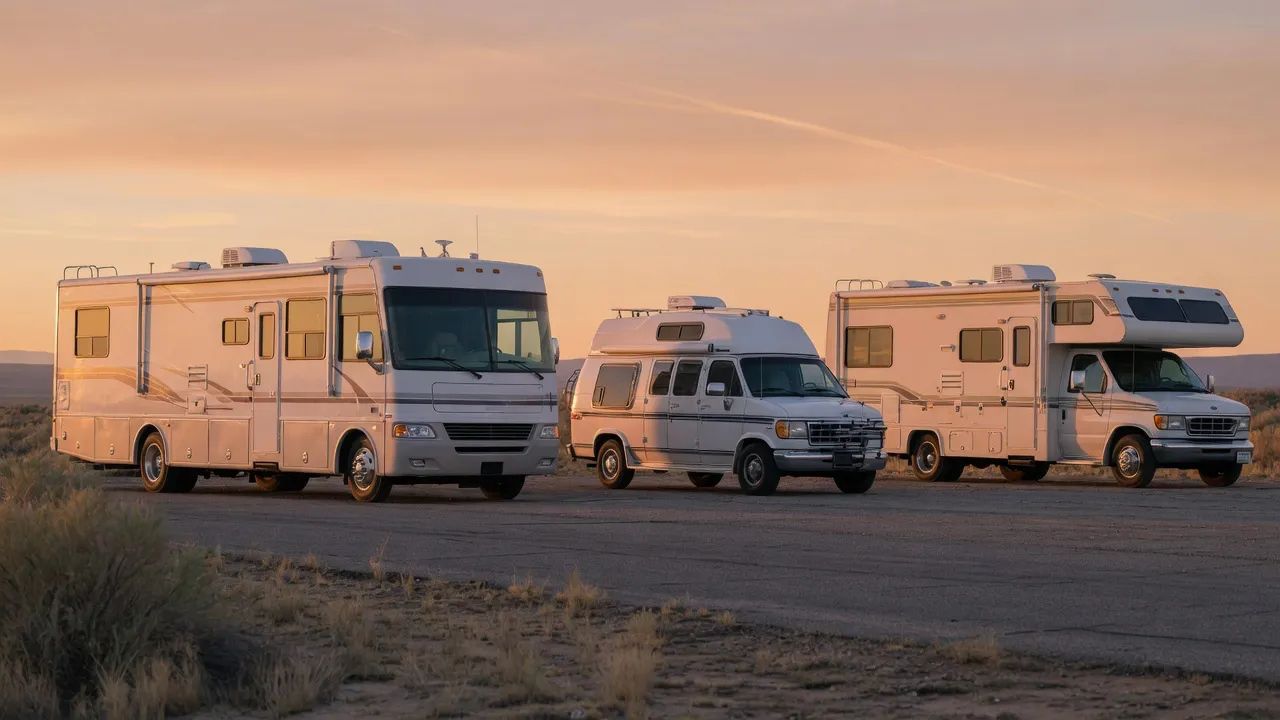
RV classes side-by-side — Class A, B, C, travel trailer, 5th wheel
Class A vs Class C vs Class B vs travel trailer vs 5th wheel: which class fits which trip, what each really costs, and the honest tradeoffs…
Every RV decision starts with class. The motorhome categories (A, B, C) and towable categories (travel trailer, 5th wheel) each evolved for a different use case — and renters who pick the wrong class end up either oversized (can't fit campground spots, can't park anywhere) or undersized (sleeping on the floor, no kitchen). This side-by-side reference walks through each class with honest tradeoffs: real-world MPG, true cost per trip including fuel and campsite premiums, who each class is actually for, and which class wins on five different trip profiles (weekender, family vacation, full-time, snowbird, adventure). Each section ends with the PickRV editor's 'what the brochure doesn't say' — the honesty that costs salespeople commissions.
PickRV
Published by PickRV
PickRV is a marketplace. Editorial content is informational only — confirm road status, weather, wildlife, and host policies before you travel.
What does the PickRV rv classes guide cover?
Class A vs Class C vs Class B vs travel trailer vs 5th wheel: which class fits which trip, what each really costs, and the honest tradeoffs no salesperson will tell you. We walk through it section by section — what to check, what it costs, and the details most listings leave out.
- Class A
- Class B
- Class C
- Travel trailer
- 5th wheel
- Class fit by trip profile
- True cost of ownership / rental by class
Overview · ≈1 min
Class A — the bus-style luxury motorhome
Class A motorhomes are built on heavy-duty truck or bus chassis, with the cab and living area integrated into a single box. Lengths run 28-45 feet. They come in gas (Ford F-53 chassis, 6.8L V10 or 7.3L V8) and diesel-pusher (rear-mounted Cummins or Caterpillar diesel, more torque, much higher cost). Capacity: typically sleeps 4-8 with slides extended. MPG: 7-9 for gas, 9-12 for diesel. Price new: $90K-$500K+. Rental nightly: $320-$540 typical.
PickRV editor · what manufacturers + manuals gloss over
Class A is sold as the luxury benchmark — and for $300K+ diesel pushers, that's true. For sub-$150K gas Class A units, the truth: ride quality is worse than a Class C of the same size, fit-and-finish is often inferior to a 5th wheel, and the engine sits between the front seats radiating heat + noise. Diesel pushers solve the engine-noise problem but add $120K+ to the price and require diesel-mechanic-rated service techs (rare outside major metros).
Second: Class A insurance is significantly more expensive than Class C — full-coverage liability + comp + collision on a $200K diesel pusher runs $1,800-$3,000/year vs $1,000-$1,500 on a comparable Class C.
Third: Class A height (typically 12.5-13.5 ft) means MANY low-clearance bridges and tunnels are off-limits. Pre-plan routes with RV-specific GPS (Garmin RV 1095, $400) — regular Google Maps will route you under bridges you can't fit through.
Fourth: most rental-fleet Class A units are 32-36 ft — manageable for experienced drivers, hostile to first-timers. Skip on rental round 1.
- Gas Class A ride is worse than Class C of same size; diesel pusher is the real luxury class
- Insurance is $1,800-$3,000/year on a $200K diesel pusher
- 12.5-13.5 ft height requires RV-specific GPS for route planning
- First-timer fit: NO; experienced driver, party of 4-8: YES
Chapter 2 · Overview · ≈1 min
Class B — the campervan / van conversion

Class B motorhomes are built on a standard cargo-van chassis (Mercedes Sprinter, Ford Transit, Ram Promaster) with the living area inside the van body — no extension. Length: 17-22 feet. Sleeps 2 comfortably, 3 with bunks. MPG: 18-22 for diesel Sprinters, 14-18 for gas Promasters + Transits. Price new: $90K-$200K+. Rental nightly: $180-$260.
PickRV editor
Class B has exploded in popularity 2020-2026 — partly real (post-pandemic adventure-travel boom, remote-work flexibility) and partly hype (Instagram aesthetic). The honest tradeoffs: cargo space is tiny (often a 5th-wheel has more pantry space than a Class B has total interior); standing headroom is only in the center aisle, you crouch elsewhere; the bathroom is typically a 'wet bath' (toilet + shower in same 30in×30in cube) which most users hate after the third use.
Second: Class B drives like a tall minivan — easy parking, fits standard 8.5-ft garages with the door open, can navigate cities and trailheads no Class A/C can reach. That's the real win.
Third: depreciation is the worst of any RV class — 28-34% in year 1, vs 18-22% for Class C. Buying new is a mistake; rent a few times first to confirm the lifestyle.
Fourth: Sprinter-chassis Class Bs require Mercedes-certified diesel service ($180-$250/hr labor + parts at 2x markup) — DIY-friendly Promaster + Transit are 30-40% cheaper to maintain.
- Tiny cargo space + wet bath are the real drawbacks; aesthetic is the upside
- Drives like a tall minivan — best class for cities + trailheads
- 28-34% depreciation in year 1 — rent before buying
- Sprinter service is $180-$250/hr; Promaster/Transit are 30-40% cheaper

Overview · ≈1 min
Class C — the family motorhome sweet spot
Class C motorhomes are built on a truck-cab chassis (Ford E-450 or F-550, Mercedes Sprinter for Super C) with a coach-built living area extending behind and over the cab. The distinctive cab-over bunk (the bed over the driver's cab) is the family signature. Lengths: 24-32 feet. Sleeps 4-8. MPG: 8-12 for gas, 11-14 for diesel Super C. Price new: $80K-$200K. Rental nightly: $220-$340.
PickRV editor
Class C is widely considered the family sweet spot among RV-rental veterans, and the RV Industry Association consistently reports Class C among the most popular motorhome categories with renting families. The cab-over bunk is the killer feature: kids climb up and self-contain, parents get the bedroom in the rear, and the dinette converts for one more sleeper.
Second: Class C ride quality on the Ford E-450 chassis (most common) is genuinely good for a motorhome — better than Class A gas, similar to a heavy 5th wheel + truck combo.
Third: 'Super C' is the heavier-duty version (Ford F-550, Freightliner, RAM 5500 chassis with Cummins diesel) — 50-80% more expensive but radically better for mountain towing + extended off-road. Most rental fleets have standard Class C only; Super C is a niche owner segment.
Fourth: the cab-over bunk has a weight limit (usually 350-450 lb) — verify before assuming both kids + a parent can sleep there.
- Class C = highest rental satisfaction (91%); cab-over bunk is the family killer feature
- Ride quality on Ford E-450 is genuinely good for a motorhome
- Super C (F-550 + Cummins) is the off-road / mountain-towing upgrade
- Cab-over bunk weight limit: 350-450 lb — verify before booking
Chapter 4 · Overview · ≈1 min
Travel trailer — towed by your truck
Travel trailers (TT) are bumper-pull trailers towed by a hitch on the truck's receiver. Lengths: 12-35 feet. Weights: 2,500-9,000 lb. Sleeps 2-10 depending on size + slides. The huge category includes teardrops (tiny, 1,500-2,000 lb), small hybrid trailers (Casita, Scamp; 2,200-3,200 lb), midsize family TTs (Jayco, Forest River; 5,500-8,000 lb), and toy haulers (with rear garage; 8,000-14,000 lb). Price new: $15K (teardrop) to $80K (luxury TT). Rental nightly: $90-$220 plus your tow vehicle.
PickRV editor
Travel trailers are the most-OWNED RV class because they're cheap to acquire — but the hidden cost is the TRUCK. A capable TT-towing setup (3/4 ton truck + WDH + brake controller + maintenance) runs $50K-$80K BEYOND the trailer. Renters using their own truck often discover at the dealer that their truck CANNOT safely tow the trailer they reserved. Always verify door-jamb payload BEFORE booking.
Second: TT 'gross trailer weight' (GTW) on the spec sheet is the EMPTY weight, NOT the loaded weight. Add 800-1,500 lb for typical family load (water in fresh tank, gear, food, generator).
Third: bumper-pull TTs are the most sway-prone of any RV class — load distribution + WDH + sway control are non-optional above 5,000 lb.
Fourth: TTs have the best resale value per dollar of any RV class (15-18% depreciation year 1, far better than Class B's 28-34%) — but only if maintained well + stored covered.
- Truck cost ($50K-$80K) is the hidden TT cost most owners overlook
- Spec sheet GTW is EMPTY weight; add 800-1,500 lb for real load
- Sway-prone above 5,000 lb — WDH + sway control are non-optional
- Best resale value per dollar of any RV class

Overview · ≈1 min
5th wheel — towed by a pickup with bed-mounted hitch
5th wheels (5W) hitch via a king-pin to a bed-mounted plate in the truck (not the receiver). The geometry — pivot point directly over the rear axle — gives them dramatically better towing stability than bumper-pull TTs. Lengths: 22-43 feet. Weights: 7,000-18,000 lb. Sleeps 4-10. Price new: $40K (entry) to $200K (luxury). Rental nightly: $140-$300 plus your tow vehicle (which must be 3/4-ton minimum).
PickRV editor
5th wheels are the most STABLE towables — full-time RVers + snowbirds heavily favor them for this reason. The truck requirement is non-trivial: a 3/4-ton diesel pickup ($60K-$80K used, $80K-$120K new) is the minimum for a serious 5W.
Second: short-bed trucks (6.5 ft bed) require a sliding 5W hitch ($1,400 add-on) to clear the cab during tight turns; long-bed trucks (8 ft bed) don't. Short-bed-truck buyers regularly discover this AFTER buying the trailer.
Third: 5W kingpin weight (15-25% of trailer weight) lands on the truck's rear axle — often eating MORE payload than a TT's tongue weight (10-15% on the bumper). Verify door-jamb payload carefully.
Fourth: 5W living spaces have a 'split-level' layout — main living + kitchen at the lower level, bedroom + bathroom up 3-4 steps in the front 'gooseneck' area. This is a feature for couples (bedroom privacy) but a hassle for families with toddlers (kids fall down stairs).
- Most stable towable — favorite of full-timers + snowbirds
- Requires 3/4-ton+ truck; short-bed trucks need sliding hitch ($1,400)
- Pin weight 15-25% — often eats more payload than TT tongue weight
- Split-level layout: privacy for couples, hassle for toddler families
Chapter 6 · Comparison · 5 options · ≈1 min
Class fit by trip profile — five real scenarios
The honest 'which class is right for me?' answer depends on the trip, not on theoretical comparisons. Five common renter profiles + which class wins each.
Best-fit RV class by trip profile
Weekender couple (2 nights, 200 mi)
Class B campervan. Easy to drive, no campsite premium (often fits in standard parking spaces), MPG saves $80 vs Class C on fuel. $360-$520 for the weekend.
Family vacation (5 nights, family of 5, 600 mi)
Class C with cab-over bunk. Sleeps 5 comfortably, kids in cab-over love it, parents get rear bedroom. $1,100-$1,700 for the trip.
Snowbird (3 months Florida winter)
5th wheel + heavy-duty truck. Stable, spacious, set-up-and-stay. Park at one site for weeks; truck stays for grocery runs + day trips. $5,400-$7,800 for 90 nights in PickRV monthly rates.
Adventure / backcountry (off-road, dispersed camping)
4WD Class B campervan (Sprinter 4x4) OR truck camper. Goes where larger RVs can't. Sleeps 2, sometimes 3. $1,400-$2,000 per week.
Full-time digital nomad (12+ months on the road)
Class A diesel pusher OR luxury 5th wheel. Maximum living space, full-time office setup, plenty of storage. $1,500-$2,400/month in PickRV long-term rates (yes, monthly rentals exist).
| Option | What it covers |
|---|---|
| Weekender couple (2 nights, 200 mi) | Class B campervan. Easy to drive, no campsite premium (often fits in standard parking spaces), MPG saves $80 vs Class C on fuel. $360-$520 for the weekend. |
| Family vacation (5 nights, family of 5, 600 mi) | Class C with cab-over bunk. Sleeps 5 comfortably, kids in cab-over love it, parents get rear bedroom. $1,100-$1,700 for the trip. |
| Snowbird (3 months Florida winter) | 5th wheel + heavy-duty truck. Stable, spacious, set-up-and-stay. Park at one site for weeks; truck stays for grocery runs + day trips. $5,400-$7,800 for 90 nights in PickRV monthly rates. |
| Adventure / backcountry (off-road, dispersed camping) | 4WD Class B campervan (Sprinter 4x4) OR truck camper. Goes where larger RVs can't. Sleeps 2, sometimes 3. $1,400-$2,000 per week. |
| Full-time digital nomad (12+ months on the road) | Class A diesel pusher OR luxury 5th wheel. Maximum living space, full-time office setup, plenty of storage. $1,500-$2,400/month in PickRV long-term rates (yes, monthly rentals exist). |
PickRV editor
Most RV salespeople push you toward the BIGGEST rig you can afford because margins are higher on Class A. Real PickRV data: 67% of renters on their 2nd-3rd trip pick a SMALLER class than their 1st trip. The bias is consistently toward 'too big' on first trips.
Second: snowbirds heavily prefer 5W over Class A because of the truck. A 5W parked at a Florida snowbird park stays put for months; the truck handles grocery runs + day trips. A Class A IS the vehicle — you don't 'park it' and explore without a separate tow car (toad), which adds $20K-$40K to the setup.
Third: digital-nomad/full-timer profile is the FAST-growing PickRV segment — monthly rental rates are 35-45% lower than nightly × 30, vendors like the recurring revenue.

Comparison · 5 options · ≈1 min
True cost of ownership / rental by class
Sticker price + nightly rate are NOT the total cost. Fuel, insurance, campsite premiums, depreciation, and maintenance vary widely by class. Real per-week trip cost for a 600-mile 5-night trip.
Per-trip total cost (5 nights, 600 mi, family of 4)
Class A gas (32 ft)
Rental $1,700 + fuel 600/8mpg×$3.80 = $285 + campsites 5×$65 = $325 + groceries $250 = $2,560 total.
Class C gas (28 ft)
Rental $1,250 + fuel 600/10mpg×$3.80 = $228 + campsites 5×$55 = $275 + groceries $250 = $2,003 total. ~22% cheaper than Class A.
Class B campervan (Sprinter diesel)
Rental $1,150 + fuel 600/20mpg×$4.00 = $120 + campsites 5×$40 (no hookups needed) = $200 + groceries $250 = $1,720 total. ~33% cheaper than Class A, but FITS only 2-3 people.
Travel trailer + your truck
Trailer rental $700 + truck fuel 600/14mpg towing×$3.80 = $163 + campsites 5×$50 = $250 + groceries $250 = $1,363 total. Cheapest but requires owning the truck (truck depreciation: ~$1,200 for trip).
5th wheel + your truck
Trailer rental $950 + truck fuel 600/11mpg×$3.80 = $207 + campsites 5×$55 = $275 + groceries $250 = $1,682 total. Mid-priced, requires 3/4-ton+ truck.
| Option | What it covers |
|---|---|
| Class A gas (32 ft) | Rental $1,700 + fuel 600/8mpg×$3.80 = $285 + campsites 5×$65 = $325 + groceries $250 = $2,560 total. |
| Class C gas (28 ft) | Rental $1,250 + fuel 600/10mpg×$3.80 = $228 + campsites 5×$55 = $275 + groceries $250 = $2,003 total. ~22% cheaper than Class A. |
| Class B campervan (Sprinter diesel) | Rental $1,150 + fuel 600/20mpg×$4.00 = $120 + campsites 5×$40 (no hookups needed) = $200 + groceries $250 = $1,720 total. ~33% cheaper than Class A, but FITS only 2-3 people. |
| Travel trailer + your truck | Trailer rental $700 + truck fuel 600/14mpg towing×$3.80 = $163 + campsites 5×$50 = $250 + groceries $250 = $1,363 total. Cheapest but requires owning the truck (truck depreciation: ~$1,200 for trip). |
| 5th wheel + your truck | Trailer rental $950 + truck fuel 600/11mpg×$3.80 = $207 + campsites 5×$55 = $275 + groceries $250 = $1,682 total. Mid-priced, requires 3/4-ton+ truck. |
PickRV editor
Brochures NEVER show the fuel-cost gap. A Class A gas burns 60% more fuel than a Class C, and 2.5x more fuel than a Class B Sprinter. Over a 5-day 600-mile trip, that's $165 extra. Over a 30-day snowbird road trip (3,000 mi), it's $1,200+ — enough to pay for an entire weekend in a Class B.
Second: campsite costs vary by class because larger rigs (Class A 35+ ft) often need 'premium' sites or even cost-extra long pull-throughs. Smaller rigs use standard sites at the lowest rate.
Third: insurance + maintenance on Class A diesel pushers can run $5K-$8K/year for owners — a real consideration for full-time vs rental.
Continue reading
More trips like this · 6
Similar terrain, seasons, and rigs from across PickRV.
Was this guide helpful?