PickRV Mega Guide
RV towing explained — payload vs tow capacity, hitch types, and what your salesperson won't say
Towing capacity is the marketing number; payload is the killer. Plus hitch class, sway control, brake controllers — the real rules of safe…
Of all the ways new RVers get hurt — financially, legally, or literally — overloaded towing tops the list. Manufacturer brochures publish 'tow capacity' numbers that are technically true under ideal conditions (driver only, no fuel, no passengers, no cargo, factory hitch, level road). The number that ACTUALLY matters — payload — is buried on the truck's door-jamb sticker and reduces with every option you check. This guide walks through the math, the hitch system layers (receiver class, weight-distribution, sway control, fifth-wheel pucks), the brake controller rule (every state requires it for trailers over 3,000 lbs but enforcement varies), and the safety physics that determine whether your rig survives a 70mph crosswind.
PickRV
Published by PickRV
PickRV is a marketplace. Editorial content is informational only — confirm road status, weather, wildlife, and host policies before you travel.
What does the PickRV rv towing guide cover?
Towing capacity is the marketing number; payload is the killer. Plus hitch class, sway control, brake controllers — the real rules of safe RV towing. We walk through it section by section — what to check, what it costs, and the details most listings leave out.
- Tow capacity vs payload
- Hitch classes I-V
- Brake controllers
- Sway control
- 5th wheel hitching
- Legalities
- The 7 most expensive towing mistakes

Overview · ≈1 min
Tow capacity vs payload — the gap that kills tow-vehicle math
Tow capacity is the maximum WEIGHT the truck can tow (trailer + everything in it). Payload is the maximum WEIGHT the truck itself can carry (passengers + cargo + trailer tongue/pin weight). For travel trailers, tongue weight is typically 10-15% of trailer weight; for 5th wheels, pin weight is 15-25% of trailer weight. That weight sits on the truck's rear axle and EATS your payload before you put a single suitcase in. A Ford F-150 rated for 13,000 lb tow but only 1,800 lb payload can MAYBE pull a 9,000 lb 5th wheel (pin weight ~1,800 lb) — but with passengers in the truck, you're over.
PickRV editor · what manufacturers + manuals gloss over
Salespeople quote tow capacity to close deals. The math they hide: factory tow capacity assumes a 150-lb driver, no passengers, no cargo, no aftermarket accessories. Every 100 lbs you add to the truck SUBTRACTS from your effective tow capacity at the same payload ceiling. A real-world F-150 with a 220-lb driver, 180-lb spouse, 80-lb dog, 200-lb of gear, and a 60-lb hitch starts with 720 lb already used against the 1,800 lb payload — leaving 1,080 lb for trailer pin/tongue. That translates to maybe 7,200-8,500 lb of trailer (not the 13,000 lb the brochure promised).
Second: 'tow capacity' is a SAE J2807 standard since 2013 — newer trucks have real, comparable numbers. Pre-2013 trucks used manufacturer-specific tests, often inflated.
Third: heavier-duty trucks (3500/F-350) have BOTH higher payload AND higher tow capacity, so the gap matters less — but they cost $15-30K more than half-ton trucks. Buy your truck FOR the trailer; do not retroactively justify your truck.
- Payload is the BINDING constraint for towables; check door-jamb sticker
- Tongue weight (TT) = 10-15% of trailer; pin weight (5W) = 15-25%
- Every 100 lbs added to truck SUBTRACTS from effective tow capacity
- Half-ton trucks rarely safely tow 5th wheels — go 3/4-ton or larger
Chapter 2 · Comparison · 5 options · ≈1 min
Hitch classes I-V — what each can pull

Receiver hitches on trucks/SUVs are rated by class (I-V), each with a max gross-trailer-weight (GTW) and max tongue-weight (TW). Higher class = bigger receiver tube + stronger mount. Check the rating on the hitch itself (stamped on the receiver), NOT just the vehicle's tow capacity — they should match, but aftermarket installations sometimes use lower-class receivers than the vehicle would support.
Receiver hitch class capacity (GTW / TW max)
Class I (1.25" receiver)
Up to 2,000 lb GTW / 200 lb TW. Bike racks, cargo carriers, very small utility trailers. NOT for RVs.
Class II (1.25" receiver)
Up to 3,500 lb GTW / 350 lb TW. Small pop-ups, teardrops, small TT. Most small SUVs.
Class III (2" receiver)
Up to 8,000 lb GTW / 800 lb TW. Mid-size TT, mid-size SUVs (Tahoe, Explorer). Add WDH at 5,000+ lb.
Class IV (2" or 2.5" receiver)
Up to 12,000 lb GTW / 1,200 lb TW. Half-ton trucks (F-150, Silverado 1500). Large TT, small 5W with proper truck.
Class V (2.5" receiver)
Up to 20,000+ lb GTW / 2,700 lb TW. HD trucks (F-250+, Ram 2500+). Real 5th wheel + gooseneck territory.
| Option | What it covers |
|---|---|
| Class I (1.25" receiver) | Up to 2,000 lb GTW / 200 lb TW. Bike racks, cargo carriers, very small utility trailers. NOT for RVs. |
| Class II (1.25" receiver) | Up to 3,500 lb GTW / 350 lb TW. Small pop-ups, teardrops, small TT. Most small SUVs. |
| Class III (2" receiver) | Up to 8,000 lb GTW / 800 lb TW. Mid-size TT, mid-size SUVs (Tahoe, Explorer). Add WDH at 5,000+ lb. |
| Class IV (2" or 2.5" receiver) | Up to 12,000 lb GTW / 1,200 lb TW. Half-ton trucks (F-150, Silverado 1500). Large TT, small 5W with proper truck. |
| Class V (2.5" receiver) | Up to 20,000+ lb GTW / 2,700 lb TW. HD trucks (F-250+, Ram 2500+). Real 5th wheel + gooseneck territory. |
PickRV editor
Buyers buy by 'tow capacity' but forget hitch class. A Class III receiver on a 2018 F-150 maxes at 8,000 lb even if the truck is RATED for 13,000 — you can't legally tow above the WEAKEST LINK. Verify the receiver stamping.
Second: 5th wheel + gooseneck hitches are SEPARATE systems, mounted in the truck bed (not the receiver). A truck rated for 5th wheel might not have the bed-rail puck system — adding it costs $1,200-$2,500 + install.
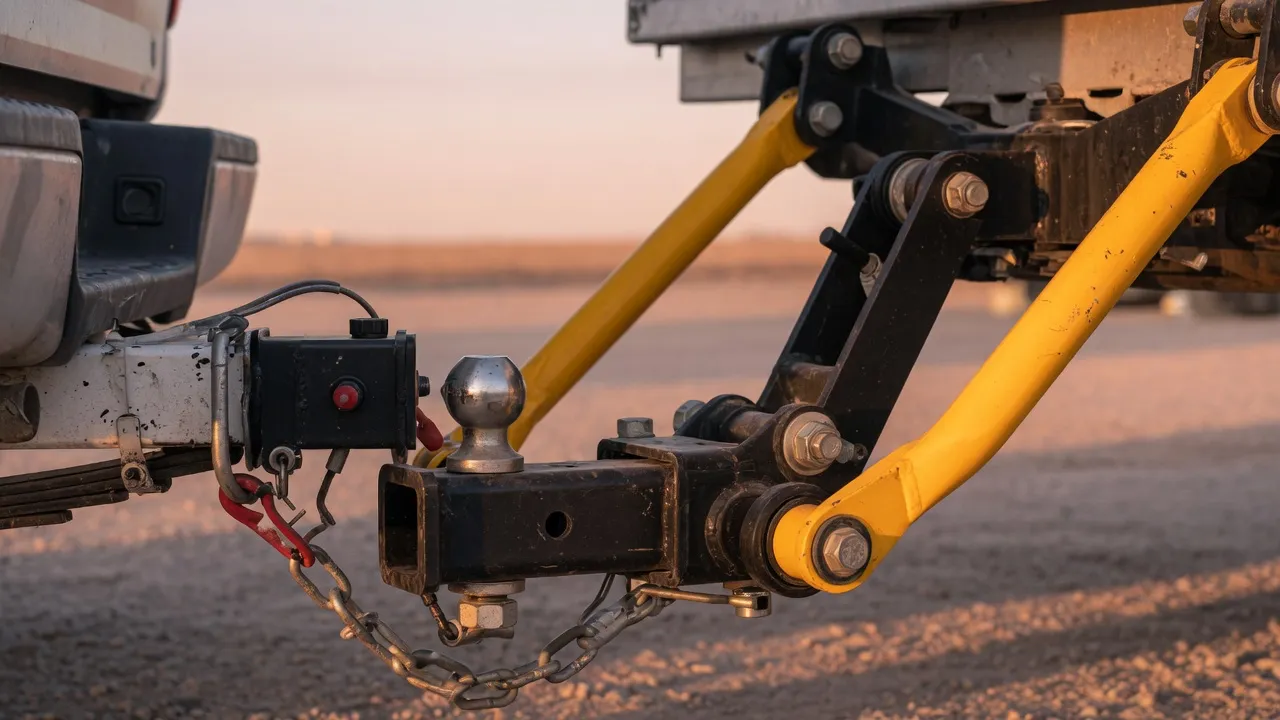
Third: weight-distribution hitches (WDH) — required for most trailers over 5,000 lb — physically REDISTRIBUTE 10-30% of tongue weight to the trailer axles via spring bars. They DO NOT add capacity; they EQUALIZE existing capacity.

How-to · 5 steps · ≈2 min
Brake controllers — required by law over 3,000 lbs
Electric trailer brakes are required by every US state for trailers over a certain weight (most states: 3,000 lbs gross; some: 1,500 lbs). The controller mounts in the truck cab and tells the trailer brakes when to engage based on truck brake pedal pressure. Without a controller, your trailer's electric brakes do nothing — your truck brakes alone try to stop both vehicles, with predictable consequences.
- 1
Verify your truck has brake-controller wiring
Most trucks 2010+ have a factory tow-prep package with brake-controller pre-wire. The plug is usually under the driver's-side dash. If yes, installation is $40 part + 10 min. If no, you need $200-$400 of wiring.
- 2
Pick proportional, not time-delay
Proportional controllers (Tekonsha P3, $130) sense truck deceleration and apply trailer brakes proportionally. Time-delay controllers (cheap $30 units) just ramp up trailer brakes over a fixed time after pedal press — works but is jerkier and harder to dial in.
- 3
Adjust gain on a flat, empty parking lot
Hitch up, drive to 25 mph, manually apply trailer brakes (controller has a slider). If trailer locks up, gain is too high. If trailer drags forward, gain is too low. Target: just enough to feel trailer pulling truck back at hard brake.
- 4
Re-adjust when load changes
Empty 5th wheel + full 5th wheel need different gain settings. Most controllers have a save function for 2-3 presets.
- 5
Test before every long trip
Use the manual override (slider) to verify trailer brakes engage. Burned-out brake magnets are common after 30K+ miles.
PickRV editor
Salespeople don't volunteer that the FACTORY brake-controller mount in newer trucks is often a JUNK module that lasts 30K miles before failing. The $130 Tekonsha P3 aftermarket is more reliable + adjustable. Second non-obvious: trailer brake magnets wear at ~50K miles, often without warning — testing manually before every trip catches half-dead brakes before they kill you on a grade.
Third: state laws vary — some states (FL, TX) require brakes on ALL trailers over 3,000 lb regardless of length; others (CA) require brakes on any trailer that brings the COMBINED weight above 6,000 lb. Cross-state trips can put you out of compliance unknowingly.
- Required by all US states for trailers above ~3,000 lb (verify your state)
- Proportional > time-delay; Tekonsha P3 ($130) is the standard
- Re-adjust gain when load changes; test before every trip
Chapter 4 · Overview · ≈1 min
Sway control — physics of high-speed instability
Trailer sway is when the trailer oscillates side-to-side at speed, sometimes uncontrollably. Causes: passing semi-trucks (pressure waves), crosswinds, downhill grades, mis-loaded trailers (cargo behind axles), under-inflated tires. Above 65 mph, sway can rapidly escalate to a jackknife — trailer pushes truck off the road. Sway control devices (friction, dual-cam, anti-sway WDH) dampen lateral movement by adding resistance to the hitch joint.
PickRV editor
Manufacturer brochures show beautiful trucks pulling beautiful trailers — never the YouTube videos of sway-induced jackknifes. The single biggest sway risk is LOAD DISTRIBUTION. The rule: 60% of cargo weight forward of trailer axle (toward truck), 40% behind. Anything heavy behind the axle (tool cabinets, motorcycles in toy hauler) AMPLIFIES sway. Second non-obvious: tongue weight ratio matters even more than total weight. Below 10% tongue weight (e.g. 600-lb tongue on a 7,000-lb trailer is 8.5% — too low), sway is nearly guaranteed at speed. Add weight to the front of the trailer (or rearrange) to get to 12-15%.
Third: WDH with built-in sway control (Reese Strait-Line, $700-$1,000) is the modern best-practice for any TT over 5,000 lb.
- Sway = lateral oscillation; jackknife at 65+ mph is the worst case
- Load 60% forward of trailer axle, 40% behind; tongue weight 12-15%
- WDH with sway control = standard for TT >5,000 lb

How-to · 5 steps · ≈2 min
5th wheel hitching — the truck-bed-mounted alternative
5th wheel hitches mount in the truck BED (not the receiver) using bed-rail brackets or 'gooseneck-style' puck systems. The hitch pivots like the kingpin on a semi-tractor, distributing tongue weight directly over the truck's rear axle (not behind it). This geometry is far more stable than bumper-pull travel trailers, allowing 5th wheels to scale to 35-45 feet without sway problems — at the cost of needing a pickup truck with bed access.
- 1
Verify truck has bed-rail prep or puck system
Most 2017+ 3/4-ton + 1-ton trucks have factory pucks (4 mounting holes in the bed). Older trucks need bed-rail brackets ($400-$800) or a 'rail kit' to mount the hitch.
- 2
Install the hitch (one-time setup)
Drop the hitch base into the bed-rail brackets or puck system. Most modern hitches release with a single lever for removal — useful when you want the bed empty.
- 3
Back the truck under the 5th wheel kingpin
Open the hitch jaws (squeeze the handle), lower the trailer onto the hitch so the kingpin slides into the jaws. Pull forward gently to test latch. Set the safety pin.
- 4
Connect the cord + brake lines
7-pin trailer connector for lights + brakes. Verify all running lights, turn signals, brake lights, and trailer brakes work before driving off.
- 5
Test for hitch slop on a slow start
Drive 10 feet forward, brake gently. You should feel solid coupling. Any clunk or excessive play means the jaws aren't fully latched.
PickRV editor
Buyers obsess over the hitch BRAND (B&W Companion vs Reese Goosebox vs Andersen Ultimate). Truth: B&W is the gold standard for under-bed installs ($1,100). Andersen is a lightweight aluminum alternative ($900) — popular with snowbird couples. Reese is the budget option at $700 but parts are harder to find.
Second: 'short-bed' trucks (6.5 ft bed) need a SLIDING 5th wheel hitch ($1,400+) to clear the cab during tight turns. Long-bed trucks (8 ft bed) don't need a slider. Pre-buy decision matters — converting a short-bed truck to handle a 5th wheel adds $400-$1,500 over the long-bed option.
Third: payload math for 5th wheels is even tighter than for TT — a 14,000-lb 5W has 2,500-lb of pin weight, often over half-ton truck payload before you put a single passenger in.
Chapter 6 · FAQ · 4 questions · ≈1 min
Legalities — state-by-state quirks
Towing laws vary by state in ways that catch out-of-state RVers off guard. Length limits, speed limits, passenger restrictions — verify before each trip.
Can passengers ride in a 5th wheel or travel trailer while it's being towed?
Depends on the state. CA, AZ, NV, NM, OK, KS, MN, ND, SD allow it (with seatbelts where available). TX, FL, NY, NJ, MA, PA, OH, MI, IL prohibit it. Always check before allowing kids in the trailer mid-drive.
What's the maximum trailer length I can tow?
Most states cap combined truck+trailer at 65 ft. CA and a few others cap at 65 ft total. FL, TX cap at 75 ft. National parks have their own road-by-road caps (Going-to-the-Sun in Glacier is 21 ft; Tioga in Yosemite is 35 ft).
Do I need a special license to tow a large RV?
Federal CDL is required only for commercial use over 26,000 lb gross combined weight. Personal RV use is exempt in most states, but CA, NV, HI, MI, WI, WY, KS, IL, NC, NM, NY, PA require a special non-commercial 'Class B' or 'Recreational' license for combined weights over 26,000 lb. Check your state DMV.
What about speed limits when towing?
Most states use the regular speed limit. CA, OR, MT, ID limit trucks-with-trailers to 55 mph regardless of posted limit. Always check signs at state lines.
PickRV editor
Third-party roadside and RV-club sites have varying-quality state-by-state matrices. Cross-reference your destination state's DOT website.
Second: insurance also varies — some states (CA, MA, NY) require your liability to cover the trailer; others (FL, TX) let the trailer ride on the truck's policy passively. Verify before a trip with your specific carrier — getting in an out-of-state accident with the wrong coverage is the #1 way to lose your house.

Overview · ≈1 min
The 7 most expensive towing mistakes
Pulled from real PickRV vendor incident reports + RVer field-data: the towing screwups that cost real money + real injuries. Most are preventable with 30 minutes of pre-trip math.
PickRV editor
Mistake #1: Buying the trailer before the truck. Always specify the trailer first, then size truck to fit it. Many couples buy a $40K travel trailer thinking their existing F-150 will pull it, only to discover they need a $60K F-250 first. Mistake #2: Trusting brochure tow capacity. ALWAYS check door-jamb payload. Mistake #3: Skimping on the hitch. A $300 generic hitch on a $50K rig is the worst $300 you'll ever save — until it shears mid-grade. Mistake #4: Ignoring tongue/pin weight at loading. Stuff the front of the trailer with heavy gear; never load behind the axles. Mistake #5: Skipping the brake-controller adjust. The factory default is rarely right for your specific trailer. Mistake #6: Driving 70+ mph with a TT. The wind drag on a flat-front box-shape trailer doubles at 75 mph vs 60 mph — fuel economy halves AND sway risk doubles. Mistake #7: Forgetting to retighten lug nuts at 50 mi. Trailer wheels can shift after first heat cycle — re-torque after the first 50 mi, then 500 mi, then every 1,000 mi.
- Buy truck FOR the trailer, never retrofit
- Tongue/pin weight: 10-15% TT / 15-25% 5W is the safe range
- Hitch spend is not where to economize
- Retorque lug nuts at 50/500/1000 mi after install
Continue reading
More trips like this · 6
Similar terrain, seasons, and rigs from across PickRV.
Was this guide helpful?