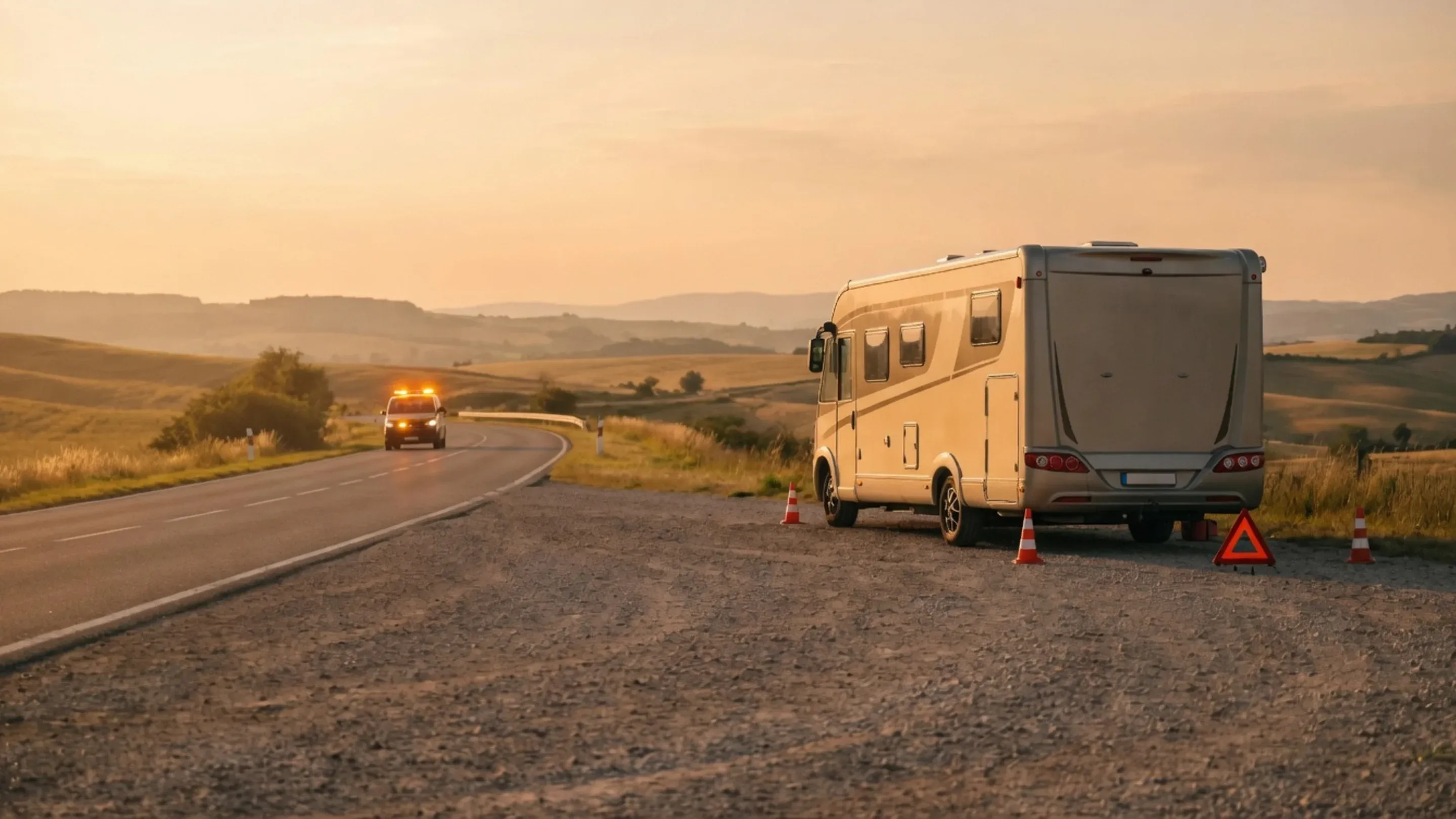
Coverage types decoded
Diminished Value — When Your Rental's Repair Doesn't Restore Its Worth
Educational only · not insurance advice. PickRV is not an insurance broker, agent, producer, or carrier. Coverage varies by carrier and policy. Verify any decision with a licensed insurance professional in your state.
TL;DR
Diminished value (DV) is the loss in market resale price a repaired vehicle suffers compared to an undamaged counterpart, even after a flawless repair. It is most relevant for hosts when a renter damages a high-value rig; it is potentially recoverable from the at-fault party's liability carrier or the renter, depending on state law and contract terms.

The boundary
Where this coverage stops

Covered
4- The difference between the pre-loss market value and the post-repair market value, when proven by qualified appraisal.
- In some states, recovery from the at-fault driver's liability insurer (third-party DV).
- In rare cases, recovery from your own collision policy (first-party DV — most carriers exclude this).
- Documented hits on Carfax / AutoCheck that depress resale by quantifiable amounts.
Not covered
5- Sentimental value or inconvenience.
- Loss in value from cosmetic wear or pre-existing damage.
- First-party diminished value in states where it is excluded from collision policies (most states).
- DV claims unsupported by qualified appraisal.
- DV when the rig had pre-existing structural damage.
In practice
Real-world examples

Anonymized composite scenarios illustrating typical outcomes.
Host recovered $7,200 DV from at-fault driver in Georgia
A renter on a host's $185,000 Class A was hit by an at-fault driver merging without signal. Repair was $14,000 (fully covered by the at-fault driver's liability). The host engaged a certified DV appraiser, who calculated the post-repair resale loss at $7,200 (4% of pre-loss value, typical for high-end Class A with a body-shop record). Georgia recognizes third-party diminished value; the at-fault carrier paid the DV claim after a 60-day appraisal review.
Outcome: Host recovered $14,000 repair + $7,200 DV = $21,200. Without the DV claim, the host would have absorbed the $7,200 loss into trade-in value years later.
Renter held liable for $4,500 DV under contract clause
A renter's at-fault collision damaged a host's 3-year-old Class C. Repair: $8,300, covered by the host's commercial policy. The host's rental contract included a DV clause that made the renter personally liable for documented diminished value. A certified appraiser found $4,500 in post-repair resale loss. The renter disputed; mediation upheld the contract clause; the renter paid $4,500.
Outcome: Renter total exposure: $4,500. Renters who sign DV-liability clauses without reading them are exposed to this even when CDW pays the repair.
The money
Cost ranges

Industry-typical pricing from published carrier and industry sources. Actual quotes vary by state, vehicle, and driver history.
Industry-typical appraisal outcome; high-end vehicles often skew higher.
Required documentation for any DV claim; cost of the appraisal is recoverable in some states.
Often needed when an at-fault carrier denies the DV portion.
Fine print
What insurance companies don't say

Industry insider knowledge surfaced for educational transparency.
Third-party DV is more recoverable than first-party
Most states allow you to recover DV from the at-fault driver's liability carrier (third-party DV). Most states do NOT allow first-party DV recovery from your own collision policy. Carriers carved out first-party DV in policy language decades ago because the claim is easy to inflate.
Georgia, Texas, and Florida are favorable DV venues
Georgia in particular has well-developed DV case law (the Mabry v. State Farm decision); third-party DV claims are routinely paid. Texas and Florida also recognize DV but with stricter appraisal requirements. Most other states allow DV in principle but require strong appraisal documentation.
Carfax / AutoCheck records drive DV — keep the chain clean
Every body-shop visit triggers a Carfax record. A clean Carfax is worth real money at resale. If a repair is minor (paint scuff, plastic trim), some renters / hosts negotiate cash settlement directly with the at-fault party to avoid a body-shop record — that practice has its own legal and ethical implications, but it explains why some incidents never surface as claims.
By state
State variations

GAGeorgia
Georgia recognizes third-party DV per Mabry v. State Farm and case-law successors.
TXTexas
Texas allows DV with qualified appraisal under Texas Civil Practice & Remedies Code.
FLFlorida
Florida recognizes DV but requires strong appraisal foundation; FL Statute §624.155.
MIMichigan
Michigan no-fault regime limits DV recovery; consult specialty attorney.
FAQ

Is diminished value recoverable from my own policy?
Rarely. Most states do not allow first-party DV recovery from your own collision policy. Some states (Georgia notably) do; most states have policy language excluding it.
Can I claim DV against the renter who damaged my RV?
If your rental contract explicitly assigns DV liability to the renter, yes. If the contract is silent, the answer depends on state law — some states recognize a marketplace host's right to DV; others tie it to the at-fault driver's liability carrier.
How do I prove DV?
Hire a certified appraiser. The report should include the pre-loss fair-market value, post-repair fair-market value (factoring the body-shop record), and a defensible methodology. Self-prepared estimates rarely survive carrier review.
What is the typical DV amount?
2%-10% of pre-loss value, with higher-end vehicles and structural damage skewing higher. A $100K rig with a moderate repair commonly shows $3,000-$8,000 in DV.
When is DV not worth pursuing?
When the appraisal cost approaches the claim amount, when the rig is old enough that resale value is minimal, or when the repair is so minor (a panel touch-up) that Carfax does not record it.
When to consult a broker

DV is more of an attorney consultation than a broker question once a loss has occurred. Ask a broker pre-loss about whether your policy excludes first-party DV (most do) and whether your state recognizes third-party DV. After a loss, engage a personal-injury or property-damage attorney with DV-specific experience.
Sources
- [1]III — Collision and Comprehensive Coverage — Collision and comprehensive explainers
- [2]NAIC — Auto Insurance Buyer's Guide — Auto insurance coverage explained
- [3]NAIC — Consumer Insurance Search — Consumer regulator + complaint portal
- [4]Georgia Office of Insurance and Safety Fire Commissioner — Georgia state insurance regulator
- [5]Texas Department of Insurance — Texas state insurance regulator
- [6]Florida Office of Insurance Regulation — Florida state insurance regulator

Nearby & related
Planning a Georgia trip?
Sourced costs, campground directories, and the places worth a detour — the next layer of Georgia trip planning.
- RV rentals in GeorgiaLocal rigs, owner-set prices
- Georgia RV rental costFuel · camping · tax, sourced
- Georgia RV-friendly campgroundsHookups, rig limits, booking tips
- Campervan & van rentals in GeorgiaVan-life routes, rules & rigs
- BLM landsDispersed-camping country
- Historic sitesHistory worth the detour
- Wild & scenic riversFree-flowing river trips
- RV driving & licensingLicenses, lanes & low bridges
Your next step
Now the thing you were going to insure
Coverage only makes sense against a specific rig and a specific week — the deductible on a 30-foot Class C is not the deductible on a towable. Start from what you would actually drive.
What you'll see there
Nothing in Georgia is bookable yet — the search page says so in those words. What it shows instead are labelled sample rigs, so you can see what a listing looks like before there is one to book.
What you'd pay
The complete price sits on every listing, and the exact total is itemized before you pay — nothing appears at the last step.
If plans change
Full rental refund 48h+ before pickup on every booking, in every state.
Tell us when you want to drive Georgia.
Nothing in Georgia is bookable today. Dated requests are what we take to owners, so give us the window you actually want — you get one email the day a rig covers it, and nothing else.