R V = Rental Vehicle · the trucks hub
Truck Rentals — Pickup, Box, Flatbed, Overland
Pickup (F-150, Silverado, Ram, Tundra, Tacoma), box truck (16-26ft non-CDL moving), flatbed (lumber + equipment + contractor), and overland-prep (4Runner TRD Pro, Tacoma TRD Pro, Bronco Wildtrak). 25+ truck-friendly US states. SAE J2807 tow + payload spec on every listing.

Four truck categories
Each hub carries real .gov / SAE / DOT citations, honest pros + cons, and per-state best fits.
pickup
The US pickup truck is the best-selling vehicle category in America — Ford F-Series has been #1 for 47+ consecutive years (Ford internal sales data + IHS Markit). PickRV's pickup catalogue spans light-duty (F-150, Silver...
Explore pickupbox truck
Box trucks (also called cube vans or straight trucks) are 16-26ft enclosed cargo trucks ideal for moving, delivery, and freight. PickRV's box-truck catalogue covers the entire non-CDL range (under 26,000 lbs GVWR per FMC...
Explore box truckflatbed
Flatbed trucks are open-deck commercial trucks for hauling lumber, drywall, steel, machinery, equipment, and oversize cargo that won't fit in a box truck. PickRV's flatbed catalogue spans light-duty stake-bed (12-16ft, F...
Explore flatbedoverland prep
Overland-prep trucks are built-out 4WD rigs with off-road tires, lift kits, recovery gear, rooftop tents or sleeping platforms, and trail-spec components — purpose-built for primitive USFS roads, BLM trails, and remote w...
Explore overland prep25 truck-friendly states
Each state page carries real DMV/DOT/CDL/SAE citations + honest scale framing.
The truck category in depth — tow math, CDL line, state DOT rules
Sourced from SAE J2807, FMCSA 49 CFR 390.5, Ford / GM / Stellantis / Toyota US brand pages, the RVIA Standards Program, and state DOT statutes. Every link goes to a primary source.

Trucks are the working backbone of the US rental marketplace, and PickRV treats them differently from RVs or off-road rigs: every truck listing surfaces the SAE J2807 tow rating, the GVWR (Gross Vehicle Weight Rating), the payload (the difference between GVWR and curb weight), and the GCWR (Gross Combined Weight Rating, which caps truck + trailer together). These four numbers are not interchangeable, and conflating them is the single most common mistake first-time tow renters make. A 2024 Ford F-150 SuperCrew 4x4 with the 3.5L EcoBoost and the Max Tow Package is rated by Ford at 13,500 lb tow capacity (ford.com) — but only with the right hitch class, the right weight-distribution bars, the right wheelbase, and a trailer that does not exceed the GCWR ceiling. A 2024 Ram 1500 with the 5.7L HEMI and a Class IV hitch tops out at 12,750 lb per Stellantis (ramtrucks.com). A 2024 Chevrolet Silverado 1500 with the 6.2L V8 and Max Trailering tops at 13,300 lb per GM (chevrolet.com). PickRV's listing template displays the rated number AND the limiting factor (hitch class, axle ratio, payload), so a renter can verify the rig matches the trailer before booking.
The SAE J2807 standard itself is worth understanding because it changed how OEMs publish tow numbers. Before J2807 (adopted industry-wide between 2013 and 2015), every manufacturer used its own test protocol — a Ford 'maximum tow' number was not directly comparable to a Toyota number. J2807 fixed that: it specifies the exact ramp grades (Davis Dam, AZ, on State Route 68), the exact uphill speed targets, the brake performance, the cooling thresholds, and the cabin air-conditioning load that must be sustained while towing. Every modern Ford, GM, Stellantis, Toyota, and Nissan light-duty truck sold in the US is rated to J2807 (the standard is published by SAE International at sae.org). PickRV uses the J2807 number because it is the only apples-to-apples cross-brand comparison that exists. We do not publish the marketing-headline 'best-in-class tow' number; we publish the J2807 number tied to the actual trim and powertrain of the rented unit.
On the CDL question, FMCSA's federal definition (49 CFR 390.5, ecfr.gov) draws the commercial-vehicle line at 10,001 lb GVWR for interstate commerce, and a CDL is required at 26,001 lb GVWR or for any combination over 26,001 lb GCWR where the trailer alone exceeds 10,000 lb. Translation for renters: every light-duty half-ton pickup (F-150, 1500, Silverado 1500, Tundra, Tacoma) is non-CDL. Every box truck up to and including the 26-foot class is designed to come in under 26,000 lb GVWR so it can be operated on a standard non-commercial license — Penske, Ryder, U-Haul, and Budget all spec their 26-ft cube vans to roughly 25,999 lb GVWR for this exact reason. PickRV's box-truck cohort follows the same convention. A 3/4-ton (250/2500) or 1-ton (350/3500) pickup pulling a heavy gooseneck can cross the CDL line; the listing flags it and lists the towed-trailer GVW ceiling that keeps the renter non-commercial.
Half-ton (1500-series) versus 3/4-ton (2500) versus 1-ton (3500) is the next math layer. A 2024 F-150 SuperCrew payload sits between roughly 1,500 lb and 2,400 lb depending on configuration — the heavy options like a 36-gallon fuel tank and a 4WD transfer case eat into payload, and Ford publishes the as-built sticker inside the driver-door jamb. An F-250 Super Duty with the 7.3L gas V8 carries roughly 3,800-4,200 lb of payload and tows up to 22,000 lb conventional / 22,800 lb gooseneck per Ford (ford.com). An F-350 dually pushes payload past 7,000 lb and gooseneck tow past 35,000 lb but requires more careful weight distribution. The rule of thumb PickRV publishes: a half-ton handles a single-axle 24-ft travel trailer + family; a 3/4-ton handles a tandem-axle 32-ft trailer or a small 5th-wheel; a 1-ton handles a triple-axle 5th-wheel or a heavy gooseneck. Real numbers, real limits — no marketing inflation.
Fifth-wheel and gooseneck hitches add a state-DOT dimension most national tow guides skip. A bed-mounted 5th-wheel hitch is allowed on any standard-bed pickup in every US state, but the trailer kingpin-to-rear-axle clearance must be enough to prevent the trailer from striking the cab during a tight turn — short-bed (5.5-ft) trucks need a slider hitch (Reese, B&W Companion, PullRite) and the cost of that hitch is roughly $1,400-$2,300. Goosenecks are functionally similar but use a ball-in-the-bed mount; they are dominant in agricultural and oilfield work. Texas, Oklahoma, Kansas, and the Mountain West rely heavily on goosenecks; coastal states see more 5th-wheels for RV use. A handful of state DOTs publish weight + hitch-class rules that differ from the federal baseline — California requires a brake controller on any trailer over 1,500 lb GVW (CA Vehicle Code §26458), and Pennsylvania requires breakaway switches on any trailer over 3,000 lb GVW (75 Pa.C.S. §4525). PickRV's per-state pages link directly to the state DOT page for the exact rule. We do not paraphrase the rule from a blog and call it research.
Pricing posture. The host keeps 100 percent of the price they set; the listed price is stable and all-in, and a transparent 10 percent renter service fee is shown at checkout. Renters bring their own coverage; PickRV is not an insurer and does not sell or offer coverage. Regardless of coverage, unpermitted oversize or overweight loads require a state-issued permit per Federal Bridge Formula thresholds (FHWA), and commercial freight requires a corresponding USDOT number. The RVIA Standards Program (rvia.org) publishes the tow-vehicle pairing matrix used by reputable RV dealers; PickRV uses the same matrix in reverse — a renter telling us the trailer they intend to tow gets back a list of trucks in the catalogue rated for that trailer with payload + GCWR headroom. The truck host network is small and hand-curated by design; we add hosts as each new host's commercial truck policy and tow-rating documentation is verified.
What you get with a PickRV truck rental

Five concrete commitments on every truck listing.
SAE J2807 tow + GVWR + payload on every listing
Listings display the rated tow capacity (per SAE J2807, tied to the specific trim and powertrain), the GVWR, the payload number from the driver-door sticker, and the GCWR ceiling. No marketing 'best-in-class' headline numbers. If you tell us your trailer GVW we filter the catalogue to trucks with payload + GCWR headroom to spare.
CDL threshold disclosed up front
Every truck is classified non-CDL or CDL-required at the top of the listing per FMCSA 49 CFR 390.5. Box trucks in the catalogue are spec'd under 26,000 lb GVWR so a standard license operates them. Heavy 1-ton pulling a heavy gooseneck flags the GCWR line that keeps you non-commercial.
Hitch class + brake controller verified
The receiver hitch class (II-V), the ball size, the weight-distribution requirement, and the integrated brake controller (Ford TBC, GM ITBC, Ram ITBC) are listed. Where state law requires a brake controller (California over 1,500 lb GVW, Pennsylvania over 3,000 lb GVW), the listing flags it. Slider hitches for short-bed 5th-wheels included where applicable.
Tie-down + cargo-securement gear in the price
Ratchet straps rated to the cargo class, soft loops for motorcycle / UTV loading, wheel chocks, and at least one heavy-duty moving blanket are included on every pickup and flatbed. Box-truck rentals include a load bar and a dolly. Compliant with FMCSA cargo securement rules (49 CFR 393 Subpart I) for non-commercial use; commercial-use renters bring their own USDOT-numbered logbook.
Mexico + Canada crossing disclosed before checkout
Most US truck rental contracts prohibit Mexico crossings; the few border-state hosts that allow it require a Mexican auto insurance rider (typically through ChubbMex or HDI Seguros) and written approval. Canada is generally allowed with notice. The listing tells you the host's policy before you book so you do not hit a wall at Laredo or Niagara.
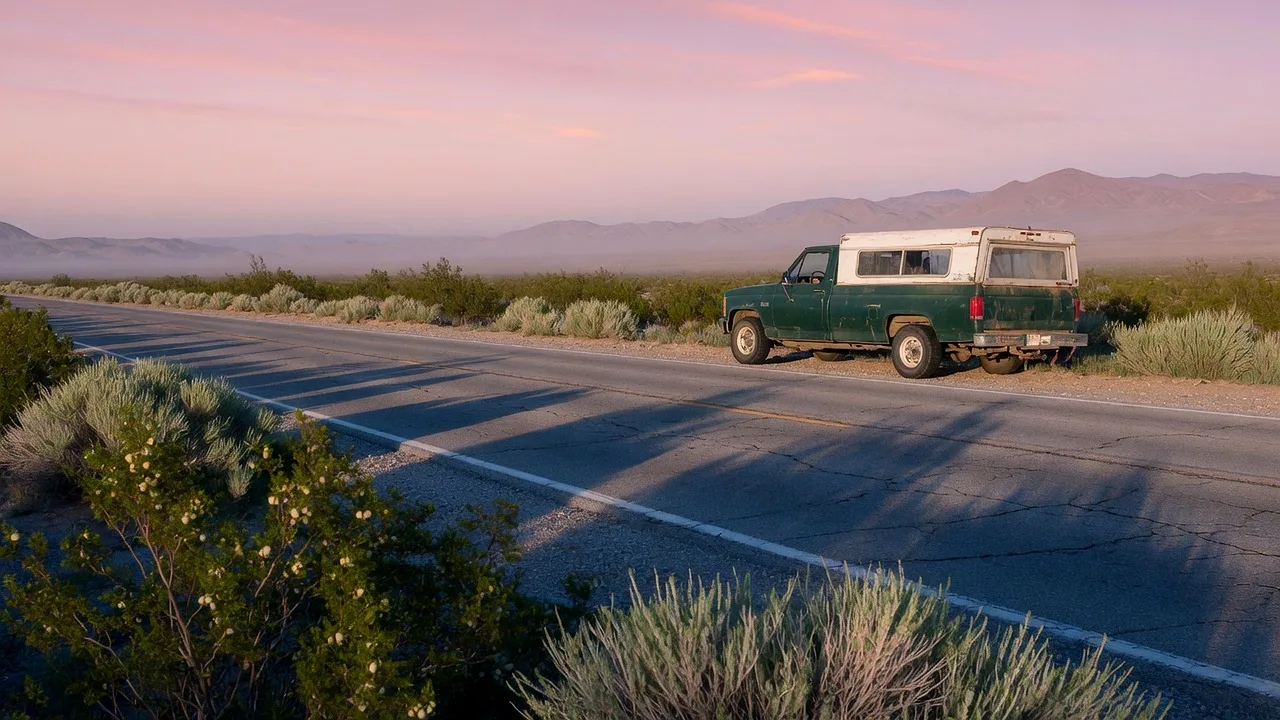
The line that matters
26,001 lb GVWR is where a rental stops being non-CDL — every listing states its class before you book.
Tow + payload math — the four numbers that matter

Four numbers govern every loaded truck on the highway: GVWR (the truck alone, fully loaded), payload (GVWR minus curb weight — what you can put IN the truck), GCWR (truck + trailer combined ceiling), and the SAE J2807 tow rating (what the truck can pull on a 7 percent grade at Davis Dam). The most common renter error is filling the bed AND maxing out tow — payload and tow are not the same budget. A 2024 F-150 with 12,000 lb tow capability and 1,800 lb payload pulling a 10,000 lb travel trailer transfers roughly 1,000-1,500 lb of tongue weight onto the truck rear axle, which IS counted against payload. Family of four + luggage + tongue weight can exceed payload before the truck leaves the driveway.
PickRV's listing template displays the four numbers on a single line so the conflict is visible immediately. If the planned trailer GVW + tongue-weight estimate + passenger + cargo weight exceeds payload, the booking tool warns before checkout. Bigger trucks (F-250 / 2500 / Ram 2500) carry materially more payload — the bottleneck is usually payload, not tow rating, for family-haul use cases.
Where the CDL line actually falls

FMCSA's commercial driver license threshold is 26,001 lb GVWR for a single vehicle, or 26,001 lb GCWR for a combination when the trailer alone exceeds 10,000 lb GVWR (49 CFR 383.5). Every half-ton pickup in the PickRV catalogue is well under that. A 26-foot box truck is intentionally spec'd at 25,999 lb GVWR to stay non-CDL. The pinch point is the 3/4-ton or 1-ton pickup hooked to a heavy gooseneck or 5th-wheel — a Ford F-350 dually (GVWR 14,000 lb) pulling a 20,000-lb 5th-wheel hits a 34,000-lb GCWR, which crosses both the 26,001-lb GCWR line AND the 10,000-lb trailer line. That combination requires a Class A CDL.
Hosts who list 1-ton diesels make the GCWR ceiling explicit. Renters who need to stay non-commercial choose a trailer GVW that keeps GCWR under 26,001 lb — the booking tool enforces this. State-by-state CDL exemptions for farm vehicles, RVs, and personal-use rigs exist but vary widely; PickRV does not extend an exemption claim across state lines without the renter accepting written responsibility for the regional rule.
State DOT hitch + brake rules — where they diverge from federal

Federal baseline (FMCSRs 49 CFR 393) requires brakes on any trailer over 3,000 lb GVW and safety chains on every trailer. States add layers: California Vehicle Code §26458 requires brakes on any trailer over 1,500 lb GVW (a much lower threshold than federal). Pennsylvania (75 Pa.C.S. §4525) requires breakaway switches on any trailer over 3,000 lb. Texas (Transportation Code §547.401) tracks the federal 3,000-lb brake threshold but adds reflector + triangle requirements. New York Vehicle and Traffic Law §375 requires lights wired through the truck connector at any trailer weight.
PickRV per-state pages link directly to the issuing-state statute, not to a third-party blog. Hosts disclose the as-installed brake controller, the as-rated hitch class, and any state-specific gear (CA chain laws, OR fire-season tow restrictions on USFS land). The renter is responsible for the road rule once the keys change hands, but the listing makes the rule visible before the booking confirms.
Box-truck moving — 16, 20, 24, 26 feet and the math behind each

Roughly one in eight Americans moves residence each year (US Census ACS — census.gov). The cube-van rental category serves that demand. PickRV's box-truck cohort tracks the industry-standard length tiers: 10-12 ft (studio), 16 ft (1-bedroom), 20 ft (2-bedroom), 24 ft (3-bedroom), 26 ft (4+-bedroom). Cargo volume scales roughly linearly with length (a 16 ft cube is ~800 cu ft, a 26 ft cube is ~1,700 cu ft). All non-CDL by design.
What the national chains tend to bury: per-mile fees, fuel-on-return policy, ramp-versus-no-ramp distinction, and the difference between a parcel-shelf 'Mom's Attic' cab-over storage and a flat cube. PickRV lists the cubic-foot capacity, the door height clearance, the ramp width, whether the cab-over storage exists, and the host's miles-included policy on a single line. Pricing is positioned 15-25 percent below national-chain comparable equipment in PickRV states, because the host is renting their own working asset and skipping the lot overhead.
What FMCSA + state DOTs don't tell you

Mechanical and regulatory facts that don't appear in the standard agency literature.
- SAE J2807 numbers assume a 150-lb driver, a 150-lb passenger, optional equipment 'as-tested', and Davis Dam grade — your real-world payload after passengers, fuel, and gear is almost always lower than the marketing number.
- The Ford door-sticker payload is calculated AFTER the truck rolls off the line — the dealer-added running boards, lift kits, or bed liners reduce the number further. PickRV records the as-built sticker reading the day the host onboards.
- Gas vs diesel on a 3/4-ton is roughly $10,000 of MSRP differential plus a 700-1,000 lb curb-weight differential (the Cummins, Power Stroke, or Duramax weighs that much more than the gas V8) — meaning the gas truck often has MORE payload even though it tows less.
- 5th-wheel hitches are NOT interchangeable across truck brands without an adapter — Ford / GM / Ram each have their own factory puck-system geometry; renting a Reese Goose Box on a Ford and expecting it to drop into a Ram is a no-go.
- Brake controllers integrated by the OEM (Ford TBC since 2008, GM ITBC since 2014, Ram ITBC since 2010) are calibrated differently per axle — re-calibrate them at the trailer the first time you load up and stop hard on private property, not on I-95.
Where the trucks rent — 8 anchor states at a glance
Curated cross-links to the highest-volume truck-rental states. Each card opens the state's DMV / DOT / CDL citation page.
Texas
F-150 #1 sales state since 1977; Eagle Ford + Permian flatbed
California
CARB-compliant DPF/DEF; PCH + Sierra alpine overland
Florida
Hurricane-season flatbed; Keys US-1 height-clearance
Arizona
Davis Dam J2807 country; overland Tacoma TRD Pro market
Colorado
Mountain-pass low-range gearing; CO-passes chain laws
Georgia
Port of Savannah container drayage; SE construction
Tennessee
Nissan Smyrna plant + GM Spring Hill; Tundra adjacency
Washington
Cascades 4WD overland + Seattle metro contractor flatbed
Truck rental hub FAQs

Do I need a CDL to rent a 26-foot box truck?
No. FMCSA's commercial-driver-license threshold (49 CFR 383.5) is 26,001 lb GVWR for a single vehicle. Every 26-ft cube in the PickRV catalogue is spec'd at roughly 25,999 lb GVWR — purposefully under the CDL line. Your standard non-commercial driver's license operates it. The exception is interstate commercial freight for hire, which adds a USDOT-number requirement regardless of weight.
What is SAE J2807 and why does PickRV cite it instead of the OEM headline number?
SAE J2807 (https://www.sae.org/standards/content/j2807_202008/) is the industry-standard tow-rating test — every modern Ford, GM, Stellantis, Toyota, and Nissan light-duty truck is rated to it. It specifies the test grade (Davis Dam, AZ, 7 percent), the speed targets, the brake performance, the cooling thresholds, and the cabin air-conditioning load that must be sustained while towing. Before J2807 each OEM used its own protocol, so cross-brand comparison was unreliable. PickRV cites the J2807 number tied to the actual trim and powertrain of the rented truck, not the marketing 'best-in-class' headline.
How do I know the truck I'm booking can actually pull my trailer?
Tell us the trailer GVW (gross vehicle weight, found on the trailer's VIN plate) and the tongue-weight estimate (typically 10-15 percent of GVW for conventional, 20-25 percent for 5th-wheel). The booking tool checks payload (GVWR minus curb weight, with passengers and tongue weight subtracted) and GCWR (truck + trailer combined ceiling). If either is exceeded, the booking warns before checkout. The RVIA tow-vehicle pairing matrix (https://www.rvia.org/standards) is the underlying reference.
Can I cross into Mexico or Canada with a PickRV truck?
Canada is generally allowed with prior notice. Mexico is restricted: most US truck rental contracts prohibit Mexico crossings, and the few border-state hosts that allow it require a Mexican auto insurance rider through a recognized carrier (ChubbMex, HDI Seguros, GNP) and written host approval. The listing surfaces the host's specific policy before you book.
What is the difference between half-ton, 3/4-ton, and 1-ton?
Industry shorthand for payload class: half-ton (F-150 / 1500 / Silverado 1500) carries roughly 1,500-2,400 lb of payload and tows 8,000-13,500 lb. Three-quarter-ton (F-250 / 2500) carries 2,800-4,200 lb and tows 14,000-22,000 lb conventional. One-ton (F-350 / 3500) carries 4,000-7,300 lb and tows up to 35,000+ lb gooseneck. The class is a function of suspension, axle, brake, and frame — not just badging. Heavier classes are bigger, heavier, and use more fuel; pick the smallest truck that legitimately covers your trailer + cargo with payload + GCWR headroom.
Does PickRV provide a brake controller and the right hitch?
Yes. Every truck listing displays the integrated brake controller (Ford TBC since 2008, GM ITBC since 2014, Ram ITBC since 2010) and the receiver hitch class (II-V). For 5th-wheel rentals, the hitch and any short-bed slider (Reese Sidewinder, B&W Companion, PullRite SuperGlide) are included. State-specific brake-controller requirements (California over 1,500 lb GVW per CVC §26458, Pennsylvania over 3,000 lb per 75 Pa.C.S. §4525) are flagged on the listing.
PickRV is open to licensed truck owners in 25 truck-friendly states, and these pages are how a renter finds them. Wherever a rig is listed, SAE J2807 tow rating, GVWR, payload, CDL requirements, and tie-down compliance are shown up front, not in fine print. The price you see is stable and all-in — a transparent 10% renter service fee, shown at checkout.