GVWR, GCWR, hitch class, ball weight vs pin weight. The math that prevents the most common towing accident.
Travel trailer vs fifth-wheel — architectural difference
Both are 'towable' RVs — no engine, requires a tow vehicle. The difference is the hitch point.
Travel trailer: connects to a hitch mounted at the rear bumper of the tow vehicle (Class III/IV/V receiver hitch). Length range: 16-35 ft. GVWR typically 4,000-10,000 lbs.
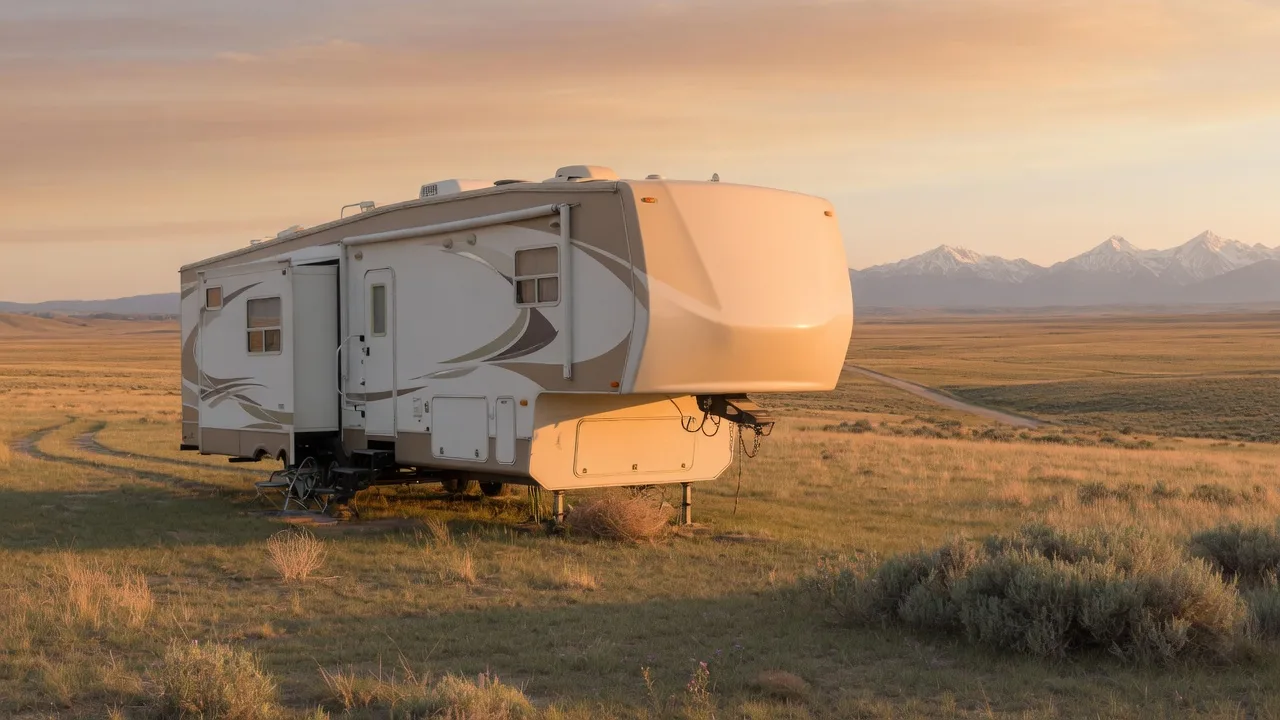
Fifth-wheel: connects to a hitch mounted in the BED of a pickup truck (over the rear axle). Length range: 25-45 ft. GVWR typically 10,000-20,000 lbs.
Per the Society of Automotive Engineers (SAE) J2807 standard (finalized 2013), all post-2015 tow vehicles publish a tested tow capacity for each hitch type. The numbers are different — a truck rated for 12,000 lbs conventional tow might be rated for only 16,500 lbs fifth-wheel.
- Travel trailer: bumper-mounted Class III/IV/V receiver hitch · 16-35 ft typical
- Fifth-wheel: pickup-bed-mounted fifth-wheel hitch · 25-45 ft typical
- Travel trailer GVWR: 4,000-10,000 lbs typical
- Fifth-wheel GVWR: 10,000-20,000 lbs typical
The four weights you must verify (per FMCSA + SAE J2807)
Every tow setup involves four weight constraints. Miss one and your insurance + liability may deny claims after an accident.
(1) Tow vehicle GVWR: max legal weight of tow vehicle alone, loaded with passengers + cargo + fuel.
(2) Trailer GVWR: max legal weight of trailer alone, loaded with water + propane + gear + food.
(3) GCWR: Gross Combined Weight Rating — max legal weight of tow vehicle + trailer combined, loaded. Typically tow-GVWR + max-tow rating per manufacturer table.
(4) Hitch/pin weight: vertical load on the receiver or pin (10-15% of trailer weight for stability).
- Tow vehicle GVWR: door-jamb sticker (FMVSS 110 required)
- Trailer GVWR: VIN sticker on trailer A-frame or sidewall
- GCWR: owner's manual + specific tow-rating brochure per axle ratio
- Tongue weight (travel trailer): 10-15% of trailer GVWR
- Pin weight (fifth-wheel): 15-25% of trailer GVWR (higher than tongue)
Tow vehicle pairing — travel trailer (3 examples)
Example 1: Toyota Tacoma 2024 (max tow ~6,500 lbs SAE J2807): pairs with travel trailers under 5,000 lbs GVWR loaded. Allows ~500 lbs tongue + 5,000 lbs trailer + payload margin. Single-axle 21-24 ft travel trailers fit.
Example 2: Ford F-150 EcoBoost 2024 (max tow ~13,000-14,000 lbs SAE J2807 per spec): pairs with travel trailers under 10,000 lbs GVWR. Most dual-axle 25-30 ft travel trailers fit. Verify your specific truck's tow package + axle ratio.
Example 3: Ford F-250 Super Duty Diesel 2024 (max tow ~22,000+ lbs SAE J2807): pairs with anything in travel-trailer category. Often overkill for travel trailers; appropriate for large fifth-wheels.
Tow vehicle pairing — fifth-wheel (3 examples)
Fifth-wheels require a 3/4-ton or 1-ton pickup truck. Pin weight ranges 1,800-4,500 lbs — exceeds payload capacity of most half-ton trucks.
Example 1: Ford F-250 Super Duty (1,800-2,500 lb payload capacity loaded with passengers): handles fifth-wheels up to ~15,000 lbs GVWR.
Example 2: Ford F-350 Dually (3,500-4,500 lb payload loaded): handles fifth-wheels 15,000-20,000+ lbs GVWR.
Example 3: Ram 3500 / Chevy 3500HD (similar): same range as F-350.
Weight-distributing hitch (WDH) — when required for travel trailer
Per most truck manufacturer specs, WDH is required for any conventional trailer with tongue weight over 500-600 lb (varies by truck). The hitch distributes a portion of tongue weight to the trailer axle + front truck axle via spring bars, restoring level ride + steering authority.
Major brands: Reese, Equal-i-zer, Andersen Hitches, Curt. Quality WDH costs $400-800. Setup requires correct spring bar rating + correct ball mount drop/rise + leveling.
Without WDH on a heavy travel trailer: rear suspension squat, headlights aim too high (other drivers blinded), reduced steering authority, increased sway risk.
Fifth-wheel hitches — installation + truck modifications
Fifth-wheel hitches mount in the truck bed via rails bolted through the bed floor to the frame. Major brands: B&W Trailer Hitches, Curt, Reese, Andersen, PullRite.
Installation typically $1,200-2,500 (hitch + labor). Some trucks come 'prep' from the factory (Ford Tremor + Lariat trim with factory tow prep) and add ~$1,800 to MSRP.
Truck bed becomes partially unusable while hitch is installed. Removable rail kits ($150-300 added cost) allow hitch removal in 5 min.
Brake controller — required by law in most states
Per state DOT regulations (most states), trailers over 3,000-4,500 lbs GVWR require electric brakes on at least 1 axle (varies by state). The brake controller mounts in the tow vehicle cab + activates trailer brakes proportional to tow-vehicle brake pressure.
Major brands: Tekonsha (P3, Prodigy), Curt Echo wireless, Reese Brakeman.
Most modern 1/2-ton+ pickups (Ford F-150 2015+, Ram 1500 2019+, Silverado 1500 2019+) have factory-integrated brake controllers as standard or option.
Pin weight vs tongue weight — the payload math that decides truck class
The single number that disqualifies most half-ton trucks from fifth-wheel duty is not the marketing 'tow rating' — it's the payload sticker glued to the driver-side door jamb. Per FMVSS 110, that sticker lists the vehicle's actual maximum payload after factory options were installed (sunroof, leather seats, larger wheels all subtract). A 2024 Ford F-150 SuperCrew with a moderate options package commonly ships with 1,400-1,650 lbs of payload — not the 2,000+ lbs the brochure advertises for the stripped base configuration.
Fifth-wheel pin weight is typically 18-22% of loaded trailer weight per the manufacturer-published specs (Grand Design, Forest River, Jayco, Keystone). A 12,000-lb loaded fifth-wheel exerts ~2,400 lbs of vertical force on the truck bed hitch. Subtract 600 lbs for the hitch hardware + 500-700 lbs for two passengers + 100-200 lbs for cargo — and you need 3,600-3,900 lbs of payload capacity. No half-ton truck on the US market in 2026 ships with that payload as standard.
Travel trailer tongue weight is typically 10-15% of loaded trailer weight. A 7,000-lb loaded travel trailer at 13% = 910 lbs of tongue weight, comfortably within half-ton payload after passengers. This is why the half-ton + travel-trailer pairing dominates the rental market while half-ton + fifth-wheel almost never appears.
- Half-ton (F-150, Ram 1500, Silverado 1500): typical payload 1,400-1,800 lbs (door-jamb sticker)
- 3/4-ton (F-250, Ram 2500, Silverado 2500HD): typical payload 2,800-4,200 lbs
- 1-ton SRW (F-350, Ram 3500): typical payload 4,000-5,500 lbs
- 1-ton dually (F-350 DRW, Ram 3500 DRW): typical payload 5,500-7,800 lbs
- Fifth-wheel pin weight: 18-22% of loaded trailer = ~2,400 lbs on a 12,000-lb rig
- Travel trailer tongue weight: 10-15% of loaded trailer = ~910 lbs on a 7,000-lb rig
Sway control — the cheap insurance against jackknife (travel trailer only)
Per US DOT crash-cause analysis + NHTSA towing safety bulletins, trailer sway is the #1 contributor to towing-related fatalities. Sway starts when a side force (wind gust, passing semi, crowned road) initiates lateral oscillation at the trailer axle. If tongue weight is correctly set at 12-15% AND the WDH is properly configured, oscillation damps out in 2-3 cycles. If tongue weight is under 10% OR the trailer is overloaded behind the axle, oscillation amplifies and the trailer eventually pulls the tow vehicle into a jackknife.
Friction-based sway control (Reese Dual-Cam, Equal-i-zer 4-point) uses spring-loaded friction pads to resist lateral movement. Cost: $80-200 add-on for an existing WDH. Effective for trailers under 7,000 lbs GVWR.
Integrated sway-control WDH systems (Equal-i-zer 4-point, Andersen No-Sway, ProPride 3P) build sway resistance into the geometry of the hitch itself rather than adding friction. Cost: $700-1,400. Standard equipment recommended for travel trailers over 7,000 lbs GVWR or anyone towing through high-wind plains corridors (Wyoming I-80, Texas I-40, Kansas I-70).
Fifth-wheels do not require sway control. The hitch is mounted over the tow vehicle's rear axle, which eliminates the lever-arm geometry that allows conventional trailer sway to develop. This is one of the structural reasons fifth-wheels feel more stable at highway speed despite being larger and heavier.
What truck dealers + RV salespeople don't tell you
Under-shared truth #1: dealer 'tow rating' is the SAE J2807 max — the legal ceiling. Real safe max is 75-85% of this once you account for tongue/pin weight + passengers + cargo + WDH gear. A truck rated 12,000 lbs SAE J2807 should typically tow trailers under 10,000 lbs GVWR for safety + suspension longevity.
Under-shared truth #2: Ford and Ram advertise 'max tow' that assumes 1 driver, no passengers, no payload, specific axle ratio, specific tow package. The actual fielded truck on your driveway is typically rated 15-25% lower. Verify with your truck's specific VIN-decoded specs (use a tool like RVTowingCalculator or Etrailer's lookup).
Under-shared truth #3: insurance + warranty exclusions kick in fast on towing violations. Exceed GCWR by 10% in an accident, and your tow-vehicle warranty + collision insurance may deny. Weigh the loaded combo at a CAT scale ($14, truck stops nationwide) before any long trip — keep the receipt as documentation.
Frequently asked questions
What's the main difference between a travel trailer and a fifth-wheel?›
Travel trailer connects to a bumper-mounted hitch on any tow vehicle. Fifth-wheel connects to a hitch in the bed of a pickup truck (over the rear axle). Fifth-wheels are larger (25-45 ft, 10-20K lbs GVWR) and require 3/4-ton or 1-ton trucks.
Can my half-ton pickup tow a fifth-wheel?›
Not recommended. Fifth-wheel pin weight is 15-25% of trailer GVWR — exceeds the payload capacity of most half-ton trucks loaded with passengers. Use 3/4-ton minimum (F-250, Ram 2500, Silverado 2500HD).
Do I need a weight-distributing hitch (WDH)?›
Most truck manufacturers require WDH for conventional trailers with tongue weight over 500-600 lbs. WDH distributes tongue weight to the trailer axle + front truck axle, restoring level ride + steering authority. Costs $400-800.
What's SAE J2807?›
Society of Automotive Engineers tow-rating standard (finalized 2013). Mandates a unified test protocol: vehicle must accelerate 0-60 in ≤30 sec on a 7% grade while towing, complete the Davis Dam test (11 mi, 6% grade, 100°F), pass durability tests. All post-2015 US-market trucks publish J2807-compliant tow ratings.
Do I need sway control on a travel trailer?›
Strongly recommended for trailers over 5,000 lbs GVWR, and standard practice for anything over 7,000 lbs. Friction-based sway control ($80-200 add-on) works for smaller trailers; integrated sway-control WDH (Equal-i-zer 4-point, Andersen No-Sway, ProPride 3P, $700-1,400) is the standard for larger rigs. Fifth-wheels do not need sway control — hitch geometry over the rear axle eliminates the lever-arm problem.
Why can't a half-ton truck tow a fifth-wheel even if the tow rating is high enough?›
Payload (not tow rating) is the limiting factor. A 12,000-lb fifth-wheel exerts ~2,400 lbs pin weight on the bed hitch. After 600 lbs hitch hardware + 500-700 lbs passengers + cargo, you need 3,600+ lbs payload. No half-ton on the 2026 US market ships with that as standard — most are 1,400-1,800 lbs payload per the FMVSS 110 door-jamb sticker.
Continue your research on PickRV
Sources
- 1.FMCSA Vehicle Weight + Tow Standards 49 CFR 393FMCSAgovernment or university source
- 2.SAE J2807 Tow Capacity StandardSAE Internationalcompany or industry source
- 3.NHTSA FMVSS 110 Tire + Weight StandardsNHTSAgovernment or university source
- 4.CAT Scale truck-stop scale locatorCAT Scale Company (industry)company or industry source
- 5.Ford Super Duty Tow Ratings BrochureFord Motor Company (manufacturer)company or industry source
- 6.NHTSA trailer sway + towing safety bulletinsNHTSAgovernment or university source
Sources are a mix of government and university publications and the company or industry documentation for the specific equipment, store policy or standard discussed — each row above says which one it is, so you can weigh it yourself. Last verified 2026-05-25. Report broken links to support@pickrv.com.
Ready to roll?
Pick a rig. Write the road.
Complete nightly price on every listing — your exact total itemized before you pay · 48h full rental refund. Every rig near you, one checkout.
Related reads


Plan around this guide · 3
Hub anchors · mega-guides · cost calculator — one click each.
Related on PickRV
Tell us when you want to travel.
Owners list their own rigs on PickRV. Add your dates and we'll email you when one is listed for them — nothing else, no spam.
Was this guide helpful?