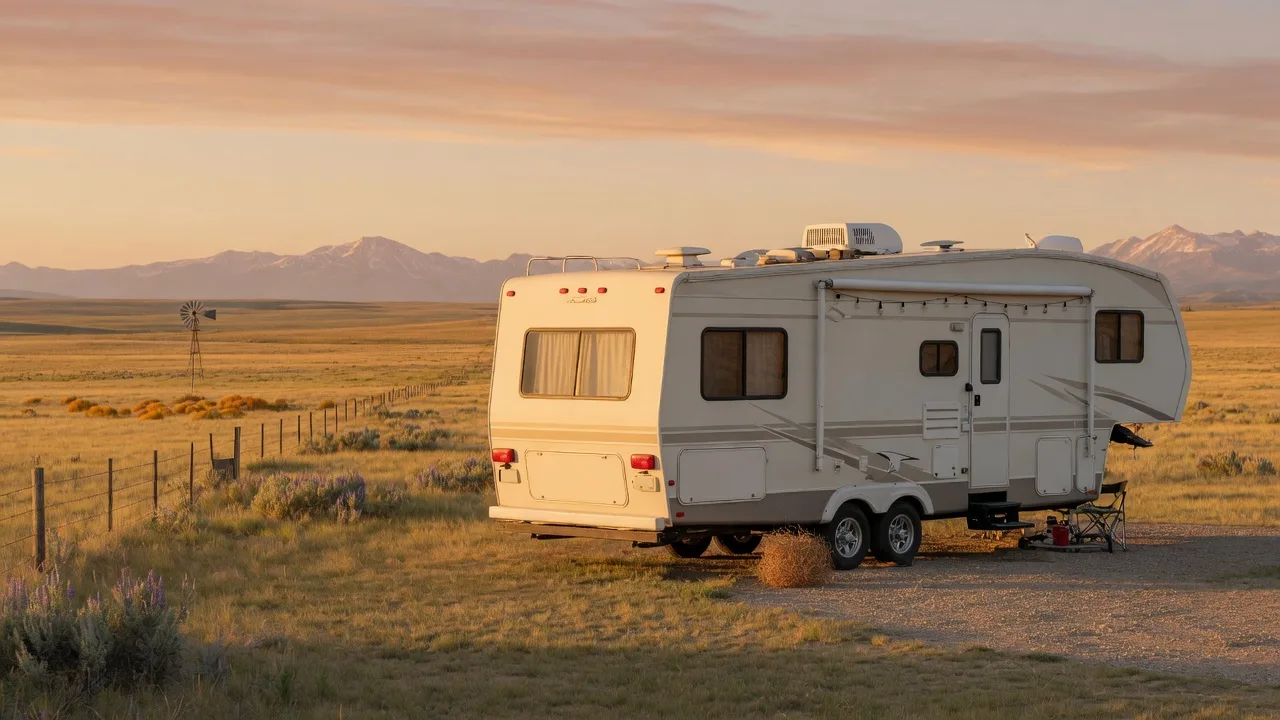
The towing capacity numbers in your truck's brochure are NOT what you can actually pull. Real SAE J2807 math + brake controller wiring + WDH setup.
SAE J2807 — what 'tow capacity' actually means
Before 2013, manufacturers self-rated tow capacity using inconsistent test protocols. SAE J2807 (Society of Automotive Engineers standard, finalised 2013) created a unified protocol: tested vehicle must accelerate 0-60 mph in ≤30 sec on a 7% grade while towing, complete the Davis Dam test (11 mi, 6% grade, 100°F), and pass specific frame + cooling + transmission durability checks.
Every truck manufactured for the US market after 2015 publishes a J2807-compliant tow rating. That number is the LEGAL maximum trailer weight. Real-world safe towing is typically 75-85% of the J2807 max once you account for tongue weight + passengers + cargo + WDH (weight-distributing hitch) gear.
- J2807 max = published manufacturer maximum (legal ceiling)
- Real safe max = 75-85% of J2807 (accounts for tongue + payload + safety margin)
- Tongue weight = 10-15% of trailer weight (must be within hitch + receiver class rating)
- GCWR = Gross Combined Weight Rating (truck + trailer + cargo, all-in)
The four weight numbers that matter (memorise these)
Every tow setup involves four weight constraints, any of which can disqualify a combo. Miss one and your insurance + liability protection evaporates after an accident.
(1) Truck GVWR: max legal weight of truck alone, loaded. (2) Trailer GVWR: max legal weight of trailer alone, loaded. (3) GCWR: max legal weight of truck + trailer combined, loaded. (4) Tongue weight: vertical force on hitch ball (must be 10-15% of trailer weight for stability; under 10% = sway, over 15% = rear-suspension overload).
- Truck GVWR — typically 7,000-11,500 lb for half-ton, 10,000-14,000 lb for 3/4-ton
- Trailer GVWR — printed on trailer VIN sticker, NOT the empty weight
- GCWR — typically truck-GVWR + max-tow rating, but verify per manufacturer table
- Tongue weight — measure with a portable scale at full trailer load (food, water, gear)
Weight-distributing hitches (WDH) — when required, how to set up
WDH is required for any trailer with tongue weight > 600 lb (Reese, Equal-i-zer, Andersen, and Curt are the major brands). The hitch distributes a portion of tongue weight to the trailer axle + front truck axle via spring bars, restoring level ride + steering authority.
Setup ritual: hitch the trailer level, measure front + rear truck fender heights, apply spring-bar tension via head adjustment + bar-link chain count, re-measure. Front fender should drop ≤0.5 inch from unloaded; if more, increase tension. WDH setup is a one-time per-trailer ritual — once dialled, it stays.
- Reese SC (sway-control built in) — most popular for travel trailers 5,000-15,000 lb
- Equal-i-zer — integrated 4-point sway control, slightly heavier
- Andersen No-Sway — chainless ratcheted design, easier setup
- Curt TruTrack — 4-point sway, mid-price tier
Brake controllers — proportional vs time-delayed, wiring basics
Trailer brake requirements are STATE law, not federal, and the weight threshold varies by state — check the requirement for every state on your route before towing. (FMVSS 121 is the federal air-brake standard for trucks, buses, and air-braked trailers; it does not govern electric brakes on consumer trailers.) To activate electric trailer brakes, the tow vehicle needs a brake controller wired into the truck's brake system.
Proportional controllers (Tekonsha P3, Curt Spectrum, Reese Brakeman): sense truck deceleration via an internal accelerometer and apply trailer brakes in proportion. Smooth, premium, $130-250. Time-delayed controllers (Tekonsha Voyager): apply trailer brakes on a fixed ramp regardless of truck deceleration. Cheaper ($60-90) but less smooth, harder on trailer brakes.
- Proportional: Tekonsha P3, Curt Spectrum, Reese Brakeman Compact — recommended for new installs
- Time-delayed: Tekonsha Voyager — budget option, acceptable for occasional towing
- Most 2020+ trucks have factory-integrated proportional controllers — verify in your owner's manual
- Wiring: 4 wires (12V+, ground, brake-signal, trailer-brake-output) — DIY in 90 minutes or shop install $100-200
The Davis Dam test reality — mountain towing differs from flat
J2807 includes the Davis Dam test (11 mi, 6% grade, 100°F desert ambient) precisely because tow capacity in mountains is dramatically lower than on flats. Real-world mountain tow rule: subtract 15-20% from your J2807 max for sustained 6%+ grades and ambient temps > 90°F.
Practical example: a half-ton truck rated to tow 11,000 lb J2807 should be capped at 8,500-9,000 lb for Rocky Mountain or Sierra Nevada towing in summer. Transmissions overheat on long climbs; engine-braking is critical on descents.
Engine braking on descents — the truth most rental walk-throughs skip
On any descent > 6% grade for > 2 miles, service brakes alone WILL overheat and fail. Engine braking (downshift to a lower gear, let engine RPM rise to 3,000-4,000 RPM, RPM does the slowing) is the only safe technique.
Modern tow vehicles auto-downshift in 'Tow/Haul' mode (most pickups since 2010). Activate Tow/Haul before the descent, not during. Diesel pickups also have exhaust brakes (separate switch) — engage on any descent > 5%.
Sway — causes, prevention, recovery
Trailer sway is the leading cause of towing fatalities per NHTSA. Causes: (1) tongue weight < 10%, (2) crosswind + truck passing, (3) excessive trailer-tire wear or under-inflation, (4) cargo loaded behind trailer axle, (5) WDH spring bars under-tensioned.
Recovery: do NOT slam brakes. Let off gas, apply trailer brakes only (via brake-controller manual lever), steer straight. Sway dampens within 2-3 cycles. Slam brakes and the trailer jackknifes around the truck.
- Load 60% of cargo forward of trailer axle
- Maintain 60-65 psi tire pressure (most trailer tires)
- Use sway-control WDH for any trailer > 4,000 lb
- Slow to 55 mph max in crosswinds > 25 mph
What truck-brochure marketing teams don't tell you
Manufacturer brochures publish the J2807 tow max but bury the GCWR + payload-capacity reality. A truck rated to tow 13,000 lb may only have 1,400 lb of payload capacity — meaning that 1,400 lb includes passengers + fuel + cargo + tongue weight + WDH gear. Subtract 4 adults (720 lb) + 80 lb fuel + 150 lb WDH = 450 lb remaining for tongue weight. At 12% tongue, that's a trailer limit of 3,750 lb GVWR — far below the 13,000 lb advertised.
Verify payload BEFORE shopping for trailers. Payload sticker is on the driver-door jamb (yellow placard).
Hitch class + receiver rating — the small-print physics
The hitch receiver class on the truck (printed on a tag attached to the receiver tube + listed in the owner's manual) caps the maximum tongue weight + maximum trailer GVWR independent of the truck's tow rating. Per the SAE J684 hitch classification standard: Class I hitches handle ≤200 lb tongue / ≤2,000 lb trailer; Class II handles ≤300 lb / ≤3,500 lb; Class III handles ≤500 lb / ≤6,000 lb (or 1,000 lb / 10,000 lb with weight distribution); Class IV handles ≤1,000 lb / ≤12,000 lb (or 1,500 lb / 17,000 lb with WDH); Class V handles ≤1,700 lb / ≤17,000 lb (or 2,400 lb / 20,000 lb with WDH).
A factory-installed receiver on a half-ton pickup is typically Class IV. Some half-tons sold with the OEM tow package include Class V receivers; verify on the receiver tag, not the truck's brochure. The receiver rating is a HARD cap — exceeding it can shear the receiver tube + drop the trailer onto the highway at speed. Aftermarket receiver upgrades exist (Curt, Reese, B&W) for $300-800 installed; engineering certification varies, so use only SAE J684-certified replacements.
Pin-box mount on fifth-wheels carries its own load rating per the manufacturer's data plate. Andersen Ultimate, B&W Companion, and Reese 27K are the most common 2026 fifth-wheel hitch mounts; capacities range 16,000-27,000 lb GTW (gross trailer weight) with proportional pin-weight ratings per each manufacturer's published spec sheet.
- Class III (with WDH): 1,000 lb tongue / 10,000 lb trailer max per SAE J684
- Class IV (with WDH): 1,500 lb tongue / 17,000 lb trailer max per SAE J684
- Class V (with WDH): 2,400 lb tongue / 20,000 lb trailer max per SAE J684
- Receiver tube tag carries the OEM hitch class — verify before towing
- Fifth-wheel pin-box mounts: 16,000-27,000 lb GTW range per B&W / Andersen / Reese
Tongue-weight + payload measurement — Sherline scale + CAT-scale method
Two ways to measure actual tongue weight before a trip: (1) Sherline LM-1000 portable tongue-weight scale ($170-200 per sherline.com) inserted between the trailer coupler and a stationary platform — direct reading in pounds. (2) CAT-scale truck-stop weigh: weigh the truck alone with coupler in normal position, then weigh truck + connected trailer; the difference at the rear-axle weight is the actual tongue weight transferred.
Most first-time fifth-wheel + travel-trailer owners are surprised to find their actual loaded tongue weight is 12-18% of trailer GVWR rather than the published 10-15%. Loading cargo behind the trailer axle reduces tongue weight (and increases sway risk); loading forward of the axle increases tongue weight. Use the Sherline scale or CAT scale to verify before any long highway trip; budget $14-200 for verification rather than $30,000+ for a totaled rig after a sway-related rollover.
For motorhomes with a towed vehicle (the 'toad'), the same verification logic applies but to the GCWR limit. Hitch your toad, drive to the CAT scale fully loaded for travel, get the printed ticket. Compare total weight to the motorhome's GCWR (printed on the chassis manufacturer's data plate). If you're over GCWR, the only fixes are: leave the toad at home OR rent a smaller toad OR remove cargo until you're within spec.
- Sherline LM-1000 portable tongue scale: $170-200 per sherline.com
- CAT-scale method: weigh truck alone + truck+trailer · difference at rear axle = tongue weight
- Loaded tongue weight often 12-18% of GVWR vs published 10-15%
- Load 60% of cargo forward of trailer axle for sway resistance
- Verify $14-200 vs $30,000+ rollover loss
Frequently asked questions
What is SAE J2807?›
SAE J2807 is the industry-standard tow-capacity testing protocol adopted in 2013. It defines uniform performance, durability, and frame-rating tests so that 'tow capacity' is comparable across manufacturers.
Do I need a weight-distributing hitch?›
Yes, for any trailer with tongue weight over 600 lb (typically trailers over 5,000 lb GVWR). WDH restores level ride, steering authority, and prevents tail-heavy rear-suspension overload.
Is a proportional brake controller worth the extra cost?›
For trailers over 4,000 lb and any frequent towing, yes. Proportional controllers ($130-250) deliver smoother braking, longer trailer-brake life, and shorter stopping distances than time-delayed units.
How much of my truck's published tow rating can I safely use?›
75-85% in flat country, 65-75% in mountains. The remaining margin accounts for passenger and cargo weight, tongue load, and the Davis Dam grade/heat reality.
What hitch class is on my factory-installed receiver?›
Check the tag riveted to the receiver tube + the owner's manual. Half-ton pickups typically ship with Class IV; full-size SUVs typically Class III; 3/4-ton + 1-ton pickups typically Class IV or V. Verify before exceeding any tongue / trailer-GVWR figure printed on the receiver tag.
Is the Sherline tongue-weight scale worth the $170?›
For any owner towing > 5,000 lb trailer regularly, yes. Tongue weight is the single largest factor in sway prevention. A $170 portable scale checked at every loading change is the cheapest way to keep tongue at the 12-15% sweet spot.
Continue your research on PickRV
Sources
- 1.SAE J2807 StandardSAE Internationalcompany or industry source
- 2.FMVSS 121 Air Brake SystemsNHTSAgovernment or university source
- 3.NHTSA Towing SafetyNHTSAgovernment or university source
- 4.DOT Federal Bridge FormulaFHWAgovernment or university source
Sources are a mix of government and university publications and the company or industry documentation for the specific equipment, store policy or standard discussed — each row above says which one it is, so you can weigh it yourself. Last verified 2026-05-24. Report broken links to support@pickrv.com.
Ready to roll?
Pick a rig. Write the road.
Complete nightly price on every listing — your exact total itemized before you pay · 48h full rental refund. Every rig near you, one checkout.
Related reads


Plan around this guide · 3
Hub anchors · mega-guides · cost calculator — one click each.
Related on PickRV
Tell us when you want to travel.
Owners list their own rigs on PickRV. Add your dates and we'll email you when one is listed for them — nothing else, no spam.
Was this guide helpful?