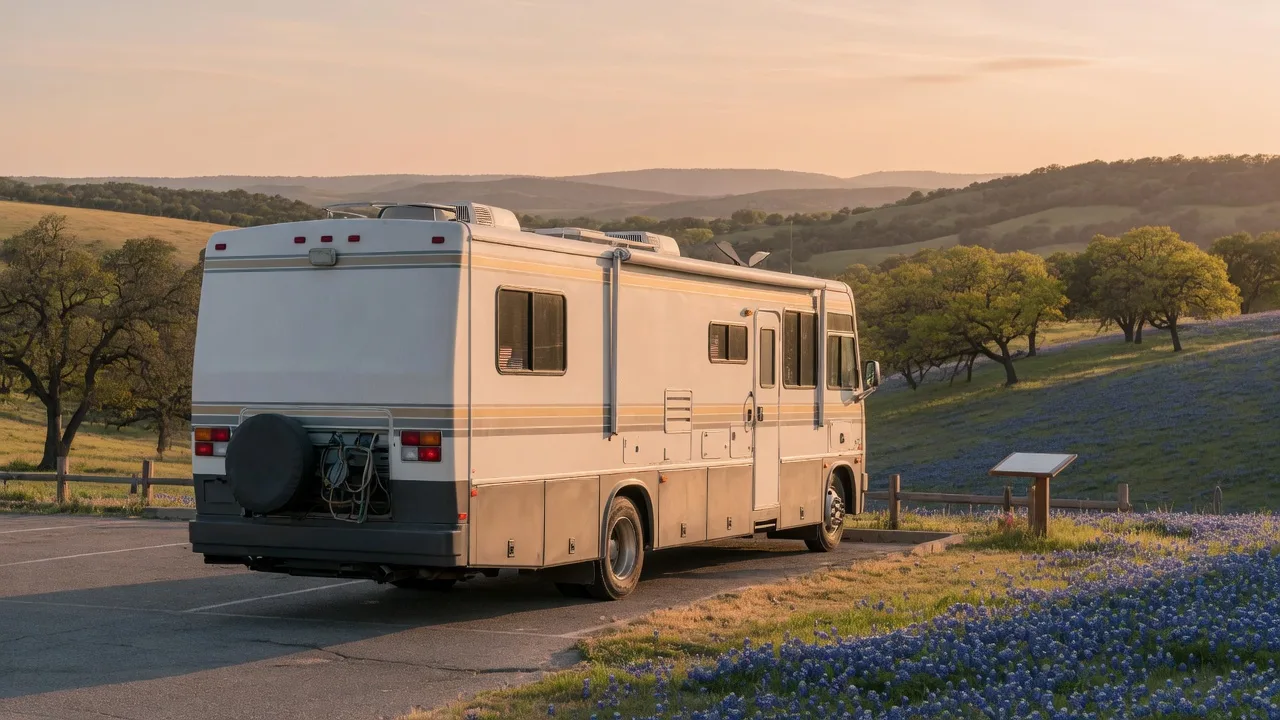
Most fully-packed RVs fail their first CAT-scale weigh. Real DOT weight definitions, the FMVSS 110 law, and a 6-step pre-trip weight audit anyone can do for $14.
Walk to a CAT scale and most rigs fail
A widely-cited finding from the RV Safety + Education Foundation (rvsafety.com) reports that a substantial majority of motorhomes weighed at public CAT scales are overloaded on at least one axle, even when the gross vehicle weight is under the manufacturer's GVWR. The reason is uneven loading: the kitchen + slide-out + freshwater tank cluster on one side, the bedroom + closet + black tank on another, and the result is one axle at 110% of its rating even when total weight is at 90% of GVWR.
The Federal Motor Carrier Safety Administration (FMCSA) and Federal Motor Vehicle Safety Standards (FMVSS 110) make GVWR enforceable in all 50 states. Per the Insurance Information Institute (iii.org), driving an overweight vehicle is grounds for insurance claim denial in all 50 states if an accident is causally linked to the overload. The fix is a $14 CAT scale weigh ticket at any truck stop before a long trip.
The five weight numbers that matter
Per FMVSS 110 + NHTSA tire-information placard standards, every RV (motorhome or towable) carries a manufacturer's data plate disclosing five weight ratings. Knowing all five — and the difference between them — is what separates a safe trip from an insurance claim denial.
- GVWR (Gross Vehicle Weight Rating) — max total weight of the rig fully loaded with fluids, cargo, passengers, hitch weight (motorhome only)
- GCWR (Gross Combined Weight Rating) — max total weight of motorhome + any towed vehicle (motorhome + 'toad')
- GAWR (Gross Axle Weight Rating) — max weight on each individual axle · published per axle on the data plate
- UVW (Unloaded Vehicle Weight) or 'dry weight' — weight from the factory with no fluids, cargo, passengers
- CCC (Cargo Carrying Capacity) = GVWR − UVW − fluid weight (water, propane, fuel) − passenger weight (180 lb each per FMCSA)
What 'cargo' really weighs
Most first-time renters underestimate cargo weight by 200-500 pounds. Per US Bureau of Reclamation water-density data, fresh water weighs 8.34 lb/gallon. A 50-gallon fresh-water tank fully loaded = 417 lb. A 30-pound propane tank fully loaded = 30 lb of LP + ~17 lb of empty tank = 47 lb each, and most rigs carry two. Add 4 passengers at FMCSA's 180-lb passenger standard (49 CFR 393.86) = 720 lb. Add a week of food + clothes + outdoor gear = typically 300-500 lb. Add a generator's fuel tank, leveling jacks, and any aftermarket items.
The total cargo load on a typical 4-person 7-day trip in a Class C motorhome routinely hits 1,200-1,800 lb. If the CCC on the data plate is 1,500 lb, the rig is right at the legal limit before any aftermarket additions. This is why CAT-scale verification matters — the only way to know your actual loaded weight is to weigh it.
- Fresh water: 8.34 lb/gal × tank capacity (50 gal = 417 lb)
- Propane: 30-40 lb per cylinder × number of cylinders
- Passengers: 180 lb each per FMCSA 49 CFR 393.86
- Fuel: gasoline 6.0 lb/gal · diesel 7.1 lb/gal × tank capacity
- Gear + food + clothes: typically 300-500 lb for a week-long trip
- Generator fuel + leveling system + aftermarket: 50-200 lb additional
The 6-step pre-trip weight audit
Total cost: ~$14 at any CAT scale truck stop. Total time: ~15 minutes. This is the highest-ROI safety check any RV renter can do.
- 1. Load the rig the way you'll travel — full fresh water, propane, fuel, passengers in seats, gear in normal locations
- 2. Drive to any Pilot Flying J, Love's, TA, or independent CAT-scale-equipped truck stop (find via catscale.com locator)
- 3. Pull onto the scale platform — drive axle on platform 1, rear axle on platform 2 (motorhome) or truck on 1+2 and trailer on 3 (towable)
- 4. Pay $14 (typical) at the kiosk — get printed weight ticket
- 5. Compare each axle weight to GAWR on the data plate · compare total weight to GVWR · compare combined weight (motorhome + toad) to GCWR
- 6. If any number exceeds the rating, reduce load BEFORE the trip — start with fresh water (only fill to 1/3 for trip start, refill at destination)
How to fix an overweight rig
If the CAT-scale ticket shows you're over GVWR or over any GAWR, the fixes are: (1) reduce fresh-water fill (8.34 lb/gallon — the easiest single ~200-400 lb reduction), (2) leave non-essential gear at home or stage at destination, (3) move heavy items from over the overloaded axle to over the other axle, and (4) for towable trailers, shift cargo from the rear to over the trailer axles.
If the rig is over GCWR, the only fix is to leave the toad at home or rent a smaller toad. Per FMCSA + state DOT enforcement, you cannot legally drive over GCWR even if the motorhome alone is under GVWR. Insurance carriers deny claims for accidents involving GCWR violations. Some states (California Class B non-commercial above 26,001 lb GVWR per ca.gov DMV) require a special driver license for any combined weight above the standard threshold.
Towable weight math (fifth-wheels + travel trailers)
For towable RVs, the weight equation expands to include the truck. Per RV Industry Association + SAE J2807 standards, the truck must satisfy: payload (truck CCC) ≥ pin weight (5th-wheel) or tongue weight (travel trailer) + passengers + gear in the truck cab; AND tow rating ≥ trailer GVWR; AND combined weight ≤ truck's GCWR.
Pin weight on a fifth-wheel runs 20-25% of trailer GVWR (e.g. 12,000 lb trailer × 22% = 2,640 lb pin weight). Half-ton trucks (Ford F-150, Ram 1500, GM 1500) have payload capacities typically 1,200-2,000 lb after passengers + gear, meaning they are NOT recommended for fifth-wheels above ~7,000-10,000 lb GVWR regardless of advertised tow rating. The advertised tow rating is the trailer side; the payload is the truck side; both must be satisfied. Use 3/4-ton (F-250 / Ram 2500 / Sierra 2500) minimum for any fifth-wheel above 10,000 lb per RVIA + Ford / Ram / GM towing guides.
What hosts must disclose
PickRV requires every listing to disclose GVWR + dry weight + cargo carrying capacity (CCC) under the rig's spec sheet. A host who can't provide these numbers — or whose listing shows numbers that don't match the rig's manufacturer's data plate — is a non-starter. There are too many properly-disclosed alternative listings on PickRV to risk an overweight surprise at pickup.
Per FTC + state consumer-protection law, misrepresenting vehicle weight ratings is a deceptive practice. PickRV's editorial standard requires hosts to disclose the manufacturer's official weight ratings exactly as printed on the data plate.
Bridge laws + Federal Bridge Formula — when long combos hit closed bridges
Beyond GVWR + GAWR, long RV combos must also satisfy the Federal Bridge Formula B from the Federal Highway Administration (per fhwa.dot.gov regulation 23 CFR 658). The formula computes a max gross weight for any set of axles based on the distance between the outermost axles in the group; it's why interstate weight stations measure axle spacing along with axle load.
For most RV combinations, the bridge formula does NOT bite at typical loaded weights — a 40-foot motorhome on 2-axle configuration with 12-15 feet of axle spacing easily satisfies the formula. But long fifth-wheel + heavy-duty truck combinations exceeding 65 feet total length can be limited on specific bridges, particularly older state-route bridges with posted weight restrictions. Per the FHWA National Bridge Inventory at infobridge.fhwa.dot.gov, more than 42,000 US bridges carry weight restrictions; the state DOT route-planning sites (e.g. txdot.gov route restrictions, caltrans.ca.gov truck-routes app) publish per-bridge restrictions before you plan a route.
State weight stations along interstates routinely measure RVs over ~26,000 lb gross weight. If the scale operator flags a discrepancy with the registration's reported weight, the rig can be pulled in for full inspection. Carry the manufacturer's data plate photo + the most recent CAT-scale ticket on your phone for quick reference.
- Federal Bridge Formula B (23 CFR 658) — limits gross weight by axle-group spacing per fhwa.dot.gov
- 42,000+ US bridges carry posted weight restrictions per infobridge.fhwa.dot.gov
- State DOT route-planning apps publish per-bridge restrictions (txdot.gov, caltrans.ca.gov)
- Interstate weigh stations routinely flag RVs >26,000 lb gross for inspection
- Carry data-plate photo + CAT-scale ticket on phone for fast inspection compliance
Frequently asked questions
Where do I find a CAT scale?›
CAT Scale operates ~2,200 truck stop locations across the US. Find one via catscale.com or in the Pilot/Flying J/Love's apps. Weighing is typically $14 cash or card, takes under 15 minutes including drive-in time.
What happens if I drive over GVWR?›
FMVSS 110 + state DOT enforcement: fines $100-2,000+ depending on state, insurance claim denial if an accident is causally linked to overload, possible CDL-class license requirement if combined weight exceeds 26,001 lb in your state.
Is the manufacturer's dry weight accurate?›
Manufacturer dry weight (UVW) is from the factory with no fluids, no cargo, no passengers, sometimes no batteries or propane. Always at least 100-300 lb less than the actual unloaded weight of the rig as delivered with all standard equipment installed. Use the CAT-scale empty-weight or the manufacturer's wet-weight if disclosed.
Can I exceed GVWR by a little if I drive slowly?›
No. GVWR is the maximum safe load for the rig's brakes, tires, frame, and suspension at any speed. Exceeding it stresses every component beyond design tolerance. Insurance carriers do not honor 'I drove carefully' as a defense for over-GVWR accident claims.
Does PickRV verify weight ratings on listings?›
PickRV requires hosts to disclose manufacturer GVWR + dry weight + CCC under the rig's spec sheet during verified-host onboarding. Renters should still cross-check by physically reading the manufacturer's data plate at pickup.
How do I weigh each axle separately on a CAT scale?›
Pull onto the platform so each axle sits on a separate weighing pad — most CAT-scale layouts have 3 numbered pads. The printed ticket reports steer-axle, drive-axle, and trailer-axle (if applicable) weights individually. Compare each to the GAWR for that axle on the data plate.
Does carrying water in tanks count toward CCC?›
Yes. Fresh water at 8.34 lb/gal counts toward gross loaded weight. A 50-gallon fresh-water tank fully loaded is 417 lb of cargo, so a rig with 1,500 lb CCC effectively has only 1,083 lb left for passengers + gear when the fresh tank is full.
Continue your research on PickRV
Sources
- 1.FMVSS 110 — tire selection + rims (governs GAWR)US DOT NHTSAgovernment or university source
- 2.49 CFR 393.86 — Rear impact guards and rear end protectionUS DOT FMCSAgovernment or university source
- 3.CAT Scale company locator + pricingCAT Scale Companycompany or industry source
- 4.RV Safety + Education Foundation weight researchRVSEFcompany or industry source
- 5.California DMV — Class B non-commercial license requirementsCalifornia DMVgovernment or university source
- 6.Insurance Information Institute — vehicle weight + claimsInsurance Information Institutecompany or industry source
Sources are a mix of government and university publications and the company or industry documentation for the specific equipment, store policy or standard discussed — each row above says which one it is, so you can weigh it yourself. Last verified 2026-06-04. Report broken links to support@pickrv.com.
Ready to roll?
Pick a rig. Write the road.
Complete nightly price on every listing — your exact total itemized before you pay · 48h full rental refund. Every rig near you, one checkout.
Related reads
Plan around this guide · 3
Hub anchors · mega-guides · cost calculator — one click each.
Related on PickRV
Tell us when you want to travel.
Owners list their own rigs on PickRV. Add your dates and we'll email you when one is listed for them — nothing else, no spam.
Was this guide helpful?