Real OEM tank capacities by RV class, plus the math that tells you when you actually need to dump (it's usually 2 days sooner than first-timers think).
Why holding tank math beats brochure capacity
Most renters undershoot dump cadence by two full days on their first trip — not because the tanks are smaller than advertised, but because real-world fill rates outrun the brochure capacity once two showers, dishwashing, and the toilet stack up on Day 1. The US EPA Office of Wastewater Management estimates the average American uses 80-100 gallons of water per day at home (epa.gov WaterSense program data). In an RV, low-flow fixtures plus deliberate frugality drop that to 6-12 gallons per person per day — but a 35-gallon gray tank still fills in 2-3 days for a couple, not the 5 days first-time renters guess.
RV manufacturers publish tank capacities in their spec sheets, but the per-class ranges below come from cross-referencing 2024-2026 model-year brochures published by Winnebago Industries (sec.gov public filings), Thor Industries (THO 10-K), Forest River (a Berkshire Hathaway subsidiary), and Tiffin Motorhomes. Capacities vary 25-40% within a class depending on floorplan, so always verify against the host's listing before you book — every PickRV listing must disclose tank capacities under the rig's spec sheet.
Class A motorhomes — the long-trip workhorse
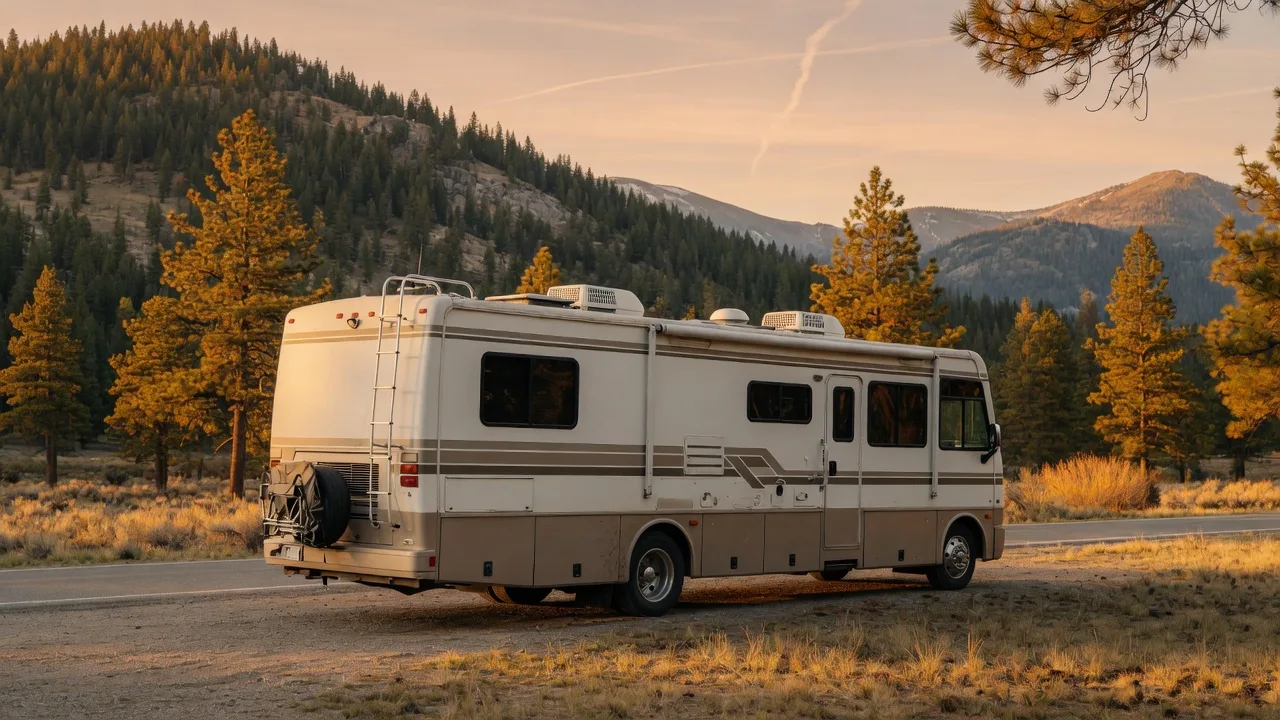
Class A motorhomes (the bus-shaped coach on a heavy commercial chassis) carry the largest tanks in the RV world. Fresh-water tanks typically run 60-100 gallons, gray-water 50-100 gallons, and black-water 40-80 gallons. A 4-person trip in a Class A with 80/60/50 (fresh/gray/black) can run 4-5 days between dumps with disciplined water use.
Diesel pushers at the high end of the Class A spectrum (Tiffin Allegro Bus, Newmar Dutch Star, Entegra Coach Aspire) often add a 30-50 gallon LP-gas tank for absorption refrigerator + furnace + water heater + range — these are ASME-spec permanently-mounted propane tanks (no DOT 12-year recertification required under 49 CFR 180.205).
- Fresh water: 60-100 gal typical
- Gray water: 50-100 gal typical
- Black water: 40-80 gal typical
- Propane: 30-50 gal ASME tank
- 4 adults · disciplined use → 4-5 days between dumps
Class C motorhomes — the rental-fleet standard
Class C motorhomes (cabover bunk over a cutaway van chassis like Ford E-450 or Mercedes Sprinter) carry mid-range tanks. The 2026 Coachmen Leprechaun + Thor Four Winds + Winnebago Minnie Winnie + Jayco Greyhawk floorplans publish 40-60 gallon fresh, 30-50 gray, 30-40 black. A 4-person family in a 28-foot Class C with 45/35/35 tanks typically dumps every 3 days.
Cabover bunk capacity caution: per OEM occupancy ratings, the cabover sleeping area on most Class C rigs is rated for 350-650 pounds total — that's two adults max in the bunk on the high-rating rigs, one adult plus one child on most. The Federal Motor Carrier Safety Administration's 180 lb/passenger standard (FMCSA 49 CFR 393.86) is what insurance carriers use to calculate occupant safety claims after an accident; exceeding the cabover rating can void coverage. Verify cabover rating on the host's data plate before assuming 'sleeps 6' means 6 adults.
- Fresh water: 40-60 gal typical (Class C cutaway chassis)
- Gray water: 30-50 gal typical
- Black water: 30-40 gal typical
- Propane: 20-40 lb DOT cylinders (12-yr recert per 49 CFR 180.205)
- 4-person family · 3 days typical between dumps
Class B campervans — the quick-trip workhorse
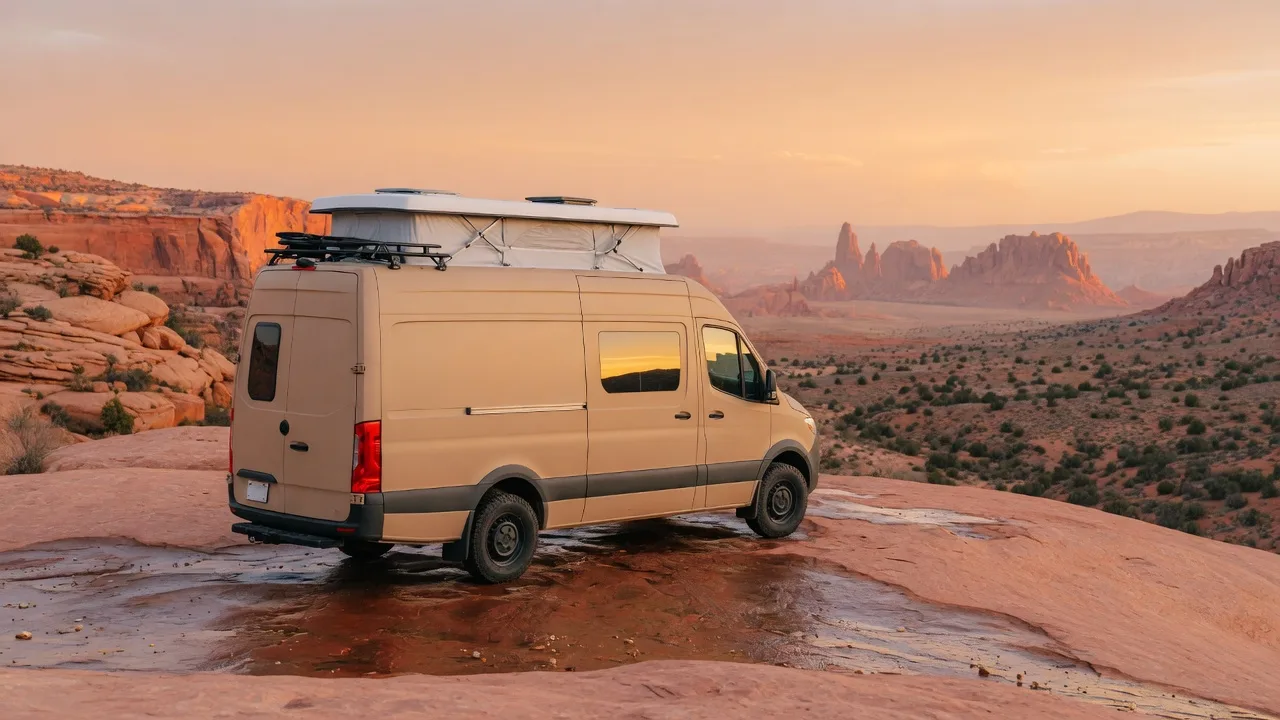
Class B campervans (Mercedes Sprinter, Ford Transit, Ram Promaster conversion vans like Winnebago Travato, Coachmen Crossfit, Storyteller Overland, Thor Sequence) trade tank capacity for drivability. Fresh-water tanks typically run 15-30 gallons, gray 15-25, black 10-15. A couple boondocking in a Class B with 22/18/12 tanks should plan to dump every 2-3 days at most.
Many Class B conversions ship with a composting or cassette toilet instead of a black tank. Composting toilets (Nature's Head, Air Head) hold 60-80 solid uses before emptying; cassette toilets (Thetford C-403, Dometic 970) hold 4-5 gallons of liquid + solid waste in a removable container that empties at any standard toilet. Always check the host's listing for the toilet type — it changes your dump-station strategy completely.
- Fresh water: 15-30 gal typical (Class B van)
- Gray water: 15-25 gal typical
- Black water: 10-15 gal · OR composting · OR cassette
- Propane: 10-20 lb DOT cylinder
- Couple boondocking · 2-3 days typical between dumps
Travel trailers + fifth-wheels — wide capacity range
Towable trailers cover the widest tank-capacity range in the RV world because the chassis isn't motorized — the trailer designer can prioritize tank space without sacrificing engine bay or fuel tank real estate. A small Airstream Bambi 16RB carries 30/26/18 (fresh/gray/black); a large fifth-wheel Grand Design Solitude or Jayco Eagle 355MBQS may carry 80/100/100.
The Jayco product literature (Jayco.com 2026 brochures) publishes per-floorplan tank sizing, as do Grand Design RV, Forest River Cherokee, and Airstream. Verify the spec sheet on the host's listing or ask before booking — towable tank ranges are too wide to assume.
- Small travel trailer (16-22 ft): 25-45/20-40/15-30 gallons typical
- Mid travel trailer (24-30 ft): 40-60/40-60/30-50 typical
- Fifth-wheel (30-40 ft): 60-100/60-100/40-80 typical
- Toy haulers: typically 80-100 gal fresh (water for ATV / dirt-bike wash-down)
The dump-cadence formula nobody publishes
Pre-trip planning math: total gray + black tank capacity ÷ (people × per-day water use) = days between dumps. Use 6 gallons per person per day for conservative boondocking, 10 for moderate use, 15 for hookup-style relaxed use. A Class C with 35-gal gray + 35-gal black = 70 gallons combined; 4 people at 10 gal/day = 1.75 days between dumps if you're not careful, 3+ days if you're conservative.
What every dump-cadence calculator misses: gray fills faster than black on most trips. Toilet uses ~0.5-1 gallon per flush (per the EPA WaterSense standard). Showers use 2-3 gallons per minute at low-flow heads (per US DOE Energy Saver guidance). Dishwashing adds another 2-3 gallons per meal. Gray tank typically fills 1.5-2× faster than black; plan dump cadence around gray, not black.
- Conservative boondocking: 6 gal/person/day
- Moderate use: 10 gal/person/day
- Hookup-relaxed use: 15 gal/person/day
- Dump cadence: total gray+black capacity ÷ (people × per-day) = days
- Gray fills 1.5-2× faster than black — plan around gray
Where to dump — the federal lands map
Per the US Forest Service campground directory (fs.usda.gov) and NPS campground services data (nps.gov), most developed federal campgrounds with hookups offer dump stations free for registered campers. Many BLM Long-Term Visitor Areas (Quartzsite, Imperial Dam, Yuma area per blm.gov) operate dump stations for a $5-15 per use fee. Recreation.gov campsite filters include 'dump station' as a search facet — use it before booking.
Outside federal land: private RV parks publish dump-station fees ranging $5-25 per dump. Some Pilot Flying J + Love's truck stops offer dump stations at fueling islands for $10-20 (verify per location on the chain's app — not all locations have them). State park dump stations vary; Texas Parks + Wildlife Department publishes locations at tpwd.texas.gov, California State Parks at parks.ca.gov.
- NPS developed campgrounds: usually free for registered campers (nps.gov)
- BLM LTVAs: $5-15 per dump (blm.gov)
- Private RV parks: $5-25 per dump
- Truck stops (Pilot Flying J, Love's): $10-20 per dump (chain-dependent)
- State parks: varies — check state agency site
Composting + cassette alternatives
Composting toilets (Nature's Head, Air Head, Separett Villa, OGO) separate liquid + solid waste at the source. Solid container holds 60-80 uses before emptying; liquid container holds 2-3 days for a couple. Solids empty into any sealed trash container then disposed in a standard waste stream per EPA Solid Waste Management Hierarchy guidance.
Cassette toilets (Thetford C-403, C-220, Dometic 970, 972) hold 4-5 gallons of mixed waste in a removable plastic container with a sliding pour spout. Empty at any standard toilet (RV dump stations, public restrooms, campground restrooms). Cassettes are illegal to empty into storm drains, lakes, rivers, or on the ground in all 50 states per the Clean Water Act.
Winterizing tanks — antifreeze type, blow-out vs pink-fluid method
Tank winterization protects fresh-water lines + pumps + tank walls from below-freezing temperatures. Per RVIA technical guidance and Camco + Thetford product literature, only propylene-glycol-based RV antifreeze (the pink stuff, sold as 'RV + Marine Antifreeze' under brands like Camco, Splash, Star Brite) is safe for fresh-water systems. Ethylene-glycol automotive antifreeze (the green stuff) is acutely toxic and ILLEGAL to introduce to any potable-water system per EPA Safe Drinking Water Act rules — never substitute.
Two methods exist: (1) Pink-fluid method — drain tanks, bypass water heater, pump 2-4 gallons of RV antifreeze through every faucet + toilet + outside shower until pink fluid runs from each. Refill traps with antifreeze. Typical cost: $15-30 per rig, 45-90 minutes labor. (2) Blow-out method — drain tanks, connect a low-pressure air compressor (max 30 PSI per most OEM service manuals — higher pressure splits PEX fittings) to the city-water inlet, open each faucet in sequence until air-only flow. Faster but leaves trace water in low spots; pink-fluid is the belt-and-suspenders approach.
Per the Forest River + Jayco + Winnebago owners-manual sections on winterization, leaving any water in fresh-water lines below 28°F for more than 24 hours risks cracking PEX fittings, ruptured water-pump diaphragms, and split fresh-water tank walls. Repair costs range from $300 (single split fitting) to $4,000+ (replacement fresh-water tank + cabinet rebuild). The 30 minutes of winterization is the cheapest insurance in the RV maintenance calendar.
- Use ONLY propylene-glycol RV antifreeze (pink) — never automotive (green)
- Bypass water heater BEFORE introducing antifreeze (don't fill the 6-12 gallon tank)
- Pink-fluid method: 2-4 gallons per rig · 45-90 min · belt-and-suspenders
- Blow-out method: ≤30 PSI compressor at city-water inlet · faster but trace water remains
- Below 28°F for >24h without winterization = high crack risk
Frequently asked questions
How often should I dump my RV black tank?›
Once it reaches 2/3 full, not on a fixed schedule. Dumping a 1/3-full black tank leaves solids behind that can pyramid into the dreaded 'poop pyramid' that needs expensive professional removal. Wait until the sensor reads 2/3 or higher, then dump black first, then gray (gray-water rinses the sewer hose).
Can I dump gray water on the ground at boondock sites?›
No — illegal in all 50 states under the Clean Water Act and most state EPA equivalents. Even 'food-safe' biodegradable gray water contains grease, soap, and food particles that contaminate watersheds and attract wildlife. Hold it and dump at a proper station.
What if my RV tank sensors don't work?›
This is extremely common — sensors get coated with residue and read 'full' permanently. Use the time-based method: track shower minutes + dish loads + toilet flushes, calculate against capacity, and dump on schedule. Many RV owners ignore sensors entirely and use the calendar method.
How much water should I budget per person per day in an RV?›
6 gallons for conservative boondocking, 10 for moderate use, 15 for hookup-relaxed use. This includes drinking, cooking, dishwashing, sponge baths or low-flow showers, and toilet flushes.
Are composting toilets worth it for rental RVs?›
If your rental has one, expect ~60-80 uses before solids need emptying — far less frequent than a 35-gallon black tank. But check the host's listing for emptying instructions; some hosts require a specific compost-bag disposal procedure.
Will my RV's tanks freeze if I park overnight in 25°F weather without winterizing?›
Risk depends on duration and tank fill level. A full fresh tank with ambient ≥25°F for a single 8-hour overnight typically survives — water mass slows the freeze. Empty lines + partially-full tanks are the highest risk. For any forecast below 28°F lasting >24 hours, winterize or run interior heat continuously and add tank-heating pads if equipped.
Is RV antifreeze safe to drink after dewinterization?›
Per RVIA + Camco product literature, propylene-glycol RV antifreeze is non-toxic but tastes terrible. Flush each line until the pink color is completely gone, then flush an additional 5-10 gallons through the fresh tank before drinking. Most RVers run 2-3 full fresh-tank rinses before consuming.
Continue your research on PickRV
Sources
- 1.EPA WaterSense — water-use statisticsUS EPAgovernment or university source
- 2.49 CFR 393.86 — Rear impact guards and rear end protectionUS DOT FMCSAgovernment or university source
- 3.49 CFR 180.205 — DOT cylinder recertificationUS DOTgovernment or university source
- 4.Recreation.gov campground services + filtersUSDA + DOIgovernment or university source
- 5.US DOE Energy Saver — low-flow showerhead standardsUS DOEgovernment or university source
- 6.BLM Long-Term Visitor Areas (Quartzsite, Imperial Dam, Yuma)BLMgovernment or university source
Sources are a mix of government and university publications and the company or industry documentation for the specific equipment, store policy or standard discussed — each row above says which one it is, so you can weigh it yourself. Last verified 2026-06-04. Report broken links to support@pickrv.com.
Ready to roll?
Pick a rig. Write the road.
Complete nightly price on every listing — your exact total itemized before you pay · 48h full rental refund. Every rig near you, one checkout.
Related reads
Plan around this guide · 3
Hub anchors · mega-guides · cost calculator — one click each.
Related on PickRV
Tell us when you want to travel.
Owners list their own rigs on PickRV. Add your dates and we'll email you when one is listed for them — nothing else, no spam.
Was this guide helpful?