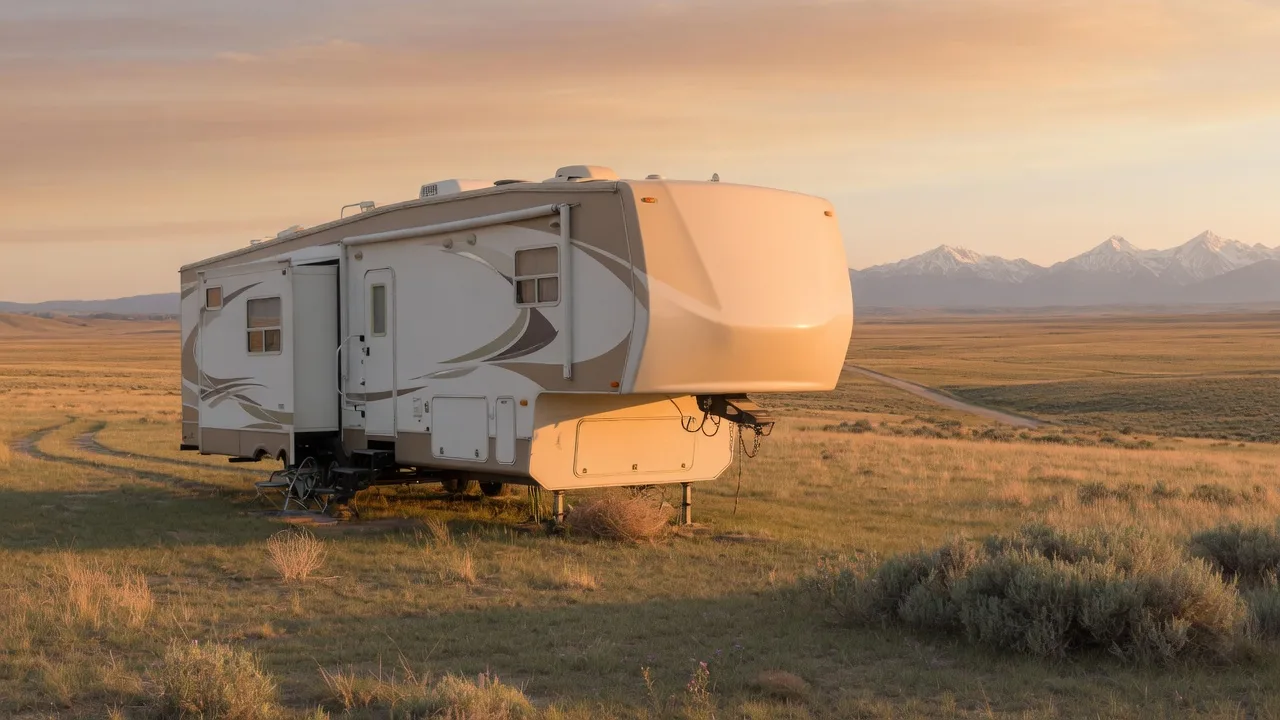
Both are bed-mounted pivots, but the geometry, pin-weight percentage, turning clearance, and state-DOT rules are not interchangeable. SAE J2638 is the standard that actually matters.
The shared geometry that makes both different from bumper-pull
A conventional travel trailer puts the tongue weight (10-15% of trailer weight) on a bumper-mounted hitch behind the rear axle. The pivot point is far aft of the truck's rear axle, which creates the classic leverage that makes sway possible. Fifth-wheel and gooseneck trailers move the pivot point into the truck bed, roughly over or slightly forward of the rear axle. The result is dramatically better stability at the cost of requiring a pickup with bed access and sufficient payload on the rear axle.
The kingpin (fifth-wheel) or gooseneck ball (gooseneck) becomes the instantaneous center of rotation. Trailer weight forward of that point is 'pin weight' or 'tongue weight' in the bed. Trailer weight behind it is carried on the trailer's axles. The truck's rear axle therefore carries the pin weight plus a portion of the truck's own weight and any cargo.
Pin weight percentage — why 15-20% is the real number, not marketing
Industry shorthand for fifth-wheels is 15-25% of the trailer's GVWR lands on the pin. Real published numbers from Grand Design, Jayco, Keystone, Heartland, and others for 30-40 ft fifth-wheels routinely land in the 18-22% range when the trailer is at GVWR with full fresh, propane, and cargo. A 14,000 lb GVWR fifth-wheel can easily put 2,500-3,000 lb on the pin. A 18,000 lb toy hauler can push 3,200-3,800 lb pin weight.
Gooseneck trailers (flatbeds, horse, equipment) are often engineered with similar or slightly higher pin percentages because the ball is farther forward in the bed than a traditional fifth-wheel hitch head. Agricultural goosenecks can run 20-25% pin on purpose to keep the trailer axles light for field work.
The 15-20% range is what you should use for planning when the exact trailer brochure is not in front of you. It is not conservative — it is the middle of the actual published spec sheets. Underestimating pin weight is how short-bed 3/4-ton owners discover they have negative payload on the rear axle once the trailer is hooked up and the fresh tank is full.
Turning radius and short-bed math — SAE J2638 and real clearance
SAE J2638 (Fifth Wheel and Gooseneck Attachment Performance) defines the test procedures and minimum performance for the coupling interface up to 30,000 lb trailer weight. It does not dictate truck bed length, but the geometry it assumes interacts directly with bed length. The critical dimension is the distance from the kingpin (or gooseneck ball) to the trailer's front corners versus the distance from the hitch pivot to the truck cab rear wall.
A long-bed (8 ft) pickup gives roughly 48-50 inches of clearance from a centered fifth-wheel hitch to the cab. Most 30-36 ft fifth-wheels need 48-60+ inches of swing clearance depending on the front cap shape and the hitch head offset. Short-bed (5.5-6.5 ft) trucks need a sliding fifth-wheel hitch (Reese, B&W Companion, PullRite) that moves the pivot point rearward when turning so the trailer front does not strike the cab. The slide adds cost ($1,400-$2,500 installed) and complexity (you must remember to slide it back for towing and forward for unhitching in tight spots).
Gooseneck balls are typically mounted farther forward in the bed than a traditional fifth-wheel hitch head. That can reduce swing clearance on some trucks and increase it on others depending on exact puck location. GEN-Y and other torsion-flex gooseneck adapters for fifth-wheel trailers are tested to exceed SAE J2638 requirements, but the physical turning radius is still governed by the truck's wheelbase, the trailer's front overhang, and the hitch offset.
- Short-bed fifth-wheel: sliding hitch almost always required
- Long-bed fifth-wheel: fixed hitch usually sufficient
- Gooseneck: ball position matters more than 'fifth-wheel vs gooseneck' label
- SAE J2638: the coupling performance standard; does not replace truck/trailer geometry checks
State DOT and CDL implications that differ by hitch type
Federal FMCSA CDL threshold is 26,001 lb GVWR single or 26,001 lb GCWR when the trailer exceeds 10,000 lb. Many states add their own rules for brake controllers, safety chains, and breakaway switches. Fifth-wheel hitches are bed-rail mounted (puck or rail) in every state. Gooseneck hitches are ball-in-bed and are the dominant configuration in Texas, Oklahoma, Kansas, and much of the Mountain West for both RV and commercial use.
Some states treat gooseneck and fifth-wheel differently for permitting or length. California CVC §26302 requires brakes on at least two wheels for trailers over 3,000 lb gross weight (manufactured after Jan 1, 1966), and CVC §26458 requires the combination's service brakes to work from a single control — with an explicit exemption for trailers using inertially controlled (surge) brakes with automatic breakaway. Pennsylvania requires breakaway protection on any towed vehicle that has brakes or exceeds 3,000 lb gross weight (75 Pa.C.S. §4502(c)). The hitch type itself rarely changes the CDL math — the GCWR and trailer GVW do. A 1-ton dually with a 20,000 lb fifth-wheel or gooseneck often crosses the GCWR line that triggers CDL even if the truck alone is under 26,001 lb.
Which one should a renter actually choose
For RV living (fifth-wheel trailers with residential interiors, slides, king beds), the traditional fifth-wheel hitch + kingpin is the mature ecosystem with the most rental inventory and the most aftermarket support. For utility, horse, or equipment trailers, gooseneck dominates because the ball is simpler, lower, and the trailers are often built around agricultural use cases.
The engineering truth: both are excellent when the truck, hitch, and trailer are matched on paper (payload, pin weight, swing clearance, GCWR) and the hardware is installed and torqued correctly. The failure modes are almost always mismatch (short-bed truck + fixed hitch + large front cap) or under-payload (3/4-ton with 2,800 lb pin weight and a full fresh tank).
PickRV will surface the exact hitch type, sliding vs fixed, and the host's measured pin weight at typical load in the listing. Renters will be required to confirm their truck's door-jamb payload sticker and GCWR before the booking is confirmed on any fifth-wheel or gooseneck listing. That is the only way to keep the real-user-complete-booking filter honest.
Frequently asked questions
Is pin weight always 20% of trailer weight?›
No — 15-25% is the typical published range for fifth-wheels at GVWR. Real numbers from spec sheets on 30-40 ft rigs are commonly 18-22%. Plan with 15-20% and weigh at a CAT scale with the trailer loaded and level.
Do I need a sliding hitch on a short-bed truck?›
For fifth-wheel trailers on 5.5-6.5 ft beds, yes in almost every case. The slide moves the pivot rearward during turns to protect the cab. Gooseneck ball position varies; measure your specific truck + trailer combination.
What is SAE J2638?›
The SAE standard that establishes minimum performance criteria and test procedures for fifth-wheel and gooseneck attachment hardware up to 30,000 lb trailer weight. It is the engineering reference that quality hitch makers (GEN-Y, PullRite, etc.) test to.
Does gooseneck or fifth-wheel change CDL requirements?›
Rarely. CDL is driven by GVWR/GCWR numbers (26,001 lb threshold) and whether the trailer exceeds 10,000 lb. State-specific brake controller and breakaway rules apply to both.
Can I convert a fifth-wheel trailer to gooseneck?›
Yes with a kingpin-to-gooseneck adapter (GEN-Y Executive, etc.). The adapter must be rated for the pin weight and tested to SAE J2638. You still need the correct ball in the truck and clearance math.
Continue your research on PickRV
Sources
- 1.SAE J2638 Fifth Wheel and Gooseneck Attachment PerformanceSAE Internationalcompany or industry source
- 2.GEN-Y Hitch — Executive and Rhino adapters tested to SAE J2638GEN-Y Hitch (manufacturer)company or industry source
- 3.PullRite Super 5th and rotational kingpin guidancePullRite (manufacturer)company or industry source
- 4.FMCSA 49 CFR 390.5 and 383.5 — CDL and GCWR definitionsUS DOT FMCSAgovernment or university source
- 5.California CVC §26302 trailer brake requirement (§26458 single-control rule)State of Californiagovernment or university source
- 6.Grand Design, Jayco, Keystone fifth-wheel spec sheets (pin weight examples)Grand Design RV / Jayco / Keystone (manufacturers)company or industry source
- 7.NHTSA / FMCSA cargo securement and towing interface contextUS DOT NHTSA / FMCSAgovernment or university source
Sources are a mix of government and university publications and the company or industry documentation for the specific equipment, store policy or standard discussed — each row above says which one it is, so you can weigh it yourself. Last verified 2026-06-05. Report broken links to support@pickrv.com.
Ready to roll?
Pick a rig. Write the road.
Complete nightly price on every listing — your exact total itemized before you pay · 48h full rental refund. Every rig near you, one checkout.
Related reads
Plan around this guide · 3
Hub anchors · mega-guides · cost calculator — one click each.
Related on PickRV
Tell us when you want to travel.
Owners list their own rigs on PickRV. Add your dates and we'll email you when one is listed for them — nothing else, no spam.
Was this guide helpful?