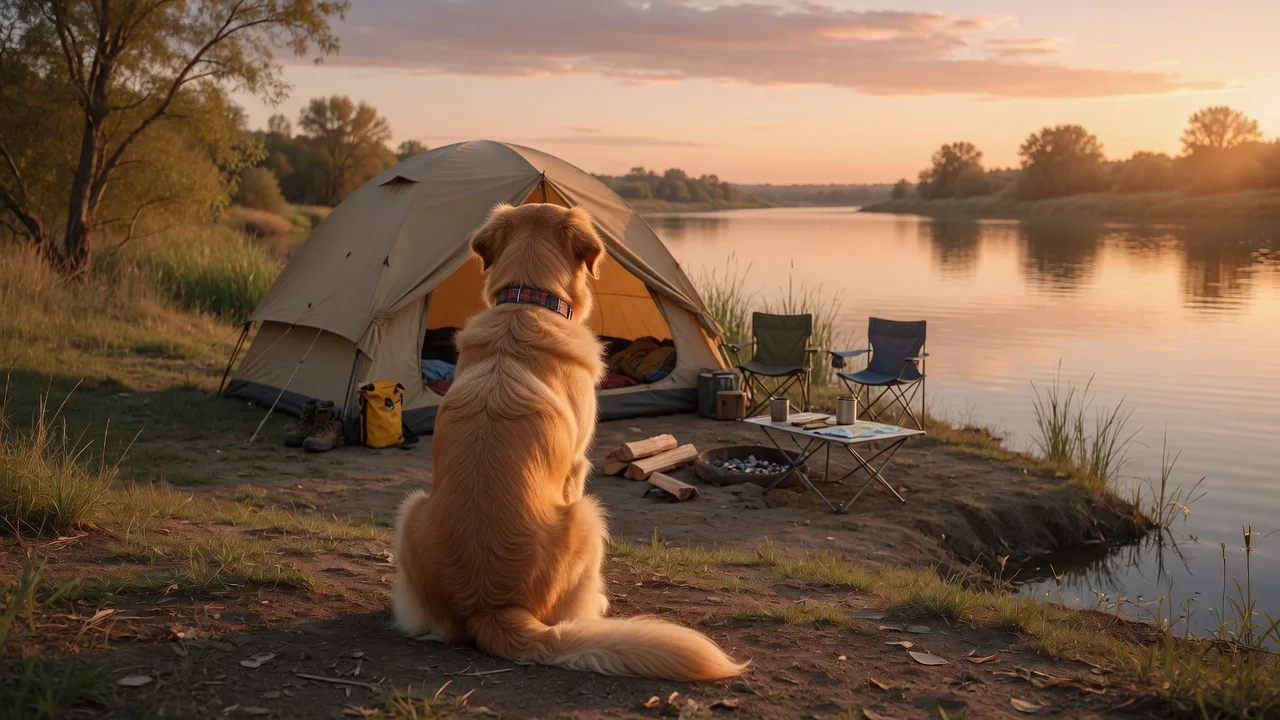
Pet policies vary dramatically between federal parks, state parks, and private campgrounds. The leash + breed + waste rules per major US camping authority.
Pet rules vary by camping authority, not state
The question 'can I bring my dog' has different answers depending on whether you're at a National Park campground, a National Forest dispersed site, a state park, a private RV park, or a BLM area. The most common renter mistake is assuming uniform rules across an entire state — in fact, the federal-vs-state-vs-private layer almost always matters more than which state you're in.
The National Park Service publishes per-park pet policies at nps.gov, state parks at each state's parks-and-recreation agency site, federal forest land at fs.usda.gov, and BLM at blm.gov. Private RV parks (KOA, Jellystone, independents) set their own policies. This article maps the major-authority defaults; verify per-site before you arrive.
National Park Service — strict leash + trail limits
Per the NPS 'B.A.R.K.' pet policy framework (nps.gov/subjects/pets/index.htm): pets in NPS units must be on a leash no more than 6 feet long, are NOT allowed on most park trails or in backcountry areas, are allowed in developed campgrounds and roads, must never be left unattended (including inside a rig with the windows closed in summer heat), and waste must be picked up + disposed in waste receptacles.
A small set of NPS units explicitly welcome pets on trails: Acadia NP allows leashed pets on most trails (per nps.gov/acad/planyourvisit/pets.htm), Shenandoah NP allows pets on most trails (per nps.gov/shen), Grand Canyon NP allows pets above the rim on paved trails (per nps.gov/grca). Most other NPS units restrict pets to campgrounds, parking areas, and developed paved areas only.
- NPS B.A.R.K. rule: Bag waste · Always leash · Respect wildlife · Know park rules
- 6-foot leash max in all NPS units
- Pets prohibited on most NPS trails (Acadia, Shenandoah, Grand Canyon are notable exceptions)
- Never leave pet unattended in vehicle (closed RV in summer = lethal heat in <15 min per AVMA + NPS guidance)
- Waste must be bagged + disposed in receptacles per nps.gov
National Forests + BLM — most pet-friendly federal land
Per US Forest Service guidance (fs.usda.gov) + BLM (blm.gov), pets are welcome on virtually all USFS + BLM trails, dispersed campsites, and developed campgrounds with limited restrictions (typically leash required in developed sites; voice-control acceptable in dispersed areas). This makes USFS + BLM land the most flexible federal-land option for traveling with pets.
Exception: USFS wilderness areas designated under the Wilderness Act of 1964 sometimes restrict pets to protect sensitive wildlife. Verify per Forest at fs.usda.gov before assuming. BLM National Conservation Areas + Wilderness Study Areas may also restrict; verify at blm.gov.
State parks — wide variation by state
State park pet policies vary dramatically. Florida State Parks (floridastateparks.org) allows leashed pets in most campgrounds + many trails with a 6-foot leash maximum + cleanup requirement. California State Parks (parks.ca.gov) allows leashed pets in campgrounds and on paved roads but prohibits pets on most trails + beaches; specific units carry different rules verified at parks.ca.gov.
Texas State Parks (tpwd.texas.gov) is one of the most pet-friendly state-park systems — leashed pets on most trails and in most campgrounds per the TPWD pets-in-parks page. New York State Parks (parks.ny.gov) varies by individual park; verify per-park. Utah State Parks (stateparks.utah.gov) allows pets in most campgrounds + some trails; check per park.
- Florida State Parks (floridastateparks.org) — pets on leash in most campgrounds + many trails
- California State Parks (parks.ca.gov) — campgrounds + paved roads only · most trails + beaches off-limits
- Texas State Parks (tpwd.texas.gov) — pet-friendly on most trails + campgrounds
- New York State Parks (parks.ny.gov) — varies per park · verify per-site
- Utah State Parks (stateparks.utah.gov) — most campgrounds + selected trails
- Colorado State Parks (cpw.state.co.us) — most campgrounds · trails vary
Private RV parks — KOA, Jellystone, independents
Per the Kampgrounds of America (KOA) corporate policy at koa.com, KOA campgrounds are universally pet-friendly with leash requirement (6-foot max), waste cleanup, and individual property rules on breed restrictions + maximum number of pets. Yogi Bear's Jellystone Park franchises (campjellystone.com) allow pets at most locations but breed restrictions and per-pet fees vary per property.
Independent RV parks set their own policies. Common patterns: $5-15 per pet per night fee, 2-pet maximum, breed restrictions on certain breeds (commonly cited: pit bull, Rottweiler, Doberman, German Shepherd, Akita, Chow Chow). Per the ASPCA + American Veterinary Medical Association, breed-specific restrictions are widely debated as not predictive of actual behavior risk, but campgrounds have set them based on insurance carrier requirements.
Service animals + emotional support animals
Per the Americans with Disabilities Act (ADA) at ada.gov, service animals (defined as dogs trained to perform specific tasks for individuals with disabilities) must be allowed at all publicly-accessible campgrounds + facilities regardless of breed or pet-policy restrictions. The ADA service animal definition does NOT include emotional support animals, therapy animals, or comfort animals — those are subject to the property's pet policy.
The Department of Transportation Air Carrier Access Act applies to airline travel but not to campgrounds; do not assume ESA documentation extends to camping. The ADA does not require service animal documentation, but property managers may ask: (1) is this animal required because of a disability, and (2) what work or task has the animal been trained to perform. Misrepresenting a non-service animal as a service animal is a misdemeanor under many state laws.
Pre-trip pet checklist
Before booking a pet-friendly trip, run through this 7-item checklist with your campground + your veterinarian.
- Verify the destination campground's specific pet policy on the campground's site (NOT a 3rd-party booking site)
- Confirm breed restrictions if applicable (most often a per-property rule)
- Confirm per-pet fee and any per-night surcharge
- Pack pet's vaccination records (rabies certificate typically required at out-of-state boarding)
- Pack leash (6-foot max for NPS), waste bags, food/water bowls, bed, and microchip ID
- Plan veterinary contacts en route (AAHA hospital locator at aaha.org/your-pet/pet-owner-education/find-an-aaha-accredited-hospital)
- Never leave pet in RV in temperatures above 70°F outside (interior temp can reach 110°F+ in 15 min per AVMA + NPS data)
When the dog is bigger than the rig
A common renter question: 'How big a dog can fit in a Class B campervan?' Per the AKC + veterinary mobility-research consensus, dogs need approximately 3-4× their body length × 2× their shoulder height of in-rig space for the equivalent of a comfortable home-bed-and-stand setup. A 70-lb Labrador needs roughly a 4×2 ft floor area; a 20-lb Cavalier King Charles Spaniel fits in much less.
For multi-week trips with multiple large dogs, a Class C or larger is significantly more comfortable than a Class B. PickRV listings disclose interior floor plans so you can verify dog-space adequacy before booking.
Cross-border + wildlife encounters — Mexico, Canada, and bear country
Per the US Department of Agriculture Animal and Plant Health Inspection Service (APHIS) at aphis.usda.gov, dogs entering the United States from any country (including returning from Canada or Mexico) must arrive with proof of rabies vaccination administered at least 28 days before arrival. The CDC publishes the current entry rules at cdc.gov/importation/bringing-an-animal-into-the-united-states. Canada requires similar documentation per the Canadian Food Inspection Agency at inspection.canada.ca. Mexico's SENASICA published its 2023-updated pet entry requirements at gob.mx/senasica — rabies certificate + health certificate within 10 days of crossing.
Wildlife encounters in NPS + USFS + BLM areas pose a unique risk for off-leash dogs. Per NPS Bear Safety guidance at nps.gov/subjects/bears, off-leash dogs in bear country can trigger defensive bear behavior that escalates to attacks on both the dog and nearby humans. Per the Interagency Grizzly Bear Committee at igbconline.org, leashed-pet protocols are mandatory in all grizzly habitat (Yellowstone, Grand Teton, Glacier, North Cascades, parts of Yellowstone-adjacent USFS). Carry bear spray + know your dog's recall reliability before any off-trail dispersed camping in bear country.
Snake encounters concentrate in desert SW + south TX + the Mojave per the AVMA snakebite-prevention guidance. Rattlesnake aversion training (offered by Western Dog Training, Natural Solutions for Pets, and many regional trainers) is the single highest-ROI training investment for any RV-traveling dog visiting the southwest in spring or summer.
- US re-entry from Canada/Mexico — rabies certificate ≥28 days pre-arrival per aphis.usda.gov
- Canada entry — see inspection.canada.ca current rules
- Mexico entry — rabies cert + 10-day health cert per gob.mx/senasica
- Grizzly country — leashed-pet protocols mandatory per igbconline.org
- Rattlesnake aversion training — high-ROI for any SW spring/summer trip
Frequently asked questions
Are pets allowed in all National Parks?›
Yes in developed campgrounds + parking areas + paved roads with a 6-foot leash maximum, no in most backcountry trails. A few NPS units (Acadia, Shenandoah, Grand Canyon above the rim) allow pets on trails. Verify per-park at nps.gov.
What is the typical pet fee at a private RV park?›
$5-15 per pet per night at most US private RV parks, sometimes with a 2-pet maximum and breed restrictions. KOA properties typically charge $5-10 per pet per night; Jellystone varies by location.
Can I leave my dog in the RV while I hike?›
Only if the rig is fully air-conditioned + the AC is verified running + a tire-mount or interior temperature monitor + cellular alert system is in place. Interior temperature can rise to lethal levels within 15 minutes if AC fails. Most professional dog-owner guidance recommends never leaving pets unattended in an unattended vehicle.
Do I need to bring my dog's vaccination records on an RV trip?›
Yes — many out-of-state campgrounds + most boarding facilities require current rabies certificate. Pack the records or have your vet email them as a PDF you can show on your phone.
Are service dogs treated differently from pets?›
Yes — per the ADA at ada.gov, service dogs trained to perform specific tasks for individuals with disabilities must be allowed at all publicly accessible facilities regardless of pet policy. Emotional support animals are NOT considered service animals under the ADA.
Continue your research on PickRV
Sources
- 1.NPS B.A.R.K. pet policy frameworkNPSgovernment or university source
- 2.NPS Acadia pet policy (trails-allowed park)NPSgovernment or university source
- 3.US Forest Service recreation pet guidanceUS Forest Servicegovernment or university source
- 4.Florida State Parks — pet-friendly campingFlorida State Parkscompany or industry source
- 5.Texas Parks + Wildlife — pets in parksTexas TPWDgovernment or university source
- 6.ADA Service AnimalsUS DOJ ADAgovernment or university source
- 7.AVMA — pets in vehicles + heat safetyAmerican Veterinary Medical Associationcompany or industry source
Sources are a mix of government and university publications and the company or industry documentation for the specific equipment, store policy or standard discussed — each row above says which one it is, so you can weigh it yourself. Last verified 2026-06-04. Report broken links to support@pickrv.com.
Ready to roll?
Pick a rig. Write the road.
Complete nightly price on every listing — your exact total itemized before you pay · 48h full rental refund. Every rig near you, one checkout.
Related reads
Plan around this guide · 3
Hub anchors · mega-guides · cost calculator — one click each.
Related on PickRV
Tell us when you want to travel.
Owners list their own rigs on PickRV. Add your dates and we'll email you when one is listed for them — nothing else, no spam.
Was this guide helpful?