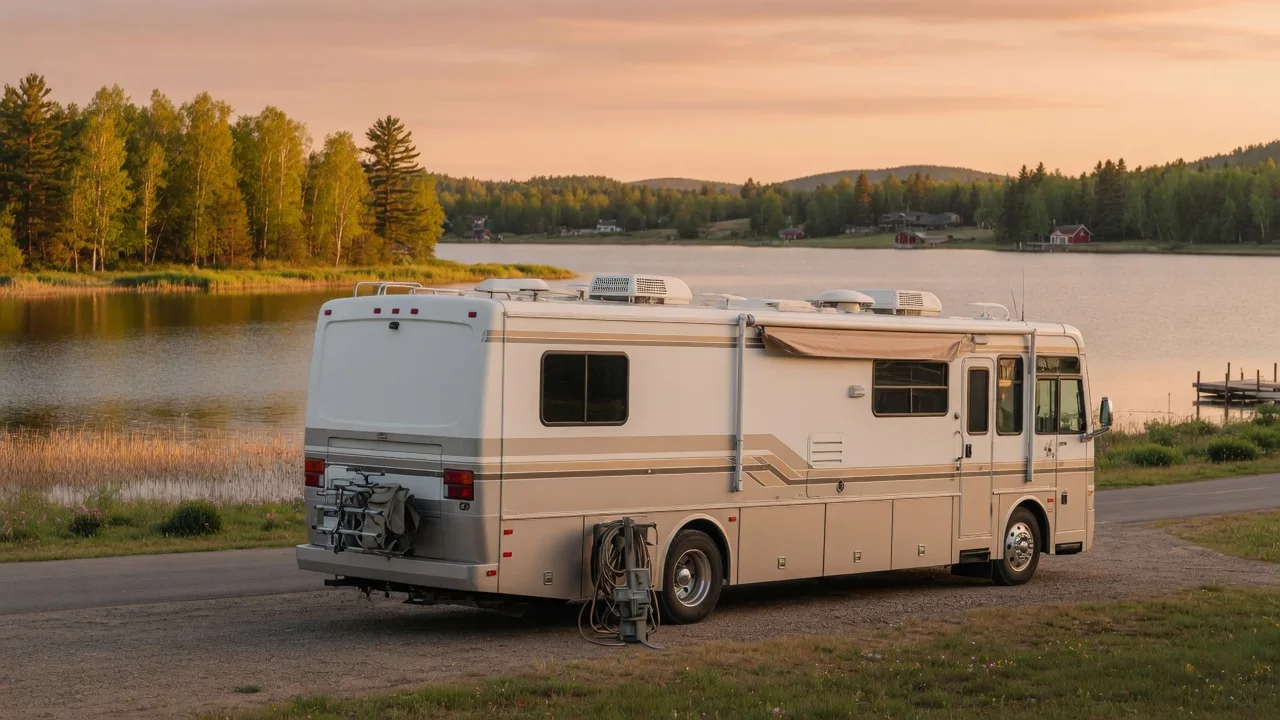
Why a 40-ft Class A can offtrack 3-5 ft on a 90-degree turn, how a 360° camera rig + mirrors beats single backup cam, and the FMCSA-endorsed training that actually transfers to RV life.
The offtracking number that surprises first-timers
A 40-foot Class A motorhome on a typical 20-25 ft wheelbase does not follow its front tires through a turn. The rear axle tracks inside the front path — offtracking — by 3-5 ft on a standard 90-degree campsite or driveway turn at normal speeds. This is geometry, not driver error: the longer the wheelbase relative to the turn radius, the greater the inward swing of the rear. RV Geeks drone footage of a 43-ft diesel pusher demonstrates the exact effect — the coach sweeps a 13-ft-wide path while the body is only 8.5 ft wide because the rear end cuts the corner.
The physics is the same one that applies to commercial motor vehicles (CMVs). FMCSA training materials for CDL backing and turning emphasize 'offtracking awareness' as a core competency precisely because the rear of a long vehicle will strike obstacles the driver thinks are cleared by the front. For RV renters, this is why a 'plenty of room' visual from the driver's seat becomes a scraped bumper or crushed sewer connection at the site.
- 40-ft Class A, typical turn: 3-5 ft inward offtrack (RV Geeks measured demos)
- Wheelbase + turn radius = primary variables; sharper turn = more offtrack
- Rear overhang (tag axle to bumper) adds tail swing on the outside of the turn
- Mirrors alone miss the rear corner by 6-10 ft on wide-body coaches
Why single backup cameras fail on tight sites
A factory or aftermarket single rear camera shows the area directly behind the bumper — useful for straight-line backing but useless for the critical 3-5 ft offtrack zone when the rig is at an angle. The camera is mounted on the centerline; as soon as the coach begins to jackknife or pivot, the image no longer covers the passenger-side rear corner that is about to contact the picnic table or fire ring.
FMCSA exemptions for camera-monitor systems (MirrorEye, Smart-Vision, Rosco) explicitly require multi-camera coverage or equivalent field-of-view to replace mirrors because a single rear view does not replicate the peripheral awareness mirrors provide during angled maneuvers. The same logic applies to RVs: a lone backup cam is a supplement, not a substitute, for proper mirror use + spotter protocol.
360° camera rigs + mirrors — the practical combination that works
The highest-success backing setups on long RVs combine three layers: (1) traditional side mirrors adjusted for the specific rig (FMCSA mirror-adjustment protocol: see the 180-lb passenger standard and sight-line requirements), (2) a 360° or multi-camera system (BirdsEye, 360° surround kits from Rosco or aftermarket RV brands) that stitches front, sides, and rear, and (3) a ground spotter with agreed hand signals who stands at the rear corner that is swinging in.
The 360° view lets the driver see the offtrack zone in real time; the mirrors give the long-range peripheral for cross-traffic and site edges; the spotter closes the 'I can't see it from here' gap. FMCSA CMV backing training (the offset backing and alley-dock maneuvers) translates directly: treat the RV site like a loading dock. Set up the approach angle before you commit to reverse, use reference points on the ground (a cone or your own marker 8 ft forward of the drive axle), and never rely on one information source.
- Adjust mirrors per FMCSA CMV protocol before every trip — not 'good enough' from last trip
- Place a temporary ground marker 8 ft ahead of rear axle as your pivot reference
- 360° camera + mirrors + one spotter at the inside rear corner = lowest incident setups
- Practice the maneuver in an empty lot with cones before you hit a $65/night national park site
FMCSA training that actually transfers to RV renters
FMCSA does not license recreational RVs under 26,001 lb GVWR in most states, but the agency's backing and offtracking curriculum is public and free. The 'Backing and Docking' modules in the CDL manual and the 'Large Vehicle Offtracking' explanatory videos (used in entry-level CMV training) are the closest thing to standardized, physics-based instruction available. Renters who watch the RV Geeks offtracking video and then the FMCSA CMV turning diagrams internalize the 'front goes here, rear goes there' mental model faster than any written checklist.
The key transferrable habit: always walk the site first, identify the inside rear swing point, and pre-position the rig so the rear axle will clear by at least the expected 3-5 ft margin. Rushing the backup because 'the camera says it's clear' is the most common cause of first-trip site damage.
What the rental listing should disclose (and rarely does)
PickRV listing policy: every motorhome listing must surface wheelbase, overall length, rear overhang if known, and whether a multi-camera system is installed. Hosts who answer the 12-question pre-booking checklist (see /wiki/first-time-rv-rental-checklist) with specific numbers on offtrack behavior and camera coverage are the ones worth the premium. Vague 'easy to back in' language is a red flag for a 40-ft rig in a 25-ft-deep pull-through that is actually a 90-degree back-in.
Frequently asked questions
How much does a 40-ft Class A really offtrack on a 90-degree turn?›
Real-world demos on 40-43 ft coaches show 3-5 ft of inward offtrack on a standard campsite turn radius. The exact amount depends on wheelbase (longer = more) and speed (slower turns increase the effect because the geometry has more time to manifest).
Is a 360° camera enough by itself for backing a long RV?›
No. A single-plane 360° view still has blind spots at the extreme rear corners when the rig is angled. Combine it with properly adjusted side mirrors (FMCSA CMV protocol) and a human spotter at the inside swing corner for the lowest risk.
Does FMCSA training apply to non-CDL RVers?›
The physics and procedures do. The public FMCSA CMV offtracking videos and backing maneuvers (alley dock, offset backing) are directly applicable to 35-45 ft RVs even if you never need a CDL. Many experienced full-timers treat their coach like a CMV for training purposes.
What is the minimum mirror adjustment for a 40-ft motorhome?›
Per FMCSA CMV mirror standards (49 CFR 393.80 and training materials): mirrors must show the rear of the vehicle and the area alongside at least one lane width. For RVs, this usually means the bottom of the mirror image should show the ground 8-10 ft behind the rear bumper when the coach is straight.
Should I practice backing before I pick up the rental?›
Yes — empty parking lot with traffic cones set to a 25-30 ft wide 'site' plus an 8-ft marker for your rear axle pivot point. Ten successful backs in both directions beats discovering the offtrack on a $150/night site with a ranger watching.
Continue your research on PickRV
Sources
- 1.FMCSA CMV Offtracking and TurningUS DOT FMCSAgovernment or university source
- 2.FMCSA Parts and Accessories — Rear-Vision Mirrors (49 CFR 393.80)US DOT FMCSAgovernment or university source
- 3.RV Geeks — How to Drive a Motorhome: Off-Tracking & Rear Overhang (drone demo)RV Geeks (practical reference)company or industry source
- 4.Stoneridge MirrorEye CMS FMCSA Exemption (multi-camera alternative)US DOT FMCSAgovernment or university source
- 5.Rosco Vision Smart-Vision FMCSA camera-monitor exemptionUS DOT FMCSAgovernment or university source
- 6.NHTSA CMV safety research — large vehicle dynamicsUS DOT NHTSAgovernment or university source
Sources are a mix of government and university publications and the company or industry documentation for the specific equipment, store policy or standard discussed — each row above says which one it is, so you can weigh it yourself. Last verified 2026-06-04. Report broken links to support@pickrv.com.
Ready to roll?
Pick a rig. Write the road.
Complete nightly price on every listing — your exact total itemized before you pay · 48h full rental refund. Every rig near you, one checkout.
Related reads
Plan around this guide · 3
Hub anchors · mega-guides · cost calculator — one click each.
Related on PickRV
Tell us when you want to travel.
Owners list their own rigs on PickRV. Add your dates and we'll email you when one is listed for them — nothing else, no spam.
Was this guide helpful?