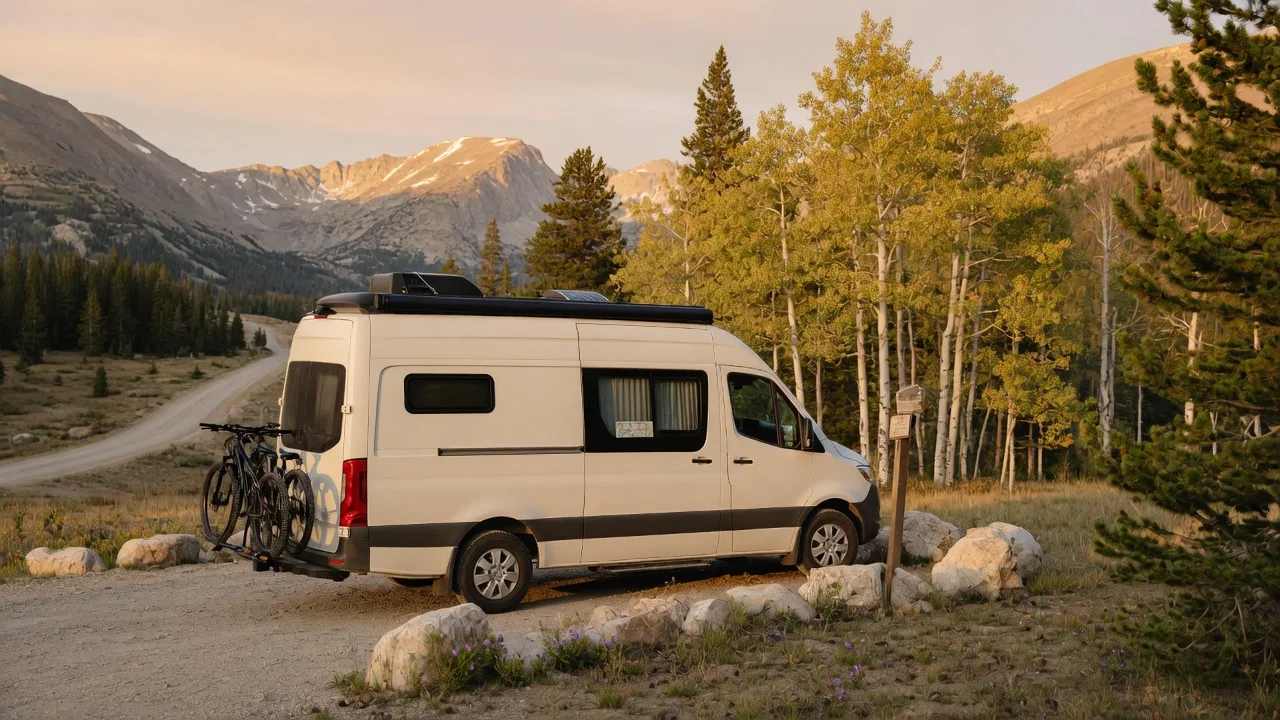
A solo traveler's rig choice is dictated by GVWR, overall length and state licensing rules long before fuel economy or 'stealth' enters the equation.
GVWR, chassis and licensing realities (NHTSA and state DMV rules)
The single most important number on any RV is the Gross Vehicle Weight Rating (GVWR) stamped on the federal certification label. NHTSA defines the classes that trigger different licensing requirements. A vehicle or combination with GVWR over 26,001 lb generally requires a Commercial Driver's License (CDL) in most states when used for non-personal transportation, but even for personal RV use the weight directly affects what license class the driver must hold and what medical certifications may apply.
Class B camper vans (Sprinter, Transit, ProMaster conversions, typically 17-22 ft) are commonly built on chassis with GVWR between 9,000 and 14,500 lb. These fall into the light-truck or medium-duty categories under NHTSA 49 CFR 571 and EPA fuel-economy tracking. Most states allow a standard Class C or D non-commercial license for these weights when the vehicle is used strictly for personal recreation. The lower curb weight also means the rig can often be driven on a regular license even when loaded with water, fuel and gear, provided the actual scale weight stays under the plate GVWR.
Small Class C motorhomes (usually Ford E-450 or similar cutaway chassis, 21-26 ft overall) frequently carry GVWR ratings of 12,500-18,000+ lb once the cab-over bunk, generator and full water/fuel tanks are added. At these weights several states require a non-CDL Class B or equivalent 'RV endorsement' or simply treat the vehicle under the same rules as a medium-duty truck for licensing purposes. The 2022-2026 NHTSA/EPA Phase 2 heavy-duty fuel efficiency and GHG rules explicitly track 'Class 2b and 3 HD Pickups and Vans' and 'Motor Home' custom chassis categories, confirming that these larger rigs are regulated differently from light-duty vans for both emissions and, by extension, operator qualifications in many jurisdictions.
The practical result for a solo traveler: a Class B under ~11,500 lb GVWR is drivable on a standard passenger license in all 50 states with only the usual medical and vision requirements. A loaded Class C that crosses 14,000-16,000 lb GVWR may require the driver to carry a different license class or additional endorsement in states that have adopted the federal CDL thresholds for non-commercial vehicles. Always weigh the actual rig at a certified scale (CAT scale or state weigh station) and compare the ticket to the door sticker before assuming your regular license is sufficient. Data as of June 2026 — always verify current state DMV rules for the exact chassis and call the issuing agency with the VIN.
Fuel economy, range and operating cost math from EPA and NREL data
Real-world fuel economy for solo RV travel is dominated by frontal area, weight and driving cycle far more than the marketing brochures suggest. The EPA and NHTSA track light-duty and heavy-duty fuel economy through the Corporate Average Fuel Economy (CAFE) program and the Phase 2 Heavy-Duty Greenhouse Gas and Fuel Efficiency standards. Motor homes and larger vans appear in the vocational and custom-chassis categories with significantly lower targets than passenger cars or light trucks.
A typical modern Class B Sprinter or Transit conversion (diesel, ~10-12k lb loaded) returns 14-18 mpg on flat highway at 55-60 mph with careful driving. The same rig in mountains, headwinds or with the generator and air conditioning running can drop to 10-12 mpg. A small Class C on the E-450 (gas or diesel, 14-17k lb loaded) commonly achieves 8-11 mpg highway and 6-8 mpg in mixed or mountain conditions. Over a 4-week solo trip covering 3,000 miles the difference is hundreds of gallons and several hundred dollars at 2026 pump prices.
NREL and ORNL Transportation Energy Data Book data show that light commercial vans in the 2b/3 weight class have improved modestly under CAFE pressure, but motor homes remain in the lowest efficiency bins because of boxy aerodynamics and high test weights. The 2024-2026 CAFE standards for light trucks project fleet averages near 49 mpg for cars and light trucks, but the vocational and motor-home categories have far lower stringency precisely because of the duty cycle and weight realities. For a solo traveler the 'fuel-economy gap' that looks attractive on paper (van vs Class C) often disappears once real loaded weights, wind, altitude and the cost of idling the generator for work or comfort are included.
Range planning must also account for DEF (diesel exhaust fluid) on modern diesels, generator fuel if boondocking, and the fact that many Class C models have smaller fresh-water and fuel tanks relative to their weight. A solo traveler in a Class B can often carry enough fuel and water for 400-500 mile legs between services; the same person in a heavier Class C may be limited to 250-300 mile legs before weight or tank capacity forces a stop. Data as of June 2026 — always verify current EPA fuel-economy labels for the specific chassis year and model and cross-check with real-world logs from owners of identical builds.
Length, height, stealth parking and state DOT / toll constraints
For solo travelers who rely on stealth or dispersed camping, overall length and height are often more limiting than fuel economy. Most big-box and casino lots, trailhead parking and many city streets have implicit or posted limits around 20-24 ft for 'overnight' vehicles. A 17-19 ft Class B van fits in a standard parking space or truck pull-through at most rest areas. A 24-26 ft Class C with cab-over and rear overhang frequently exceeds those practical envelopes and may be turned away or ticketed.
State DOT and toll authorities classify vehicles by number of axles, length and sometimes height or weight for toll pricing and tunnel/bridge restrictions. The IBTTA and individual state turnpike authorities publish tables that place most Class B vans in the 2-axle 'car' or 'light truck' toll category, while many Class C rigs with dual rear wheels or overall length over 22 ft are billed as 3-axle or commercial. Some states (Pennsylvania Turnpike, New York Thruway, Florida Turnpike, etc.) have explicit RV or 'recreational vehicle' schedules that differ from passenger cars. A solo traveler who plans routes through toll-heavy corridors can save $50-150 per cross-country trip simply by choosing the shorter, lighter rig.
Height is another hard constraint. Many older parkades, fast-food drive-thrus and some state park entrance gates have 11-12 ft clearances. A stock Class B van is usually 8-9 ft tall; a Class C with air conditioning and roof racks easily reaches 10.5-12+ ft. The difference determines whether the rig can use certain urban overnight options or must detour to truck stops. NHTSA and state motor carrier safety rules also require specific lighting and reflector placement once the vehicle exceeds certain dimensions; these are rarely an issue for a solo Class B but can become compliance items for a taller, wider Class C.
The honest decision for most solo travelers who value flexibility over interior volume is therefore the Class B platform, provided the builder has kept the finished weight and length under the thresholds that trigger extra licensing, higher tolls and parking rejection. A Class C only makes sense when the traveler needs the dedicated cab-over sleeping space, larger fresh tank or the ability to carry a towed vehicle and is willing to plan routes and stops around the larger physical envelope. Data as of June 2026 — always verify current length, height and axle-based toll schedules directly on the state DOT or turnpike authority website for every state on the planned itinerary and measure the actual rig before assuming it fits the 'car' or '2-axle' category.
Frequently asked questions
Do I need a CDL to drive a Class C motorhome?›
In most states a standard non-commercial license is sufficient for personal recreational use even if GVWR exceeds 26,001 lb, but some states have adopted additional 'RV' or non-CDL Class B requirements once the vehicle crosses certain weight or length thresholds. Weigh the actual rig and check the specific state DMV rules for the chassis GVWR and your license class before travel.
How much real-world fuel economy difference should I expect between a Class B van and a small Class C?›
Loaded highway figures for a modern diesel Class B conversion are typically 14-18 mpg; a comparable loaded gas or diesel Class C on an E-450 chassis is more often 8-11 mpg. Mountain grades, headwinds, generator use and the weight of water/fuel/provisions widen the gap further. Over 3,000 miles the difference can exceed 150 gallons.
Will a 24 ft Class C fit in the same stealth or big-box parking spots as a 19 ft van?›
Often no. Many retail and trailhead lots have practical limits around 20-22 ft for vehicles that are allowed to remain overnight. A Class C with cab-over and rear overhang frequently exceeds those envelopes and may be asked to leave or ticketed. Measure the finished rig and test the specific locations you plan to use.
Do toll authorities treat Class B vans and Class C motorhomes the same?›
Frequently not. Many turnpikes and bridges classify by axles, overall length or declared weight. A 2-axle Class B van often pays the 'car' or 'light truck' rate; a Class C with dual rear wheels or length over ~22 ft may be charged a higher '3-axle' or recreational-vehicle rate. Check the current toll schedule for every state on your route.
What is the single most important pre-purchase or pre-rental check for either platform?›
Obtain the actual scale weight of the finished, loaded rig (including full fresh, gray, black, fuel and typical cargo) and compare it to the GVWR on the certification label. Staying under the plate weight is required for safe braking, tire life and legal operation; exceeding it voids many insurance coverages and can create licensing or toll issues.
Continue your research on PickRV
Sources
- 1.NHTSA Corporate Average Fuel Economy Standards for Model Years 2024-2026NHTSAgovernment or university source
- 2.NHTSA/EPA Phase 2 Heavy-Duty Greenhouse Gas and Fuel Efficiency Standards RIA (motor home and Class 2b/3 categories)NHTSA / EPAgovernment or university source
- 3.Minnesota Commercial Driver's License Manual — Class B and Class C definitions and GVWR thresholdsMinnesota DPSgovernment or university source
- 4.Transportation Energy Data Book Edition 40 (light truck and motor home fuel economy trends)ORNL / DOEgovernment or university source
- 5.49 CFR 383 — Commercial Driver's License Standards; Requirements and Penalties (federal baseline for state licensing)FMCSAgovernment or university source
- 6.IBTTA and state turnpike authority RV and axle-based toll classification tables (example links aggregated via IBTTA resources)International Bridge, Tunnel and Turnpike Associationcompany or industry source
- 7.EPA/NHTSA regulatory categories for Class 2b/3 vans and motor homes under Phase 2 rulesEPA / NHTSAgovernment or university source
- 8.NHTSA Federal Motor Vehicle Safety Standards and state DMV guidance on non-CDL recreational vehiclesNHTSAgovernment or university source
Sources are a mix of government and university publications and the company or industry documentation for the specific equipment, store policy or standard discussed — each row above says which one it is, so you can weigh it yourself. Last verified 2026-06-06. Report broken links to support@pickrv.com.
Ready to roll?
Pick a rig. Write the road.
Complete nightly price on every listing — your exact total itemized before you pay · 48h full rental refund. Every rig near you, one checkout.
Related reads

Plan around this guide · 3
Hub anchors · mega-guides · cost calculator — one click each.
Related on PickRV
Tell us when you want to travel.
Owners list their own rigs on PickRV. Add your dates and we'll email you when one is listed for them — nothing else, no spam.
Was this guide helpful?