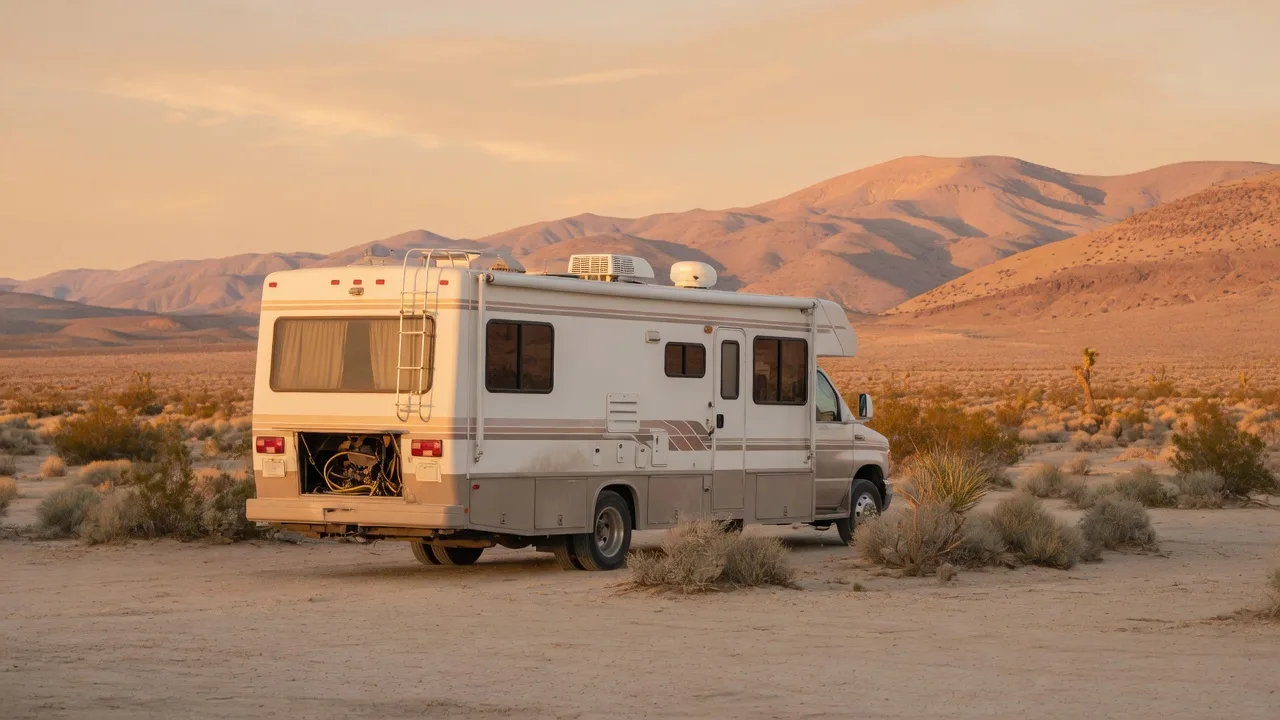
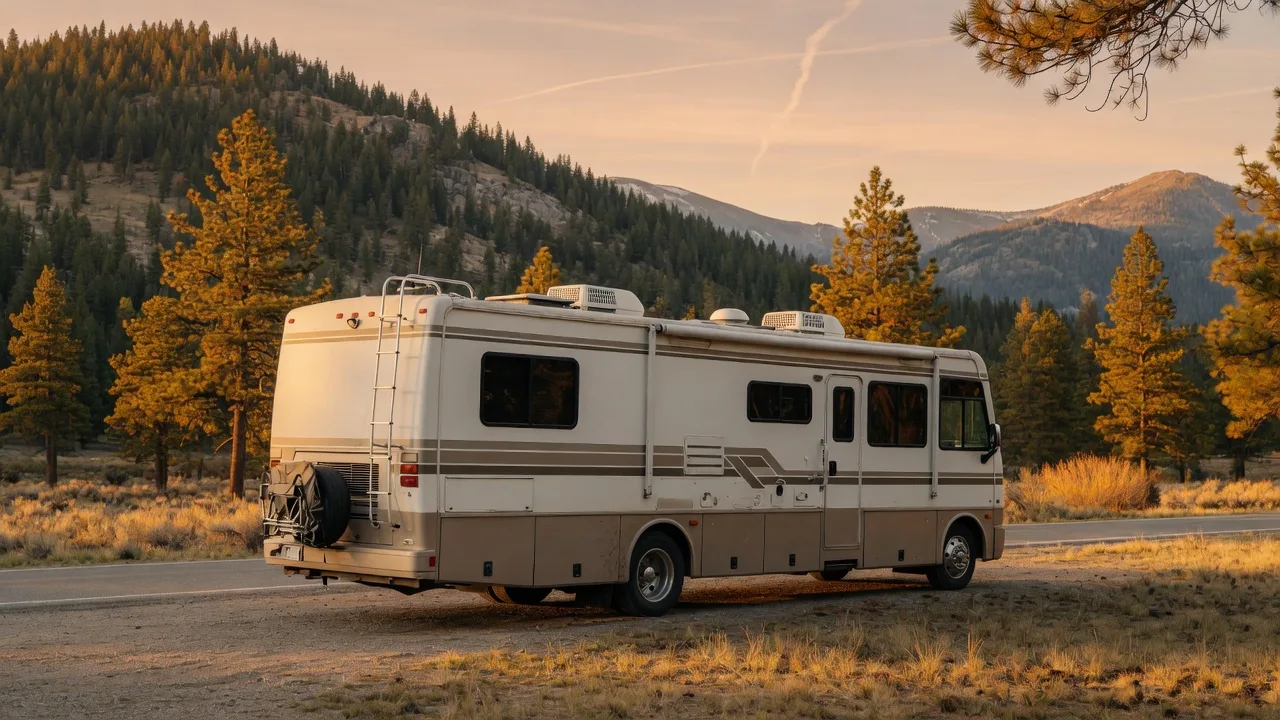
Marketing calls both 'luxury coaches.' The spec sheets, chassis weights, torque curves, and long-term ownership math say otherwise. Here is the side-by-side without the adjectives.
Chassis and weight reality — 18-26k lbs gas vs 34-52k+ lbs diesel
Per 2025-2026 Entegra Coach Vision gas Class A published specs (Ford F-53 chassis), typical GVWR ranges 18,000-24,000 lbs depending on floorplan and options, with GCWR 23,000-30,000 lbs and a standard 5,000 lb hitch receiver. Per Newmar 2026 Northern Star and larger Dutch Star / Mountain Aire data, entry diesel pushers start around 34-40 ft with GVWR 34,000-49,000+ lbs on Freightliner S2 or Spartan K3 chassis; larger tag-axle models reach 52,000 lbs GVWR. The diesel pusher is a fundamentally heavier, more robust platform built for longer-term, higher-payload travel.
Per Newmar and Entegra/Tiffin (2026 transition notes) model data, diesel pushers routinely list 12,000-15,000 lb towing capacities; gas Class A on F-53 typically 5,000 lb (some configurations to 7,500 lb with higher GCWR). The extra chassis, tag axle, larger fresh/gray/black tanks, and residential features on diesel models account for much of the weight delta.
Power and torque — 335-350 hp / 468 tq gas vs 360-525 hp / 800-1,695 tq diesel
Per Entegra Coach 2026 Vision SE and similar gas listings: Ford 7.3L V8 on F-53 chassis rated 335 hp and 468 ft-lb torque (some references list 350 hp / 468 tq de-rated calibration for RV durability vs pickup versions). Per Newmar 2026 Northern Star: 360 hp / 800 lb-ft Cummins on Freightliner S2. Larger Newmar / Entegra / Tiffin diesels use Cummins L9 or X12 at 450 hp / 1,250 lb-ft or 525 hp / 1,695 lb-ft on Spartan chassis. The torque advantage on diesel is 2-3.5x at the bottom end — decisive for mountain grades and towing.
Per owner reports aggregated on iRV2 and NIRVC ownership data, gas V8 units feel adequate unloaded on flat interstate but labor on long grades or with a toad. Diesel pushers maintain speed on passes with far less downshifting and provide strong reserve for towing.
MPG and operating cost — 6-10 gas vs 7-12 diesel (real world varies by load/terrain)
Per multiple 2023-2026 ownership summaries (NIRVC, iRV2 threads, manufacturer context): gas Class A typically returns 6-10 mpg depending on size, load, wind, and speed. Diesel pushers of similar length often see 7-12 mpg (some report 8-14 on lighter loads; heavy 40+ ft tag-axle units frequently 6-9 mpg). Diesel fuel is usually more expensive per gallon, so the mpg edge does not always translate to lower per-mile cost. DEF consumption on modern diesels adds ~2-4% to fuel cost. Over 10,000 miles the difference is measurable but secondary to the purchase price and maintenance delta for most owners.
Ride, noise, and handling — rear-engine pusher advantage
Per NIRVC and owner consensus across 2025-2026 reviews: the rear-engine diesel pusher configuration moves the heavy engine mass behind the rear axle. This yields better weight distribution, less front-end dive on braking, and dramatically lower interior noise (engine is 20-30+ feet behind the driver instead of under the floor). Most premium diesel pushers ride on full air suspension with Comfort Drive or equivalent adaptive steering. Gas Class A on F-53 typically use leaf or simpler suspension and place the V8 directly under the cockpit — more road and engine noise, more sensitivity to crosswinds and passing trucks.
Per Newmar and Entegra descriptions, the pusher ride is described as 'car-like' or 'truck-like' in comparison to the more truck-like (in a literal sense) feel of gas units. This is not marketing — it is the direct result of engine placement and chassis engineering.
Engine longevity and maintenance — 150-200k gas vs 300-500k+ diesel
Per NIRVC gas-vs-diesel ownership guide and consistent owner data on iRV2: a well-maintained gas 7.3L V8 in RV service is typically expected to reach 150,000-200,000 miles before major work. A Cummins diesel in pusher service, with proper service (oil, filters, DEF system), routinely reaches 300,000-500,000 miles; some documented examples exceed 1,000,000 miles in commercial or full-time use. Diesel engines are built for continuous high-load duty cycles from the factory. Maintenance intervals and costs are higher on diesel (larger oil capacity, DEF, potential emissions components), but the calendar time between powertrain events is substantially longer.
Purchase price, resale, and who actually needs diesel
Diesel pushers command $150k-$600k+ new depending on length and features; comparable-length gas Class A are typically $120k-$250k range. Resale on well-maintained low-mileage diesels holds better in the used market for full-timers. For weekenders and snowbirds who stay on pavement, drive <10k miles/year, and rarely tow heavy, a gas Class A on F-53 is often the rational choice. For full-timers, mountain travelers, or anyone who tows a vehicle or trailer regularly, the torque, ride, and longevity of a diesel pusher justify the premium for many owners.
Frequently asked questions
Is a diesel pusher always 'better' than a gas Class A?›
No. It depends on use case. For high annual miles, mountain routes, or heavy towing, diesel wins on torque, ride, and longevity. For lower miles, flatter terrain, and lower purchase price, gas F-53 Class A is frequently the smarter financial and operational choice.
What real mpg do owners report on 2025-2026 models?›
Gas F-53 units: commonly 6-9 mpg mixed, up to 10-11 mpg light highway. Diesel pushers: 7-11 mpg typical for 36-40 ft; heavier tag-axle 40+ ft units often 6-9 mpg. Real numbers vary wildly with load, altitude, speed, and wind.
Do I need a CDL for a diesel pusher?›
In most states, no — private RV use under 26,001 lbs GVWR does not require a CDL. Many diesel pushers exceed that; check your state's DMV for non-commercial RV rules above 26k. The chassis itself does not automatically trigger CDL for personal use.
How much more does diesel maintenance actually cost?›
Oil/filter changes on a Cummins L9/X12 can run $800-1,200 at a dealer vs $200-400 on a gas V8. DEF fluid, emissions service, and longer intervals change the math. Over 100k miles the diesel often costs less per mile in powertrain work despite higher per-service cost.
Can a gas Class A tow 5,000 lbs comfortably?›
On paper many are rated for it (5k hitch, sufficient GCWR margin on higher-GVWR F-53 models). In practice, the torque deficit on grades and the front-heavy weight distribution make towing a heavy toad or trailer more work than on a comparable diesel pusher. Test tow before committing.
Which brands build the best diesel pushers in 2026?›
Newmar (Freightliner/Spartan + Cummins), Tiffin (Cummins + various chassis), and the Entegra lineup (transitioning production to Tiffin facilities) are the primary luxury players with published high-hp/tq ratings and air-ride chassis. Verify current model-year specs directly from manufacturer sites.
Continue your research on PickRV
Sources
- 1.Entegra Coach 2026 Vision / Vision SE gas Class A specs (Ford F-53)Entegra Coach (manufacturer)company or industry source
- 2.Newmar 2026 Northern Star and lineup specs (Freightliner Cummins)Newmar Corporation (manufacturer)company or industry source
- 3.Entegra Coach to transition Class A diesel production to Tiffin (2026 notes)RV Businesscompany or industry source
- 4.Gas vs. Diesel RVs ownership comparison (longevity, mpg, ride data)NIRVCcompany or industry source
- 5.Ford F-Series Stripped Chassis platform (F-53 context)Ford Procompany or industry source
- 6.NHTSA vehicle safety resources (chassis and heavy vehicle context)US DOT NHTSAgovernment or university source
Sources are a mix of government and university publications and the company or industry documentation for the specific equipment, store policy or standard discussed — each row above says which one it is, so you can weigh it yourself. Last verified 2026-06-05. Report broken links to support@pickrv.com.
Ready to roll?
Pick a rig. Write the road.
Complete nightly price on every listing — your exact total itemized before you pay · 48h full rental refund. Every rig near you, one checkout.
Related reads


Plan around this guide · 3
Hub anchors · mega-guides · cost calculator — one click each.
Related on PickRV
Tell us when you want to travel.
Owners list their own rigs on PickRV. Add your dates and we'll email you when one is listed for them — nothing else, no spam.
Was this guide helpful?