
Off-Road Rentals on PickRV — UTV · ATV · Dirt Bike · Jeep · Snowmobile
PickRV connects you with off-road hosts staged near the BLM, USFS, and state OHV systems where the trails actually live. Five sub-types covered, twelve OHV-friendly states active, every permit requirement disclosed before checkout.
Get dirty · Pick the trail · Permit honesty included
Can I rent off-road vehicles on PickRV?
PickRV connects you with off-road hosts staged near the BLM, USFS, and state OHV systems where the trails actually live. Five sub-types covered, twelve OHV-friendly states active, every permit requirement disclosed before checkout. No listing is bookable yet — PickRV opens for bookings on October 25.
- UTV / Side-by-Side
- ATV / Quad
- Dirt Bike
- Jeep / 4WD
- Snowmobile (winter)
The off-road category on PickRV is built on a single rule: a renter should know what license, registration, and trail-pass the vehicle requires before the booking confirmation arrives. The Bureau of Land Management (BLM), US Forest Service (USFS), and state OHV offices each publish their own rules; we read them and surface them in plain English on the listing.
PickRV covers five off-road sub-types — UTV (utility task vehicle / side-by-side), ATV (all-terrain vehicle, quad), dirt bike (single-track motorcycle), Jeep / 4WD trail rig, and snowmobile (winter only). Twelve states are active right now: Utah, Colorado, Arizona, California, Nevada, Oregon, Idaho, Montana, Wyoming, Alaska, West Virginia, and Michigan. Each state page documents the OHV office of record, the registration reciprocity rules, and the trail systems hosts stage near.
Off-road is not a casual category. Hosts arrange their own OHV coverage — PickRV is not an insurer and does not verify policies — and each listing states what comes with the rig and how the host briefs you on the trail system before pickup. The host keeps 100 percent of the base price they set, and the renter pays a transparent 10 percent service fee at checkout; renters bring their own coverage, which is recommended for any rider new to the specific trail system.
The off-road category in depth — federal rules, market data, safety
Sourced from BLM Travel Management, USFS MVUM rules, SVIA / MIC retail data, ATV Safety Institute, and ROHVA. Every link goes to a primary source.
Off-Highway Vehicle (OHV) recreation in the United States is older than the interstate highway system, but the modern legal architecture around it is relatively recent. The US Forest Service's Travel Management Rule (36 CFR Part 212, finalized 2005) requires every National Forest to publish a Motor Vehicle Use Map (MVUM) designating exactly which roads and trails are open to which class of vehicle. The Bureau of Land Management's parallel Travel and Transportation Management Handbook (H-8342-1, 2012) governs BLM-administered land. Between them, these two policy frameworks define the legal trail network for roughly 440 million acres of federal land — and they update annually. A trail that was open to UTVs in 2024 may be closed in 2026 because the local Travel Management Plan was revised. PickRV's hosts re-verify their staging-area MVUM each quarter because the alternative — a renter ticketed for being on a closed route — is not theoretical.
On the demand side, the Motorcycle Industry Council / Specialty Vehicle Institute of America (SVIA) tracks US OHV sales annually. The MIC's 2023 retail data shows roughly 285,000 ATVs and roughly 365,000 UTV / side-by-side units sold in the US that year, with the UTV category having grown from under 100,000 units in 2010 — a sustained shift away from straddle-saddle ATVs toward seat-belted, roll-caged side-by-sides. (Source: MIC Annual Statistical Yearbook, summarized publicly at https://www.svia.org/statistics. PickRV does not republish proprietary tables — we link to the source.) The rental subset of that market is much smaller and harder to size precisely.
Permit reality varies more between states than most national OHV guides admit. Utah, Colorado, Arizona, Idaho, and Wyoming have a formal reciprocity compact: a current OHV registration from any of those five states is honored in the others for short visits (typically 30 days). California recognizes no out-of-state OHV registration whatsoever — every non-resident rider needs a California Non-Resident OHV Use Permit, currently $30, before riding on any state-managed OHV land (California State Parks OHMVR Division, https://ohv.parks.ca.gov). Hatfield-McCoy in West Virginia uses a per-rider trail pass system ($50/day for adults at last published rate) layered on top of a $26 trail permit per rig — a structure unique to the region. PickRV's per-state pages document each rule with a direct link to the issuing agency, not to a third-party blog.
Trail-rating systems are similarly fragmented. The most widely cited difficulty framework — the Trails Off Road / Funtreks 1-10 scale — was popularized by the Funtreks Colorado guide series and is now informally referenced by most western OHV clubs. The Rubicon Trail Foundation publishes its own internal difficulty matrix; Hatfield-McCoy uses a color-coded green/blue/black/diamond system aligned to ski-area conventions. PickRV's listings use the Funtreks 1-10 scale and bin it into four bands (Beginner 1-3, Intermediate 4-5, Advanced 6-7, Expert 8-10) for cross-state consistency, then link out to the underlying trail-system difficulty page so a renter can verify our binning against the source.
Safety in the OHV category is regulated less by federal law and more by state OHV-safety statutes (which vary widely) and by industry best-practice from the ATV Safety Institute (ASI, https://www.atvsafety.org) and the ROHVA Driver Course (https://rohva.org). ASI publishes free e-courses; ROHVA requires hands-on completion for some manufacturer rebate programs. Every PickRV off-road host includes a 30-minute orientation in the booking; for first-time riders on technical terrain, we suggest the ASI online module as pre-trip preparation. We do not require it because most state laws do not require it for adults — but we recommend it because the most common avoidable incident on rentals is a first-time rider attempting an Expert-rated route without prior experience.
Pricing posture. The listed price is stable and all-in, and a transparent 10% renter service fee is shown at checkout. Renters bring their own coverage; PickRV is not an insurer and does not sell or offer coverage. Whatever coverage a rider arranges, unpermitted trespass, competitive events, and commercial filming are the three exclusions that cause the most disputed claims in the OHV insurance industry, per public information from industry sources. PickRV's off-road host network is small and hand-curated by design; we add hosts as we verify each new host's commercial OHV policy and BLM/USFS staging-area permit.
What you get with a PickRV off-road rental
Five concrete commitments built into every booking
Permit guidance up front
Every listing names the state OHV office of record (UT OHV Program, CO Parks & Wildlife OHV, etc.), the per-rider registration fee or sticker requirement, and any non-resident permit reciprocity. We do not let a renter book a Moab rig without surfacing the Utah OHV sticker rule.
Trail-system attribution
Listings show the named trail system the host stages near — Moab, Hatfield-McCoy, Imperial Sand Dunes, Black Hills, Hayes Creek, Glamis, Pismo, Bend, Hollister Hills, etc. This is provenance, not theater: hosts cannot legitimately stage at Moab if they have no BLM permit for the staging area.
Trail rating 1-10 (four bands)
Beginner (1-3) — graded fire road, no obstacles. Intermediate (4-5) — loose surface, basic line choice required. Advanced (6-7) — moderate boulders, low-range mandatory. Expert (8-10) — articulating obstacles, winch-required scenarios. The number is a host self-assessment cross-checked against the trail system's published difficulty.
Safety gear in the price
Helmet, goggles, gloves, and a basic first-aid kit are included. Body armor for dirt bikes is included on dirt-bike rentals. The host walkthrough covers the rig's safety equipment (winch operation, recovery straps, fire extinguisher placement) before you leave the staging area.
InReach / GPS recommendation
Cell coverage on most BLM trail systems is sparse to none. We honestly recommend (not require) a satellite communicator like Garmin InReach or Spot for any trip into the backcountry. Some hosts include one in the rental; others rent at cost.
Five off-road sub-types covered
Pick the rig that matches your trail.
40 states with off-road coverage
BLM, USFS, and state-OHV permit guidance per state.
Where to ride — the 12 covered states at a glance
Curated cross-links to each state's hero trail systems. Tap through for the OHV office of record, the registration reciprocity rules, and the primary trailheads our hosts stage near.
Utah
Moab, Sand Hollow, Paiute Trail
Colorado
San Juan alpine passes, Hayes Creek
Arizona
Sedona red-rock, Florence BLM
California
Glamis dunes, Pismo, Hollister Hills
Nevada
Sand Mountain, Logandale Trails
Oregon
Bend Cascade Lakes, Oregon Dunes
Idaho
St Anthony Dunes, Salmon-Challis NF
Montana
Crazy Mountains, Beartooth USFS
Wyoming
Bighorn NF, Snowy Range
Alaska
Knik Glacier, Petersville Road
West Virginia
Hatfield-McCoy 1,000+ miles
Michigan
Drummond Island, Silver Lake Dunes
What BLM (and most online OHV guides) don't tell you
Facts that don't appear in the standard agency literature.
- ·BLM travel-management-plan changes most years, and most online OHV guides are 2-3 years out of date. We re-verify each trail system's published map every quarter.
- ·Reciprocal OHV registration exists in only some states. Utah, Colorado, and Arizona honor each other's stickers; California does not honor any out-of-state ATV registration without an additional non-resident permit.
- ·Bonding requirements at certain OHV parks (CA Glamis, OR Dunes) include a security deposit that is refunded only if the rig leaves with the same tire pressure, the same fuel level, and zero new mechanical damage. Bring documentation.
- ·Cell-coverage maps published by carriers do not reflect dispersed-camping backcountry reality. Verizon's published 'extended LTE' on the Utah BLM map is fiction beyond the trailhead.
Off-road education guides
Trail rating system, OHV permits per state — read before booking.
Off-Road Trail Rating Guide — Beginner to Expert on PickRV
Off-road trail difficulty ratings explained — easy (1-3), intermediate (4-5), advanced (6-7), expert (8-10). Real BLM, USFS, and state-OHV trail-system rating cross-references.
Read guideOHV Permit Guide — Per-State OHV Sticker Rules on PickRV
OHV permit and sticker rules per state — UT, CO, AZ, CA, NV, OR, ID, MT, WY, AK, WV, MI. Reciprocity, fees, where to buy. Real .gov links throughout, no fabrication.
Read guideOff-road rental FAQs
Do I need an OHV permit?
Almost always yes. Each state runs its own OHV program with a registration sticker requirement and (often) a per-trail-system day-use pass. The listing surfaces the rules for the specific state and trail; the host walks you through the permit purchase before pickup.
Is a helmet included?
Yes — every off-road rental on PickRV includes a DOT-approved helmet sized to the rider. Dirt-bike rentals also include body armor (chest protector, knee/elbow guards). You may bring your own gear if you prefer.
Can I take the rig to any trail?
No — the host stages near a specific trail system (Moab, Hatfield-McCoy, etc.) and the rental terms specify the trail systems the rig is permitted to ride. Crossing into a different jurisdiction may void the host's insurance.
What if the rig breaks down on the trail?
The host's commercial OHV policy covers recovery for mechanical failure within the permitted trail system. You will need a way to contact the host — cell coverage on most BLM trails is sparse, so we recommend a satellite communicator for any expert-grade trip.
Do I need my own coverage to ride off-road?
Yes — PickRV is not an insurer and does not sell or offer coverage, so renters bring their own coverage. Confirm your policy covers permitted OHV use on a registered trail system (many personal policies exclude off-road use), and note that unpermitted use, racing, and commercial filming are commonly excluded. Off-road incidents are not theoretical.
What's the minimum age?
Drivers must be 18+ with a valid driver license. Some states require an additional OHV safety certificate for riders under 25 — your host will tell you before booking.
Where can I check whether a specific trail is currently open?
Federal land: each National Forest publishes a Motor Vehicle Use Map (MVUM) under the USFS Travel Management Rule, 36 CFR 212 — find it at https://www.fs.usda.gov/visit/maps and search by forest. BLM trails are governed by the local Field Office's Travel and Transportation Management Plan, listed under https://www.blm.gov/programs/recreation. State trails: check the state OHV office (e.g. Utah State Parks, Colorado Parks & Wildlife, CA OHMVR). PickRV's per-state pages link directly to the issuing agency for every staging area.
Should I take an OHV safety course before riding?
Not legally required for most adult riders, but highly recommended. The free e-course at the ATV Safety Institute (https://www.atvsafety.org) covers ATV fundamentals; ROHVA (https://rohva.org) covers UTV / side-by-side. For dirt bikes, the Motorcycle Safety Foundation Dirt Bike School (https://www.msf-usa.org) is the gold standard. Hosts include a 30-minute trail-system orientation at pickup, but a pre-trip e-course shortens the learning curve and lowers incident rates per ASI's published statistics.
Scenes from the road
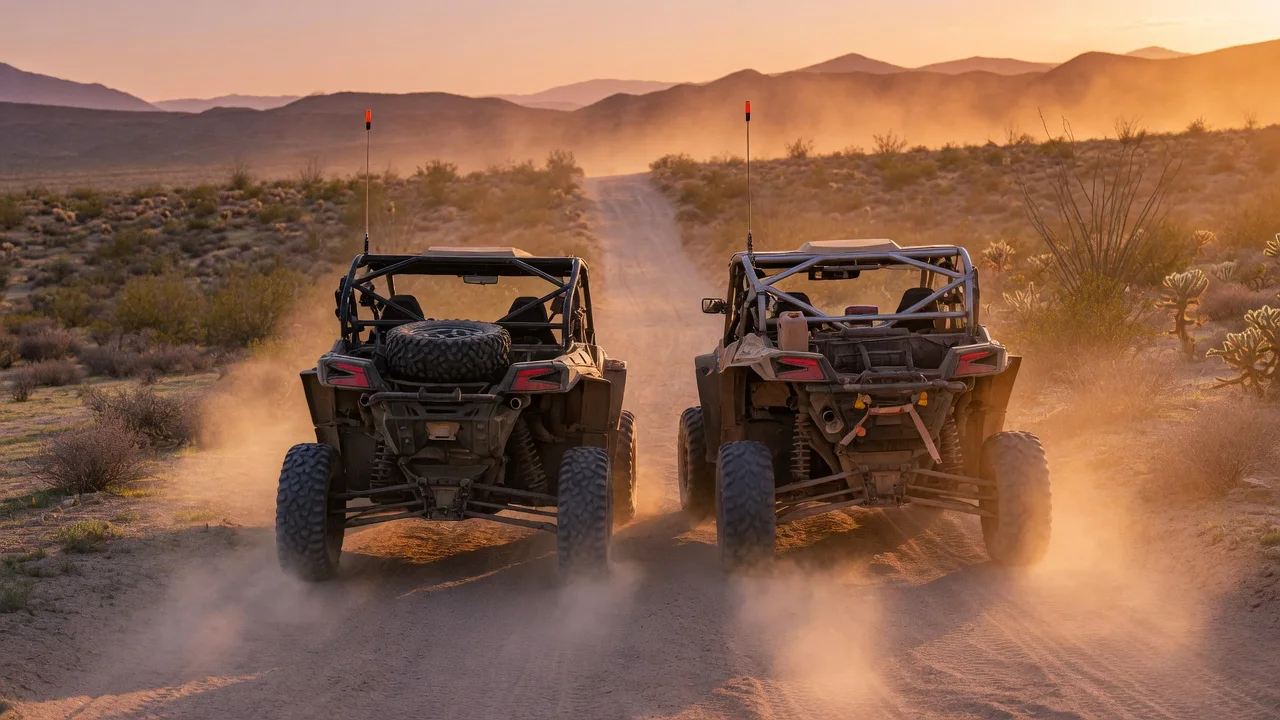
Browse the off-road listings
All hosts verified · OHV permit guidance · BLM + USFS aligned
Browse off-road rentals