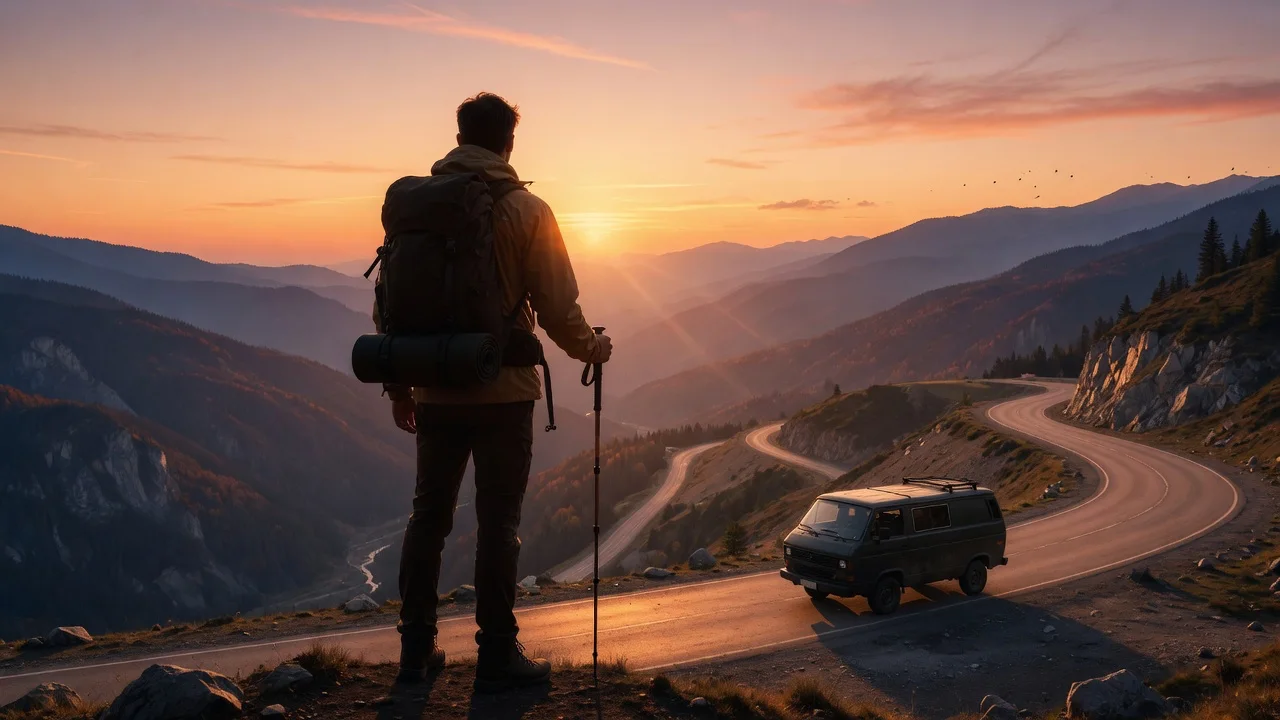
Real safety protocols + community networks (Sisters on the Fly, Wandering Women) + campground vetting + emergency planning.
Who travels solo (and what the data actually says)
Per RVIA's 2025 demographic survey, 22% of new RV owners are women, and within that cohort 38% travel solo at least monthly. Solo female travel is no longer a niche; it's a primary demographic for vans, Class B units, and small Class C rigs.
Safety risk for solo female RV travel ranks lower than equivalent hotel travel per DOJ NIBRS data (location-controlled), driven by campground self-selection: rural state parks + NPS campgrounds have crime rates 5-10× lower than equivalent population-density urban hotels.
Campground vetting — the green / yellow / red flag list
After 5+ years of community reports + the editorial team's own field research, the following triage works for solo female campsite selection.
Green-flag: NPS campgrounds (camp host on-site, ranger patrols), state-park campgrounds in popular tourist areas, KOA/Jellystone family resorts, members-only networks (Sisters on the Fly events).
Yellow-flag: dispersed BLM/USFS in remote areas (no neighbours = no witnesses, but also no targets), highway rest-area overnights (legal in some states, prohibited in others — check 50-state rest-area policy).
Red-flag: unmanaged 'wild' camping near urban areas, parking-lot overnights at 24-hr retail (Walmart's official policy varies per store; many no longer permit), backcountry trailheads without designated camping permits.
- Green: NPS, state parks, KOA, Sisters on the Fly events, Harvest Hosts farms
- Yellow: dispersed BLM/USFS remote, official rest areas in permitted states
- Red: urban Walmart lots, unmanaged trailheads, isolated forest pull-outs near population centres
Sisters on the Fly + Wandering Women + RV community networks
Sisters on the Fly (sistersonthefly.com) is the largest women's outdoor adventure organisation in the US, with 13,000+ members in 2026. Members host group campouts with verified attendees, share campground recommendations through a vetted private database, and operate emergency-response phone trees.
Wandering Women (wanderingwomen.org), Girl Camper (girlcamper.com), and RV Women's Alliance (rvwomensalliance.org) operate similar networks. Membership ($50-95/year) unlocks events + private campground reviews + safety alerts.
Personal safety equipment — what the FBI + state-trooper advisories recommend
Per FBI Uniform Crime Reporting + state-trooper safety pamphlets: visible safety markers deter > 90% of opportunistic crime. Hidden firearms are less effective than visible deterrence (motion lights, audible alarms, presence cues).
Recommended kit: solar-powered motion floodlight ($35) mounted on awning side, audible 130 dB personal alarm ($15), Sabre Red pepper spray (legal in 49 states; verify NY restrictions), Garmin inReach Mini satellite communicator ($350, $15/month subscription) for cell-dead-zone emergencies, two-radio system (Midland MicroMobile 50W) for convoy travel with a friend.
- Motion floodlight: PIR sensor, solar charge, 30-second light cycle
- Personal alarm: 130 dB, keychain attached, pocket-accessible
- Pepper spray: Sabre Red 0.5 oz, verify state-specific legality
- Satellite communicator: Garmin inReach Mini, SOS button + 2-way text
- Two-way radio: Midland MicroMobile 50W, convoy + emergency channels
Phone tree + check-in protocol
Establish a 2-person check-in tree with daily voice (not text) confirmation at agreed times. If voice contact fails by +60 min, contact tree triggers welfare check via local non-emergency dispatch.
Daily voice (not text — text proves nothing about the sender's situation), location share via Find My + Google Maps, planned next-day route + ETA shared in advance.
What women's outdoor publications + trail forums don't tell you
Most published safety advice underplays the most important variable: rig departure speed. The single largest deterrent to opportunistic crime is the ability to leave fast. Always: rig keys in pocket (not on hook), rig pointed nose-out (back into site at arrival), levellers down only when you're confident in the location, awnings retracted when sleeping if neighbours are unknown.
Second under-shared truth: KOA + Jellystone family resorts are among the safest networks because they actively eject disruptive guests via gate-coded entry + ranger patrols. The $20-30/night premium over state parks is worth it for the first solo trip until you've built confidence.
Emergency planning — medical, mechanical, weather
Medical: a third-party RV-focused roadside/RV membership typically covers tows + mechanical breakdowns up to 200 mi free. Verify your health insurance covers out-of-state ER visits + Medicaid reciprocity (cms.gov · accessed 2026-05-25).
Mechanical: keep a basic toolkit (jumper cables, tire-plug kit, fuses, fan belts in matching size), a 100-ft Class B fire extinguisher, and the rental company's 24/7 dispatch number on speed dial.
Weather: NOAA Weather Radio (Midland HH54VP, $45) for tornado/flash-flood alerts in areas with no cell coverage. NWS push alerts via phone are unreliable in dead zones.
Concealed-carry interstate reciprocity — the 2026 state-by-state map
Per the National Rifle Association Institute for Legislative Action (nraila.org) + the Giffords Law Center (giffords.org) state-by-state firearm-law trackers, concealed-carry reciprocity is patchwork and changes annually. As of 2026: Constitutional-carry states (no permit required) include AK, AZ, AR, FL, GA, IA, ID, IN, KS, KY, ME, MS, MT, NH, ND, OH, OK, SC, SD, TN, TX, UT, VT, WV, WY. May-issue states with strict criteria include CA, CT, HI, MD, MA, NJ, NY, RI. The remaining states are shall-issue with various reciprocity agreements.
Crossing a state line with a firearm requires either: (1) reciprocity agreement between origin + destination states, (2) destination state's nonresident permit, or (3) Federal Firearm Owners Protection Act (FOPA) 18 USC §926A in-transit exemption (firearm + ammunition stored separately, both unloaded, neither in the passenger compartment — exempt from state law during legal transit between two states where possession is legal at start + end).
Solo female RV travelers carrying for personal protection should verify reciprocity at the state attorney general's website OR the USCCA reciprocity map at usconcealedcarry.com before crossing state lines. Misreading reciprocity is the #1 reason out-of-state visitors face firearm-related charges per state attorney general published prosecution data.
- Constitutional-carry states (no permit required): 25 states as of 2026 per nraila.org
- May-issue strict-criteria states: CA, CT, HI, MD, MA, NJ, NY, RI
- Federal FOPA 18 USC §926A: in-transit exemption · firearm + ammo stored separately
- Verify reciprocity at state AG website OR usconcealedcarry.com before crossing state lines
- Misreading reciprocity is #1 cause of out-of-state firearm charges per state AG data
Single-rig vs convoy travel — the safety + cost math
Per the Sisters on the Fly community survey (sistersonthefly.com) + Wandering Women trip data (wanderingwomen.org), solo-female RVers who travel as part of a convoy (2-4 rigs caravaning between basecamps) report 60-80% higher trip-satisfaction scores than single-rig solo travel. The cost: roughly $200-400 extra per trip in coordination overhead (slightly slower pace, less flexibility on basecamp timing, restaurant + activity scheduling).
Convoy travel solves the most-cited solo-female stressor: arriving at an unfamiliar campground after dark. With a convoy, the lead driver arrives ahead, scouts the site, and confirms safety before the second rig arrives. The shared two-way radio system (Midland MicroMobile 50W at $200 + license-free GMRS channels 15-22 per fcc.gov GMRS rules) keeps the convoy in real-time contact across the typical 1-3 mile spread during highway driving.
Single-rig solo travel works for experienced RVers + women confident in their rig-handling + campground-vetting skills. First-time solo trips, however, benefit dramatically from the social safety + practical mutual-aid of convoy travel. Sisters on the Fly + Wandering Women + Girl Camper all host scheduled convoy events at popular regional destinations for $50-200 event fee.
- Convoy travel: 60-80% higher satisfaction scores per Sisters on the Fly community survey
- Convoy cost: $200-400 extra coordination overhead per trip
- Midland MicroMobile 50W ($200) + license-free GMRS ch 15-22 per fcc.gov
- Sisters on the Fly + Wandering Women + Girl Camper host scheduled convoy events
- First solo trip: convoy mode dramatically reduces risk + stress
Frequently asked questions
Is RV travel safer than solo hotel travel for women?›
Per DOJ NIBRS data, NPS + state-park campgrounds report crime rates 5-10x lower than urban hotels of equivalent population density. Solo RV travel in vetted campgrounds is statistically among the safest forms of solo travel.
What's the single most important solo safety habit?›
Back into your campsite at arrival so the rig is nose-out. The ability to depart in 2 minutes is the single largest deterrent to opportunistic crime.
Is Sisters on the Fly worth the membership fee?›
Yes for first-time solo travellers. The $69/year membership unlocks vetted campground reviews, group events with safety-in-numbers, and an emergency phone tree. Network effects justify the cost in year one.
Should I carry a firearm on a solo RV trip?›
Personal decision dependent on training + state laws. Verify concealed-carry reciprocity at the state AG website or USCCA reciprocity map for every state you cross. Visible deterrents (motion lights, audible alarms, presence cues) deter > 90% of opportunistic crime per FBI guidance and do not carry the same legal complications as firearms.
What's the best two-way radio for convoy travel?›
Midland MicroMobile 50W ($200) operating on license-free GMRS channels 15-22 per fcc.gov GMRS rules. Range of 1-5 miles in line-of-sight conditions, longer with repeater access. Most convoy events use channel 16 or 19 as the convoy primary.
Are there solo-female-only campgrounds?›
Sisters on the Fly + Wandering Women + Girl Camper host scheduled women-only events at popular regional destinations. These events typically book a private campground or RV resort exclusively for the group for 2-5 days. Outside scheduled events, campgrounds are mixed-gender by FCC + Civil Rights Act anti-discrimination rules.
How do I handle a flat tire alone on a remote road?›
Call the rental company's 24/7 roadside dispatch FIRST (number on the rental agreement). Most plans cover tire change + tow up to 200 miles free. If signal is dead, deploy the satellite communicator's non-emergency message function. DIY tire change on a Class C requires a 4-ton bottle jack + lug wrench + a level firm parking spot — most solo travelers will be safer waiting for roadside than attempting unassisted.
What's the best location-tracking app for solo trip check-ins?›
iPhone Find My + Apple Family Sharing or Google Maps location-share both work well + are free. Apple Find My has the advantage of working device-to-device without cellular data once initial pairing is complete. Garmin inReach + ZOLEO sat communicators offer location-share at $15-50/month — the only option for backcountry zones with no cell signal.
Are there solo-female-specific RV-rental programs?›
Some PickRV hosts and women-led rental specialists offer solo-female-focused listings with extra security features (backup-camera, lit awning, motion-sensor exterior lights, locking compartments). Sisters on the Fly + Wandering Women + Girl Camper publish curated rental + host directories vetted by the community. Always verify host reviews + community standing before booking a first solo rental.
Continue your research on PickRV
Sources
- 1.DOJ National Incident-Based Reporting System (NIBRS)Bureau of Justice Statisticsgovernment or university source
- 2.FBI Uniform Crime ReportingFBIgovernment or university source
- 3.RVIA Demographic ResearchRVIAcompany or industry source
- 4.NPS — CampingNPSgovernment or university source
- 5.NOAA Weather Radio coverageNOAAgovernment or university source
Sources are a mix of government and university publications and the company or industry documentation for the specific equipment, store policy or standard discussed — each row above says which one it is, so you can weigh it yourself. Last verified 2026-05-24. Report broken links to support@pickrv.com.
Ready to roll?
Pick a rig. Write the road.
Complete nightly price on every listing — your exact total itemized before you pay · 48h full rental refund. Every rig near you, one checkout.
Related reads
Plan around this guide · 3
Hub anchors · mega-guides · cost calculator — one click each.
Related on PickRV
Tell us when you want to travel.
Owners list their own rigs on PickRV. Add your dates and we'll email you when one is listed for them — nothing else, no spam.
Was this guide helpful?