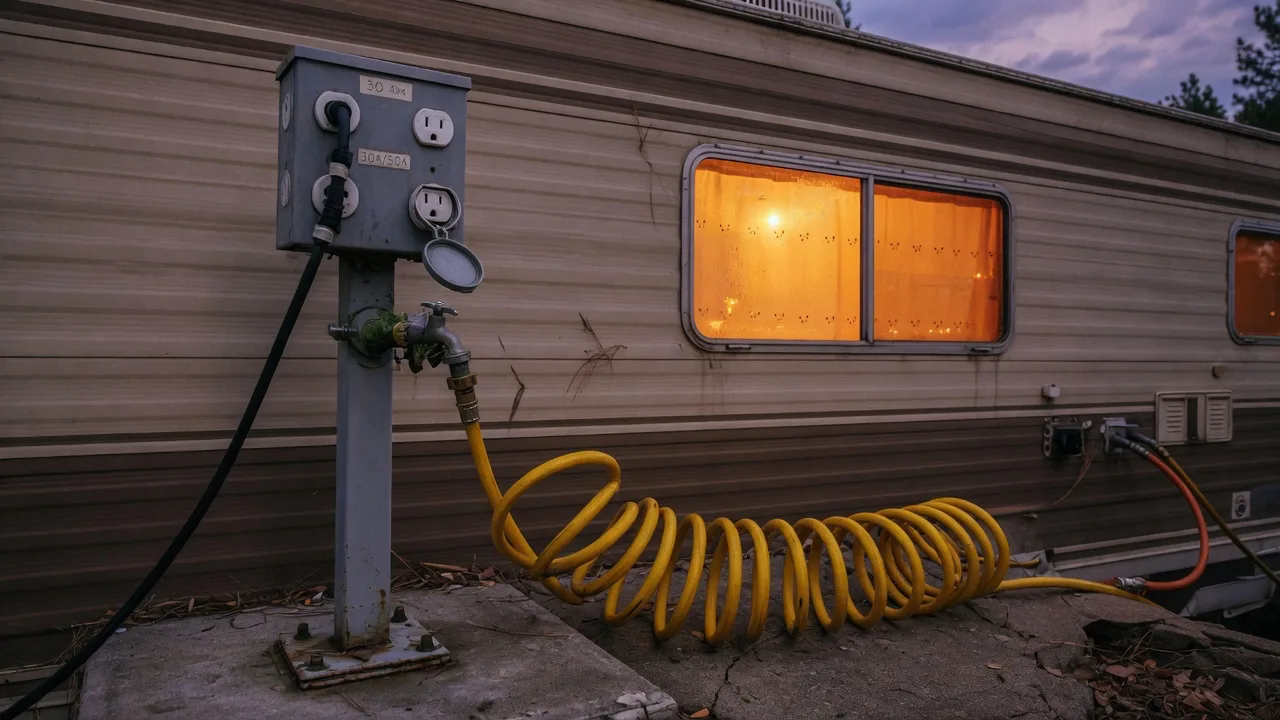
Two power worlds: 12-volt DC and 120-volt AC
Every RV runs on two electrical systems at once. The 12-volt DC side comes from your house battery and powers the things that work while you're boondocking with no hookup: lights, the water pump, the furnace fan, the fridge controls, and USB ports. The 120-volt AC side is wall-outlet power — it runs when you're plugged into shore power (a campground pedestal), when the generator is running, or when an inverter converts battery power up to AC.
Understanding which side feeds what explains nearly every 'why doesn't this work off-grid' question. Your lights and pump run off the battery all night. Your microwave, roof air conditioner, and standard outlets generally need shore power, a generator, or a big enough inverter — they drain a battery fast.
House battery, starting battery, and the depth-of-discharge trap
The chassis (starting) battery exists to start the engine; the house battery (or bank) runs the living space. Keep them straight — running your fridge controls and lights down on the starting battery can leave you unable to start the vehicle.
Battery chemistry matters for how much you can actually use. As a general rule, traditional lead-acid and AGM batteries don't like being run down below roughly half their rated capacity repeatedly, while lithium (LiFePO4) batteries tolerate much deeper discharge. The exact usable capacity, charge profile, and lifespan depend on the specific battery — so check the battery's own spec sheet rather than assuming, and on a rental, ask the host what's installed.
- Chassis battery = starts the engine. House battery = runs the living space. Don't mix them up.
- Lead-acid/AGM: treat ~50% as your practical floor unless the spec says otherwise.
- Lithium (LiFePO4): far deeper usable capacity, but verify with the unit's spec sheet.
- On a rental, ask what battery type and capacity the rig has before you plan an off-grid night.
What an inverter does (and what it can't)
An inverter turns 12-volt battery power into 120-volt AC so you can run normal household devices without shore power or the generator. A small inverter handles a laptop or phone charger easily. A large inverter can run more — but it pulls hard from the battery, so it doesn't change the fundamental limit: the battery only holds so much energy.
A high-draw appliance like a roof air conditioner or a hair dryer can flatten a typical house battery quickly even through a big inverter. That's why off-grid setups pair an inverter with a way to put energy back in — shore power, a generator, the engine alternator while driving, or solar.
Is solar worth it? The honest answer
Solar panels recharge the house battery from sunlight through a charge controller, with no fuel, no noise, and no exhaust. For people who like quiet, off-grid camping, solar is genuinely useful — it tops up the battery during the day so the lights, pump, and fridge controls keep running into the evening.
The honest caveat: how much energy solar gives you depends on panel wattage, sun, season, shade, and your battery size — there is no single number that fits every rig, and we won't invent one. Solar is great for sustaining low-draw 12-volt loads off-grid; it is generally not how you run a roof air conditioner. If you mostly stay at campgrounds with hookups, solar matters far less than it does for boondockers.
Verify locally: Real-world solar output varies enormously with panel size, sun, season, and shade — treat any single 'X panels = Y days off-grid' claim with suspicion and size your system to your actual loads.