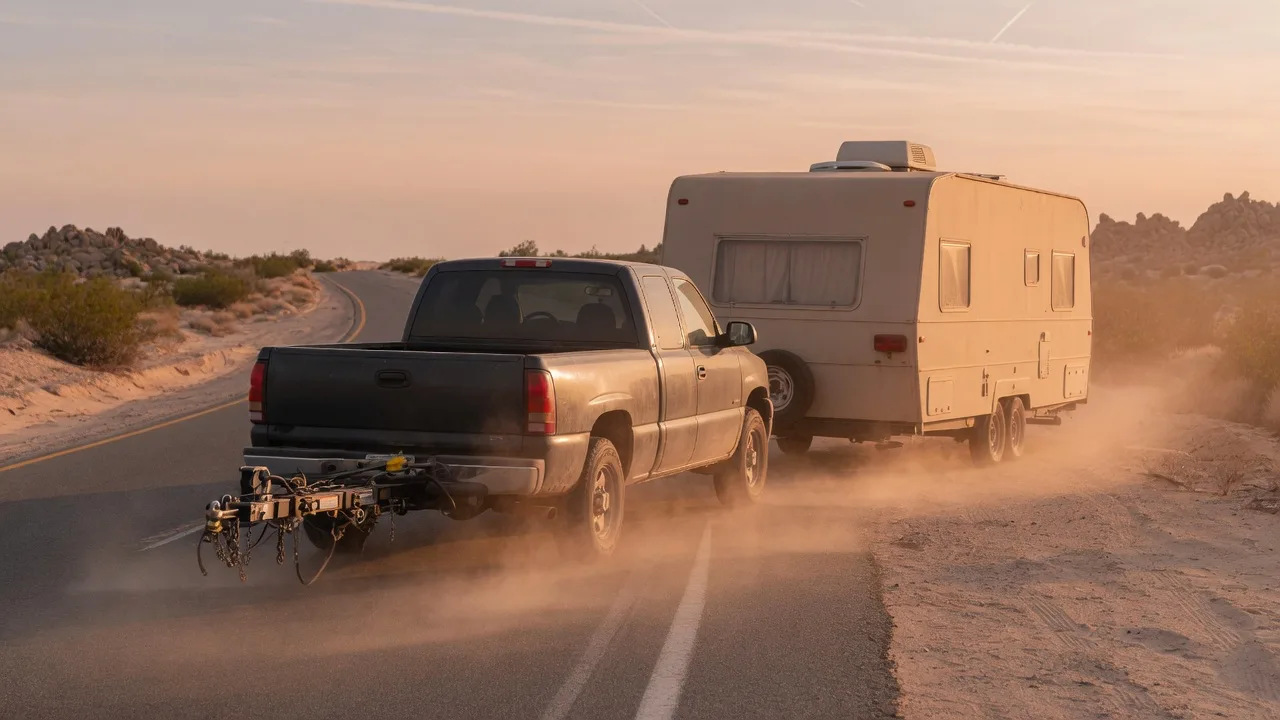
What flat-towing (dinghy towing) is
Flat-towing — also called dinghy towing or 4-down towing — means pulling a car behind a motorhome with all four of its wheels on the ground, rather than on a trailer or a tow dolly. Motorhome owners love it because once you're parked, you simply unhook the car and use it for groceries, trailheads, and town runs without breaking camp. As a towing method it's widely allowed across the US, but whether it's legal in your situation still depends on meeting each state's equipment and weight rules — and, critically, on whether your specific car can be flat-towed at all. Treat the equipment, braking, and weight rules as a per-state check rather than assuming a single nationwide standard.
Towability is vehicle-specific — the manual is the authority
This is the single most important point: not every car can be safely flat-towed. With all four wheels turning but the engine off, some transmissions (particularly many automatics and CVTs) don't circulate lubricant and will be damaged by being towed 4-down. Vehicles approved for flat-towing are typically certain manual-transmission cars and specific models the manufacturer has engineered for it. The ONLY reliable authority on whether YOUR car can be flat-towed — and the exact procedure (fuse pulls, transmission in a specific position, periodic engine starts, speed limits) — is that vehicle's owner's manual. Manufacturers publish annual 'dinghy towing' guides for the models they approve, and those approvals change model year to model year.
Verify locally: Never assume a car can be flat-towed because a similar one can. Flat-towing a vehicle the manufacturer hasn't approved can cause severe, expensive transmission damage. Confirm towability and the exact procedure in YOUR vehicle's owner's manual before towing it 4-down.
The four pieces of a flat-tow setup
A proper dinghy setup is a system, and skipping a piece is both unsafe and, in many places, illegal. The four core components:
- Baseplate — a vehicle-specific bracket bolted to the towed car's frame that the tow bar attaches to.
- Tow bar — connects the motorhome's hitch receiver to the baseplate; rated for the car's weight.
- Safety cables / chains — a required backup connection in essentially every state.
- Wiring / lighting — the towed car must show working brake lights, turn signals, and running lights, typically via a wiring kit or magnetic lights.
- Supplemental braking system — a device that applies the towed car's brakes; widely required by state law above certain weights and recommended for all dinghy towing.
Supplemental braking and the legal basics
Most states require a separate (supplemental) braking system on a towed vehicle once it exceeds a certain weight, because a heavy car pushing an unbraked load dramatically increases stopping distance. The exact weight threshold and whether breakaway protection is required vary by state, so there's no single national number to quote. On top of braking, the universal requirements are working lights on the towed car, safety cables/chains, and staying within your motorhome hitch's and tow bar's rated capacity. Some states also set lower speed limits while towing and restrict which lanes you may use.
Verify locally: Whether a supplemental braking system is legally required — and at what towed-vehicle weight — varies by state, as do towing speed limits and lane rules. Confirm the requirements with the DMV of your state and every state on your route before you tow.
Before your first dinghy tow
Run through this: (1) confirm in the owner's manual that your car is approved for 4-down towing and learn the exact procedure; (2) have a reputable shop install a matched baseplate, tow bar, wiring, and supplemental brake; (3) verify lights and brakes work before pulling out; (4) check the braking-system and speed rules for every state you'll cross. Practice hooking and unhooking in a flat lot — alignment takes a little technique. Done right, dinghy towing is one of the most convenient parts of motorhome travel.