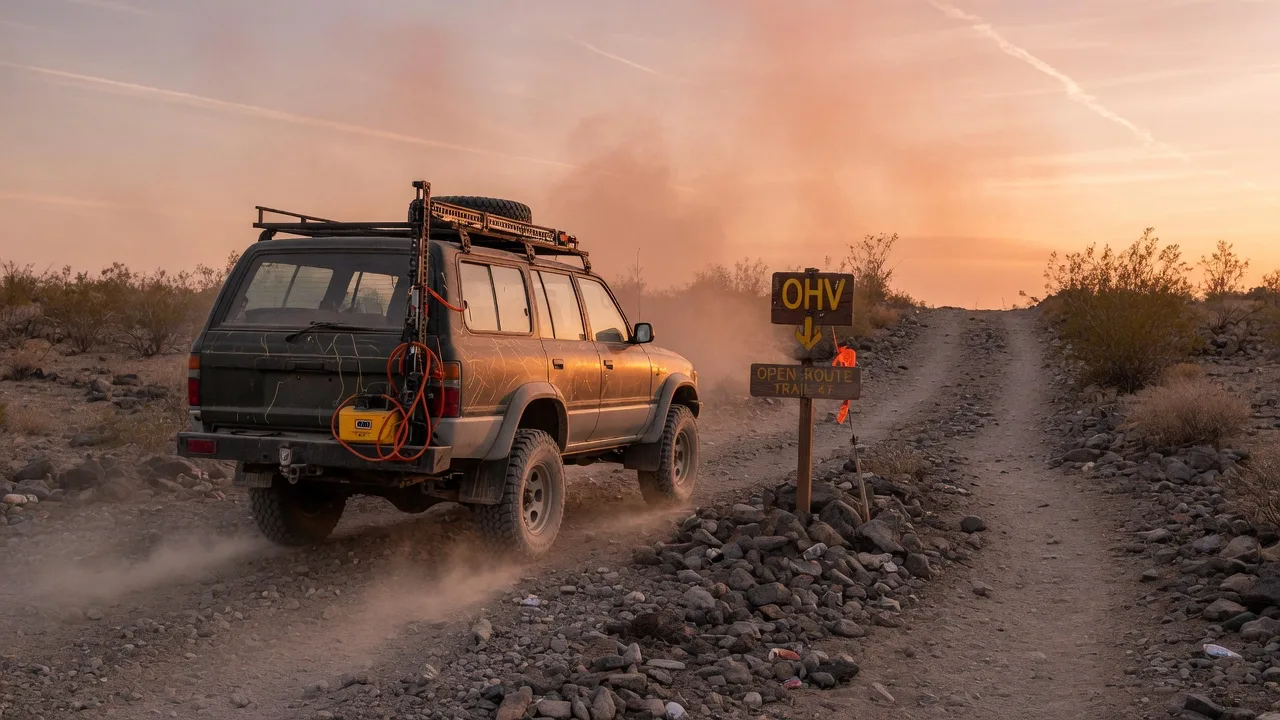
Understand your drivetrain before you leave pavement
Not every vehicle with all-wheel-drive badging is built for the same thing. A true four-wheel-drive (4x4) system usually has a transfer case with a high range (4H) for slippery roads and a low range (4L) that multiplies torque and slows everything down for steep, rocky, or sandy terrain. Many crossovers have full-time all-wheel drive with no low range and are not intended for serious trails. Before any off-road trip, learn exactly what your rig has: 2H/4H/4L selection, whether it auto-engages, any locking differentials, and any traction or hill-descent modes.
Read the owner's manual section on off-road use. It tells you the correct speeds and conditions for shifting into 4L (often at a stop or very low speed) and whether 4H/4L are safe on dry pavement (usually they are not, on part-time systems).
When to use low range (4L)
Low range is for control, not speed. Engage 4L when you need maximum torque at very low speed: climbing or descending steep grades, crawling over rocks, pushing through deep sand or mud, or any situation where you want the engine to do the braking on a descent. In 4L the vehicle moves slowly even at higher RPM, which lets you place tires precisely and keeps you from overdriving the terrain.
Use 4H (high range) for slippery but relatively flat and faster conditions — packed snow, gravel roads, or firm dirt where you still want speed. The general rule beginners remember well: as slow as possible, as fast as necessary.
Verify locally: Shift procedures and the conditions where 4H/4L are safe differ by vehicle. Follow your specific vehicle's owner's manual — using the wrong mode on the wrong surface can damage the drivetrain.
Traction: tires, momentum, and a light foot
Most traction problems come down to tires and throttle control. Airing down — lowering tire pressure within the manufacturer's safe range — increases the tire's contact patch and dramatically improves grip in sand, rocks, and mud; re-inflate to road pressure before returning to pavement. Beyond that, smooth, steady throttle beats stabbing the gas: wheelspin digs you in rather than moving you forward. Pick a line, look well ahead, and let momentum (not speed) carry you through soft spots.
- Air down for soft terrain — within safe limits — and carry a way to re-inflate.
- Steady throttle; avoid sudden wheelspin that digs holes.
- Look ahead and pick a clean line around obstacles, not over them when you can avoid it.
- If equipped, use traction control and locking diffs as the manual describes.
- On hills, keep momentum modest and steady; if you stall on a climb, know your manual's safe roll-back-and-restart procedure.
Recovery gear that actually matters
Going off-road alone without recovery gear is how short trips become overnight problems. You do not need a trailer full of equipment, but a basic kit and the knowledge to use it safely is essential. Recovery is also where people get hurt — a snapped strap or shackle under load can be lethal — so match the gear's rated capacity to your vehicle and learn proper technique before you need it.
- Traction boards — the single most useful tool for sand, mud, and snow self-recovery.
- Rated recovery strap/snatch strap and properly rated soft shackles or D-rings, attached only to real recovery points.
- A sturdy shovel.
- Tire deflator and a portable air compressor.
- Gloves, a first-aid kit, water, and a way to communicate where there's no cell signal.
Verify locally: Vehicle recovery can cause serious injury or death if done incorrectly. Use only properly rated equipment attached to designated recovery points, keep bystanders clear, and get hands-on instruction before attempting a winch or kinetic recovery.
Go with a plan — and ideally not alone
Before you head out: tell someone your route and return time, check the area's legal status and conditions (see our public-land guide), carry navigation that works offline, and start on easy, well-traveled trails to build skill. Traveling with a second vehicle turns most stuck situations into a quick recovery rather than a crisis. Build experience on green/easy routes before stepping up to anything rated advanced.