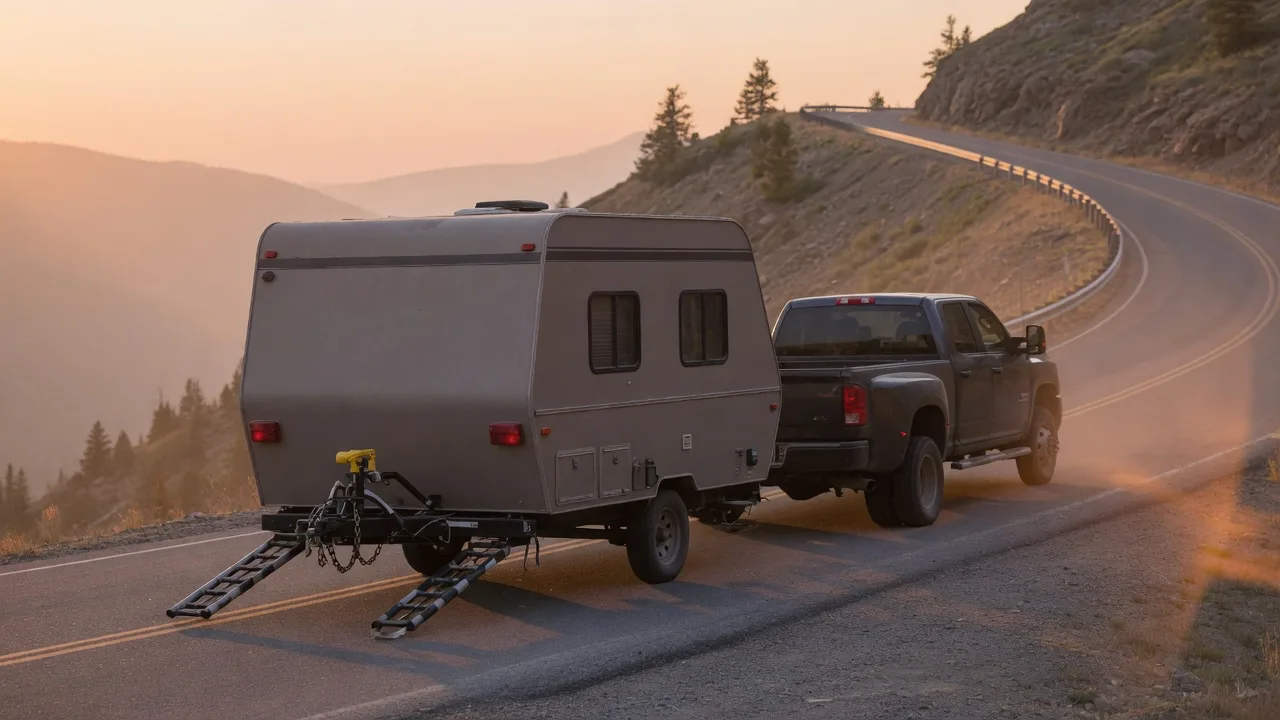
Most towing needs only a regular driver's license
For the vast majority of recreational towing — a travel trailer, a small camper, a utility trailer, or a boat behind a pickup or SUV — a standard, non-commercial driver's license is all that's required in every US state. You do not need a special endorsement to tow a typical RV trailer for personal, non-commercial use. The complications start only when the combination gets very heavy or very large, and even then the thresholds and license classes are set state by state.
The real federal line: the CDL threshold
There is one well-established federal benchmark worth knowing. A Commercial Driver's License (CDL) is generally required when a vehicle or combination has a Gross Vehicle Weight Rating (GVWR) or Gross Combination Weight Rating (GCWR) of 26,001 pounds or more — and, for a trailer, when that trailer's GVWR exceeds 10,000 pounds and the combination is over 26,001 pounds. That 26,001 lb figure is a real, fixed number under federal commercial-driver standards.
The crucial nuance: CDLs exist for commercial operation. Most states exempt recreational vehicles and personal-use towing from the CDL requirement, even at high weights. So a heavy motorhome or a large fifth-wheel for personal use usually does NOT require a CDL — but it may require a different, non-commercial upgraded license class in certain states (see below). Do not conflate 'heavy' with 'needs a CDL.'
Verify locally: The 26,001 lb / 10,000 lb GVWR figures are the federal commercial benchmarks, but how each state applies them to PERSONAL recreational towing differs. Confirm whether your weight triggers any license requirement with your state DMV.
States with non-commercial Class A / Class B for heavy combos
A handful of states require a special NON-commercial license class — often labeled a Non-Commercial Class A or Class B — for personal vehicles or combinations above a certain weight, even though it isn't a CDL. Where these exist, the exact triggering weight, the name of the required class, and the exemptions (some states exempt many RVs and motorhomes outright) differ from state to state, and the list of which states have such a rule changes over time. Because of that, don't assume your state does or doesn't have one based on a neighbor's rules — and don't rely on a remembered weight figure.
- Some states have a non-commercial Class A/B (or similar weight-based endorsement) for heavy personal rigs; many do not — verify your own state.
- Where such a class exists, the triggering weight and the exemptions for recreational vehicles vary by state.
- The license you hold must cover the rig you actually drive in YOUR state — and ideally satisfy the rules of states you travel through.
Verify locally: Which states require a non-commercial Class A/B (or special endorsement) for heavy personal rigs — and at exactly what weight, with which RV exemptions — varies by state and changes. Don't rely on a memorized list or figure: confirm your state's exact threshold and license class with the state DMV before you buy or rent a heavy combination.
Trailer-brake and equipment thresholds
Separate from licensing, states regulate when a towed trailer must have its own braking system. The common pattern is that trailers above a certain gross weight must have functioning brakes (often electric brakes operated by a controller in the tow vehicle), and many states also require breakaway protection so the trailer brakes engage if it separates from the tow vehicle. The exact weight at which brakes become mandatory varies by state — there is no single national number — and safety chains, working trailer lights, and sometimes a specific class of hitch are also required almost everywhere.
- Trailer brakes — required above a state-set gross weight; the threshold varies by state.
- Breakaway system — commonly required on trailers heavy enough to need brakes.
- Safety chains and working lights — required essentially everywhere.
- Towing mirrors, speed limits for towing, and lane restrictions — set by state.
Verify locally: The weight at which trailer brakes and breakaway systems become mandatory varies by state, as do towing speed limits and mirror/equipment rules. Confirm the requirements with the DMV of every state you'll tow through.
Know your numbers before you tow
Whatever your state requires, never tow beyond your equipment's ratings. Stay within the tow vehicle's manufacturer tow rating and GCWR, within the hitch's rated capacity, and within the trailer's GVWR — these are engineering limits, not just legal ones. The plates and stickers on the vehicles list these numbers. If you're renting, the host or rental company should provide the rig's weights and ratings; if a listing doesn't publish GVWR and dry weight, ask before you book.