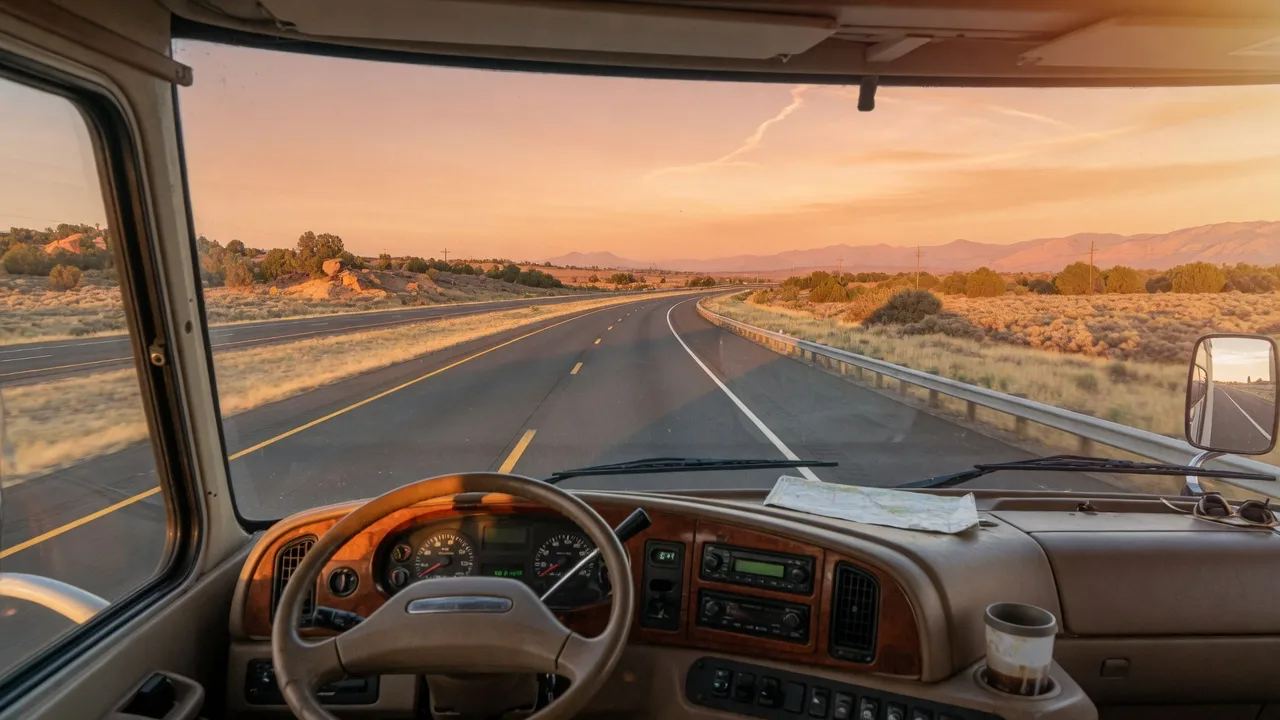
Before you roll: seat, mirrors, and a walk-around
Spend ten minutes before you drive. Set the seat so you can reach the pedals and wheel comfortably and see the full instrument cluster. Adjust both side mirrors — most Class A coaches have a flat main mirror plus a convex spot mirror — so you can see down the side of the rig and the lane behind. There is no rear-view mirror that sees through the coach; the side mirrors are your world.
Do a walk-around: check tire condition, that bay doors and the awning are latched, the antenna/satellite is down, the steps are retracted, and nothing is plugged in or chocked. Note the rig's height (posted on a card in most rentals) and write it on a sticky note on the dash — low clearances are the most common rookie damage.
- Know your height and keep it visible on the dash.
- Set both mirrors before moving; they are your only rear vision.
- Confirm awning, steps, antenna, and bay doors are secured.
Turning: you're longer than you think
The biggest Class A surprise is the rear overhang and the long wheelbase. To avoid clipping curbs and poles, swing wider and later than instinct says: pull further into the intersection before you crank the wheel, and watch your mirrors so the rear of the coach clears the corner. The back end also 'tail-swings' the opposite way you turn, so leave space on the side you're turning away from.
Practice right and left turns in an empty lot — cones or parking-line corners work — until the geometry feels natural before you do it in traffic.
Verify locally: Posted size, height, and bridge-clearance limits are real traffic laws and vary by road and state. Obey posted clearances and any state RV-specific route restrictions; mountain and parkway routes especially.
Braking and following distance
A loaded coach weighs many times your car and needs far more room to stop. Double or triple your normal following distance and brake early and smoothly. If your coach has an exhaust/engine brake (common on diesel pushers), learn to use it on long downgrades to save the service brakes from overheating — ride them continuously down a long hill and you can fade or lose them.
On downgrades, gear down before the hill, not partway down it. Let engine braking and the exhaust brake do the work, and use the service brakes in firm, brief applications rather than a constant drag.
Wind, trucks, and the highway
A tall flat-sided coach catches crosswind and the pressure wave of passing semis. Keep both hands on the wheel, anticipate gusts on open stretches and bridges, and make small, smooth steering corrections rather than big jerks. Stay a few mph below the flow if the wind is pushing you around — there's no prize for keeping up.
Backing up and parking
Never back up blind. Use a spotter outside the rig with agreed hand signals (or phone audio), and if you're solo, get out and look — GOAL: 'Get Out And Look.' Back slowly, make small wheel inputs, and pull forward to reset if the angle goes wrong. Most rental coaches have a backup camera; trust it but still use a spotter for tight sites.
- Use a spotter or 'Get Out And Look' before and during backing.
- Pull forward and reset rather than forcing a bad angle.
- Choose pull-through campsites for your first trips.