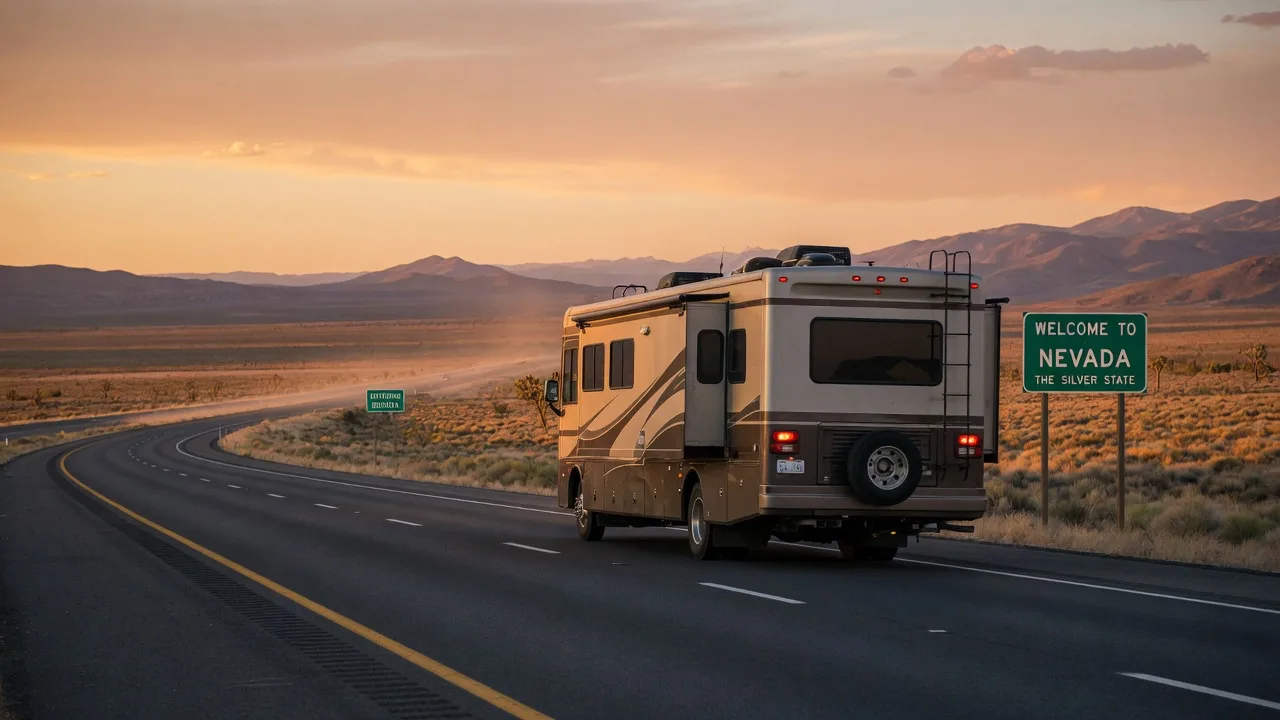
The national default, restated
The CDL is a commercial credential under the FMCSA, and personal RV use falls under its recreational-vehicle exemption — so a CDL is almost never required to rent and drive an RV for a vacation. On top of that federal baseline, each state decides whether to require any additional non-commercial credential for large personal motorhomes. Many states require nothing beyond a regular license, regardless of how big the coach is.
The exception: non-commercial special licenses
A smaller group of states require a non-commercial special license — typically labeled a non-commercial Class A or non-commercial Class B — for personal-use vehicles or combinations above a weight (and sometimes length) threshold. The most common threshold mirrors the established federal CDL number, 26,001 lb GVWR/GCWR, but some states use different cutoffs or add length triggers.
Critically, the requirement follows the state that issued your driver's license, not the state you're traveling in or the state where the RV is registered. So a renter licensed in a 'special license' state may need that credential even to drive a rig picked up elsewhere, while a renter licensed in a 'regular license is enough' state generally doesn't.
- Non-commercial Class A / Class B — a state special license, not a CDL.
- Common trigger: GVWR/GCWR at or above 26,001 lb (the federal CDL number).
- Some states add a vehicle-length trigger; some require nothing extra at any weight.
- The rule follows YOUR licensing state.
Verify locally: Which states require a special license, and at exactly what weight or length, is the single most state-variable part of RV licensing and changes over time. We deliberately do not publish a hard list here — verify the current rule for your licensing state with its DMV.
How to check your state in five minutes
You don't need to memorize 50 sets of rules — you only need your own. Here's the reliable way to get a current, authoritative answer:
- Search your state DMV's official site for 'non-commercial Class A license' or 'motorhome license requirement'.
- Look up the rented RV's GVWR (Gross Vehicle Weight Rating) on its door-jamb sticker or spec sheet, and compare it to your state's threshold (often 26,001 lb).
- If you'll tow behind the motorhome, note the combined weight too — some rules use GCWR (the combination rating).
- If anything is unclear, call or email your state DMV and ask the specific question for your exact rig and weight.
- When in doubt, choose a Class B campervan or a standard-size Class C rig — in their typical rental sizes these sit under the weight thresholds for personal use (verify a very large or unusually long Class C with your DMV).
Booking around the question
If you'd rather not deal with the special-license question at all, the simplest path is to rent a Class B camper van or a standard-size Class C motorhome. Both sit comfortably under the weight thresholds for personal use, so a regular license covers them in the rental sizes you'll typically encounter. (The rare exceptions are very large 'Super C' coaches near the heavy-vehicle threshold, and the few states that add a vehicle-length trigger — so if a Class C is unusually big or long, confirm with your state DMV.) PickRV lets you filter by class, so you can browse only the rigs your license already covers.