
Towable RV Rentals on PickRV — Travel Trailers, Fifth Wheels, Pop-ups, Teardrops, Toy Haulers
Towable RVs are the largest segment of US RVs by registration count (per RVIA). PickRV covers all five major towable types — travel trailer, fifth-wheel, pop-up, teardrop, toy hauler — with honest tow-rating math up front, not in the footer.
Pick the home you tow · Tow capacity verified at booking · Half-ton OK or HD truck required
Can I rent a towable RV on PickRV?
Towable RVs are the largest segment of US RVs by registration count (per RVIA). PickRV covers all five major towable types — travel trailer, fifth-wheel, pop-up, teardrop, toy hauler — with honest tow-rating math up front, not in the footer. No listing is bookable yet — PickRV opens for bookings on October 25.
- Travel Trailer
- Fifth-Wheel
- Pop-up
- Teardrop
- Toy Hauler
The hardest decision in towable RV rental is matching the trailer to the tow vehicle. PickRV's towable category surfaces the tow math up front: dry weight, GVWR (gross vehicle weight rating), tongue weight, recommended tow-vehicle class — all in plain numbers, not buried.
Five towable sub-types covered: travel trailer (Bullet-class lightweight to 30+ ft full-size), fifth-wheel (requires bed-mounted hitch in a pickup), pop-up (lightweight, half-ton-friendly), teardrop (smallest, almost anything tows), toy hauler (built-in garage for ATVs / dirt bikes). Each sub-type has its own physics and its own typical tow-vehicle profile.
PickRV's towable hosts cover 10 states. Many hosts offer tow-vehicle bundles (host provides the truck + the trailer) for renters who do not have their own tow rig. Others offer bring-your-own-truck rentals — these surface a Tow Capacity Calculator at booking to verify your truck meets the trailer's tow-rating spec per SAE J2807.
Can my truck tow this?
Verify your tow vehicle's payload + tow capacity against the trailer's loaded weight + tongue weight per SAE J2807. Honest math, no template.
What you get with a PickRV towable rental
Five concrete commitments — tow math up front, not in the footer.
Tow math up front
Every listing carries dry weight, GVWR, tongue weight, recommended tow-vehicle class (half-ton, three-quarter-ton, HD one-ton). The Tow Capacity Calculator at checkout cross-checks against your tow vehicle's spec.
Hitch class and brake controller surfacing
Hitch class (Class III, IV, V) and brake controller requirement (under or over 3,000 lbs determines whether brake controller is mandatory in most states) are stated on the listing.
Weight-distribution hitch guidance
Trailers over approximately 5,000 lbs typically need a weight-distribution hitch (WDH) for safe towing. The listing tells you whether WDH is required, recommended, or already included.
Tow-vehicle bundle option
Many hosts package the trailer with a host-owned pickup truck. This avoids the bring-your-own-truck compliance check and is the easiest path for first-time towable renters.
Bring-your-own-truck verified
If you bring your own truck, the booking flow checks your tow vehicle's payload, tow capacity, and hitch class. Mismatches are flagged before payment — no surprise at pickup.
Five towable sub-types covered
Travel trailer, fifth-wheel, pop-up, teardrop, toy hauler.
Travel Trailer
Bumper-pull, range from 12ft (Bullet) to 35ft (full-size)
Read sub-type guideFifth-Wheel
Pickup bed-mounted hitch; largest livable space
Read sub-type guidePop-up
Collapsing camper, lightweight, half-ton friendly
Read sub-type guideTeardrop
Smallest towable, sleeps 2, outdoor kitchen
Read sub-type guideToy Hauler
Built-in garage for ATVs / dirt bikes / SxS
Read sub-type guideTowing 101 — five educational guides
SAE J2807, hitch class, WDH, brake controller, sway control — read before the trip.
Tow Capacity Explained — SAE J2807, Payload Math on PickRV
Tow capacity, payload, GVWR, GCWR explained per SAE J2807 standard. The 'tow rating is bullshit' truth about real-world towing. Honest math for towable RV renters.
Read 101 guideHitch Class Guide — Class I-V Receivers Explained on PickRV
Hitch class (Class I through Class V) explained — capacity ratings, what each class tows, when to upgrade. Real ratings, no fabrication.
Read 101 guideWeight-Distribution Hitch (WDH) Guide on PickRV
Weight-distribution hitch (WDH) explained — what it does, when required, how it works. Sprint bars, sway control, adjustment for trailer length. Real safety guidance.
Read 101 guideBrake Controller Guide — Trailer Electric Brakes Explained on PickRV
Brake controller for trailers — when required by state law, how it works, what to look for. Integrated vs aftermarket, proportional vs time-delayed, real safety guidance.
Read 101 guideSway Control Guide — Trailer Sway Prevention on PickRV
Trailer sway control explained — friction-bar vs cam-action, why sway happens, how to prevent it. Real safety guidance for first-time towable renters.
Read 101 guideStates with towable coverage
Per-state campground, route, and tow-law guidance.
What Trailer Life doesn't tell you about towing
Honest tow math, spelled out.
- ·Tow rating vs payload gap is the silent killer. Your truck's published tow rating assumes near-empty cab and bed; once you add passengers and gear, the available payload may drop below the tongue weight of the trailer you're towing. We surface payload-vs-tongue-weight at booking.
- ·SAE J2807 (the industry tow-rating standard) was adopted by Ford in 2015, by Chevy/GMC in 2014, by Toyota in 2017, by Ram in 2015. Pre-2015 truck tow ratings may not be J2807-compliant and can over-state real tow capability.
- ·Brake controller is REQUIRED in every US state for trailers over 3,000 lbs GVWR (some states 1,500 lbs). Not optional. Most modern trucks come with integrated brake controllers; older trucks need aftermarket installation.
- ·Weight-distribution hitch (WDH) becomes mandatory above approximately 5,000 lbs in most cases — not just a recommendation. Without WDH, the front axle of your tow vehicle loses weight and steering / braking degrades.
The trailer side of the ball — SAE J684, FMCSA 393.71, and real OEM weight specs
Sourced from SAE J684 (Trailer Couplings, Hitches, and Safety Chains), FMCSA 49 CFR 393.71, the RVIA Standards Program, and published spec sheets from Airstream, Grand Design, Jayco, and Keystone. Every link goes to a primary source.
Almost every towing argument on the internet starts on the truck side of the ball — payload, axle ratio, max-tow package. PickRV's towable hub reverses the lens, because the trailer is the part that wants to swap ends at 65 mph in a crosswind. The standard that governs the iron between the two vehicles is SAE J684 (https://www.sae.org/standards/content/j684_202205/), titled Trailer Couplings, Hitches, and Safety Chains. J684 fixes the geometry and the safety margin: a Class I coupler is rated to a 2,000 lb gross trailer weight (GTW) and a 200 lb tongue weight, Class II to 3,500 lb GTW and 300 lb tongue, Class III to 8,000 lb GTW and 800 lb tongue, Class IV to 10,000 lb GTW and 1,000 lb tongue, and Class V to 17,000-20,000 lb GTW and 1,700-2,000 lb tongue. Those numbers are not the truck's tow rating — they are the maximum the coupler hardware itself is certified to hold before the ASTM-rated weld geometry begins to deform. A trailer with a Class III tongue cannot be safely upgraded by bolting a Class V receiver to the bumper of the tow vehicle. The weakest link in the chain governs.
FMCSA's federal definition of a trailer (49 CFR 390.5 plus the cargo-securement and braking rules at 49 CFR 393.71 — https://www.fmcsa.dot.gov/regulations/title49/section/393.71) treats trailers above 3,000 lb gross weight as braked vehicles in their own right. Federal baseline requires service brakes on any trailer over 3,000 lb gross weight, a breakaway device that automatically applies those brakes if the trailer separates from the tow vehicle, a separate parking brake hold, two safety chains crossed beneath the coupler, and lighting wired through the tow vehicle's seven-pin or four-pin connector. That federal baseline is the floor; several states ratchet it tighter, which we cover below.
Inside the towable category itself, three weight cohorts dominate. Travel trailers (bumper-pull, hitched to a Class III/IV/V receiver) cover the widest range: dry weight from roughly 1,200 lb (smallest single-axle Bullet, Coachmen Clipper Express, Forest River R-Pod) up to 8,000 lb (full-size 33 to 35 foot tandem-axle units), with loaded GVWR commonly 1,500-10,000 lb. Tongue weight on a properly loaded travel trailer falls in a 10-15 percent of loaded weight band; outside that band the rig is either tongue-light (which initiates sway) or tongue-heavy (which crushes payload and lifts the front axle). Fifth-wheels mount on a bed-mounted hitch in the pickup truck box; dry weight 7,000-15,000+ lb, loaded GVWR 10,000-20,000+ lb, and pin weight 18-25 percent of loaded weight. Toy haulers split into travel-trailer-style and fifth-wheel-style frames, with garage-loaded weight that routinely doubles the empty pin or tongue number once two ATVs go in the back. Pop-ups and teardrops fill the light end (700-3,200 lb dry, 10-13 percent tongue), reaching downward to crossover and small-SUV tow ratings.
GCWR — Gross Combined Weight Rating — is the number every renter argues over from the truck side but the trailer feels first. If a tow vehicle is rated 22,000 lb GCWR and curb-weighs 7,200 lb, the remaining 14,800 lb is the entire allowance for trailer + cargo + passengers + fuel. A 12,500 lb loaded fifth-wheel leaves 2,300 lb for the truck's own driver, passengers, gear, and a quarter-tank of diesel — that is the math the trailer's pin weight forces on the truck's rear axle the second the kingpin drops. PickRV's listing template surfaces the trailer's dry weight, GVWR, GAWR (gross axle weight rating, the per-axle ceiling), and either pin weight or tongue weight depending on hitch type. The renter does the GCWR subtraction once at booking, not at the scale at Iowa 80.
Real manufacturer specs cited verbatim, not paraphrased through a blog. The Airstream Bambi 16RB (a popular single-axle Bullet-class travel trailer) lists 3,500 lb GVWR and 410 lb hitch weight per Airstream's published spec sheet (https://www.airstream.com/travel-trailers/bambi/). The Grand Design Reflection 150 Series 226RK has a 7,995 lb GVWR with a 1,053 lb hitch weight per Grand Design's brochure (https://www.granddesignrv.com/travel-trailers/reflection/150-series). The Jayco Eagle HT 28.5RSTS fifth-wheel lists 11,420 lb GVWR and a 1,825 lb pin weight per Jayco's spec page (https://www.jayco.com/products/fifth-wheels/eagle-ht/floorplans/). The Keystone Raptor 423 toy hauler is 18,000 lb GVWR with a 3,460 lb pin weight per Keystone (https://www.keystonerv.com/fifth-wheels/raptor/). PickRV's hosts publish the exact factory spec sheet on the listing — no rounded marketing 'approximate weight' headline. If a host edits the dry weight upward to dodge a tow-pairing rejection, the booking tool flags the deviation against the factory spec.
Pricing posture: on towable rentals the host keeps 100 percent of the base price they set, and the listed price is stable and all-in. Renters bring their own coverage; PickRV is not an insurer and does not sell or offer coverage. Note that trailer policies commonly exclude un-permitted oversize loads, off-pavement use unless the rig is classified as an off-road camper, and unauthorized Mexico crossings. Bring-your-own-truck rentals are gated by a tow-capacity check that compares the renter's truck VIN-decoded GCWR + payload against the trailer's loaded weight + tongue / pin number; mismatches fail the booking before a deposit is taken. Tow-vehicle-bundled rentals (host provides the matched truck) skip that step. The towable host network remains small and hand-curated — every towable listing carries a factory spec sheet attached as a PDF, every host has a Form 1900-A trailer inspection on file before the listing goes live.
SAE J684 hitch class table — Class I through Class V
Receiver hitch ratings per SAE J684 (https://www.sae.org/standards/content/j684_202205/). The weakest link in the truck-coupler-trailer chain governs the safe tow weight.
| Class | GTW limit (lb) | Tongue limit (lb) | Receiver size | Typical use |
|---|---|---|---|---|
| Class I | Up to 2,000 | Up to 200 | 1 1/4 in | Lightest teardrops, small utility trailers, bicycle racks. |
| Class II | Up to 3,500 | Up to 300 | 1 1/4 in | Pop-up campers, small folding tent trailers, small boats. |
| Class III | Up to 8,000 | Up to 800 | 2 in | Bullet-class and mid-size travel trailers, single-axle boats, mid-size cargo. |
| Class IV | Up to 10,000 | Up to 1,000 | 2 in | Full-size travel trailers (28-33 ft tandem-axle), most car-hauler trailers. |
| Class V | Up to 17,000-20,000 | Up to 1,700-2,000 | 2 1/2 in (sometimes 3 in) | Large car / equipment trailers, weight-distributing setups with heavy travel trailers. |
DOT / FMCSA towing capacity by truck class
Trailer cohorts matched to FMCSA truck class definitions (49 CFR 390.5). The trailer determines which truck class you need, not the other way around.
Class 1 (light-duty 1/2-ton: F-150, Silverado 1500, Ram 1500, Tundra)
Truck GVWR: Up to 6,000 lb
Travel trailers under 5,500 lb loaded GVWR, single-axle boats, small toy haulers. Conventional bumper-pull only — no fifth-wheel unless the rare sub-7,000 lb half-ton-spec'd rig is selected.
Class 2a (heavy half-ton with max-tow: F-150 with Max Tow Package, Ram 1500 with HEMI)
Truck GVWR: 6,001-8,500 lb
Mid-size travel trailers 5,500-7,500 lb GVWR; very light fifth-wheels under 8,500 lb GVWR with a slider hitch in a short-bed cab.
Class 2b (3/4-ton: F-250 Super Duty, Ram 2500, Silverado 2500HD)
Truck GVWR: 8,501-10,000 lb
Full-size travel trailers 7,500-10,000 lb GVWR; standard fifth-wheels 10,000-14,000 lb GVWR; entry-level travel-trailer toy haulers.
Class 3 (1-ton: F-350, Ram 3500, Silverado 3500HD — single rear wheel)
Truck GVWR: 10,001-14,000 lb
Large fifth-wheels 14,000-18,000 lb GVWR; toy haulers up to 16,000 lb GVWR loaded; goosenecks under 20,000 lb GTW.
Class 3 DRW (dually 1-ton: F-350 DRW, Ram 3500 DRW, Silverado 3500HD DRW)
Truck GVWR: 12,000-14,000 lb
Largest fifth-wheels 18,000-20,000 lb GVWR; loaded toy haulers with two UTVs in the garage; goosenecks 20,000-25,000 lb GTW. Beyond this is Class 4-7 commercial pickup / medium-duty territory and the CDL line starts to matter.
Weight-class math — travel trailer vs fifth-wheel vs toy hauler
Real manufacturer spec ranges with worked GCWR examples. Pin weight is the trap, not GCWR.
Travel trailers
- ·Single-axle Bullet (Coachmen Clipper Express, Forest River R-Pod, Airstream Bambi 16): dry weight 1,200-2,800 lb, loaded GVWR 1,500-3,500 lb, tongue weight 200-450 lb. Class II to Class III hitch. Tow vehicle: any half-ton or capable SUV/crossover with Class III receiver.
- ·Tandem-axle mid-size (Jayco Jay Flight 21MML, Forest River Salem Cruise Lite, Keystone Bullet 250BHS): dry 4,200-5,800 lb, loaded GVWR 6,500-7,800 lb, tongue 650-980 lb. Class IV hitch with WDH. Tow vehicle: heavy half-ton with max-tow OR 3/4-ton.
- ·Full-size tandem-axle (Grand Design Reflection 150 Series 226RK, Jayco Eagle 332CBOK, Keystone Cougar 30RLI): dry 6,800-8,200 lb, loaded GVWR 8,500-10,000 lb, tongue 1,000-1,400 lb. Class IV or V hitch with WDH and sway control mandatory. Tow vehicle: 3/4-ton minimum.
- ·GCWR check: a 22,000 lb GCWR 3/4-ton diesel with 8,200 lb curb weight has 13,800 lb available. A 10,000 lb full-size travel trailer plus a 1,300 lb tongue applied to truck payload plus passengers and gear keeps the rig under that ceiling with realistic headroom. A gas half-ton at 16,000 lb GCWR struggles past 7,800 lb loaded trailer + tongue + cab payload — which is why the listing template enforces the truck-class step before checkout.
Fifth-wheels
- ·Light fifth-wheel (Grand Design Reflection 150 Series 268BH, Coachmen Chaparral Lite 25RE, Forest River Wildcat ONE 27RKX): dry 7,800-9,500 lb, loaded GVWR 10,000-11,800 lb, pin weight 1,600-2,200 lb. Tow vehicle: 3/4-ton diesel or heavy 3/4-ton gas with appropriate puck-system hitch.
- ·Mid-size fifth-wheel (Keystone Cougar 27SGS, Jayco Eagle HT 28.5RSTS, Grand Design Reflection 303RLS): dry 9,800-11,500 lb, loaded GVWR 12,000-14,500 lb, pin weight 2,000-2,800 lb. Tow vehicle: 3/4-ton diesel preferred, 1-ton fine.
- ·Large fifth-wheel (Jayco North Point 377RLBH, Keystone Montana 3781RL, Grand Design Solitude 380FL): dry 12,500-15,000+ lb, loaded GVWR 15,500-18,500+ lb, pin weight 2,800-3,800+ lb. Tow vehicle: 1-ton SRW or DRW based on pin weight + cab payload arithmetic.
- ·GCWR check: a 1-ton dually rated 32,000 lb GCWR with 8,800 lb curb has 23,200 lb of trailer + cargo headroom. A 17,500 lb loaded fifth-wheel with 3,400 lb pin weight uses 17,500 of that 23,200 budget on the trailer alone — the remaining 5,700 lb covers the truck's own payload (driver + passengers + 3,400 lb pin weight transferred + fuel + gear). Pin weight is the trap, not GCWR.
Toy haulers
- ·Travel-trailer-style toy hauler (Forest River XLR Boost 27QB, Keystone Carbon 348, Jayco Octane T26Y): dry 7,200-9,800 lb, loaded GVWR 10,500-13,000 lb, tongue 1,100-1,500 lb empty / 1,500-2,000+ lb with two ATVs in the garage.
- ·Fifth-wheel-style toy hauler (Keystone Raptor 423, Grand Design Momentum 397TH, Heartland Cyclone 4007): dry 13,500-16,000+ lb, loaded GVWR 17,000-20,000+ lb, pin weight 2,800-3,500 lb empty / 3,500-4,500+ lb loaded with two UTVs.
- ·The toy-hauler trap is cargo placement. Two side-by-sides (1,400-1,800 lb each) loaded all the way to the rear ramp shifts weight off the pin/tongue and amplifies sway. The factory spec sheet's pin weight assumes garage empty. Load heavy toys forward over the trailer axles, not at the ramp.
State trailer registration variance — four-state sample
Each entry links directly to the issuing DMV / HSMV statute. PickRV does not paraphrase the rule from a blog.
California (CA)
California DMV (https://www.dmv.ca.gov/portal/vehicle-registration/new-registration/trailer/) requires every utility trailer, travel trailer, and camp trailer to be registered, with two title tracks: 'Trailer Coach' (registered annually, full plate + tags) for any trailer used as living quarters, and 'Utility Trailer' (one-time permanent plate, no annual renewal) for cargo trailers under 10,000 lb GVW. Brake requirement: any trailer over 1,500 lb gross weight must have brakes per CA Vehicle Code §26458 — one of the strictest state thresholds in the country.
Florida (FL)
Florida HSMV (https://www.flhsmv.gov/motor-vehicles-tags-titles/) requires annual registration of all travel trailers and fifth-wheels with fees scaled by net weight in 1,000 lb increments (under 500 lb = $6.75; 500-1,999 lb = $18.10; 2,000-2,999 lb = $25.10; 3,000+ lb = $35.10 plus surcharges). No state inspection requirement for personal trailers. Brake threshold tracks the federal 3,000 lb GVW line.
Texas (TX)
Texas DMV (https://www.txdmv.gov/motorists/register-your-vehicle) requires annual registration of every trailer above 4,000 lb gross weight; trailers under 4,000 lb may be registered as 'travel trailer' (annual) or carry a Pro-Rated 30-day permit. Brake requirement: any trailer over 4,500 lb GVW must have brakes per Transportation Code §547.401 — looser than California, tighter than the lightest-state baselines. Texas-issued title required on every trailer over 4,000 lb sold within the state.
New York (NY)
New York DMV (https://dmv.ny.gov/registration/registering-trailer) registers trailers annually, with a fee schedule indexed to maximum gross weight: under 1,000 lb = $11; 1,000-3,000 lb = scaled per pound; 3,000-7,500 lb = $39.50+; over 7,500 lb = $58.50+. Lights wired through the tow vehicle's connector are required at any trailer weight per NY Vehicle and Traffic Law §375 — a stricter threshold than federal (federal allows no-light reflector-only trailers under 3,000 lb).
Weight-distribution hitch vs sway control — different mechanisms, different problems
Two pieces of hardware that often work together but solve different physics problems.
Weight-Distribution Hitch (WDH)
Problem
Heavy tongue weight pivots the tow vehicle around its rear axle, lifting the front axle and reducing steering + braking authority.
How it works
Spring bars (Equal-i-zer, Reese Strait-Line, Andersen No-Sway, Husky CenterLine) anchor between the trailer's A-frame and the hitch ball mount, applying upward force on the trailer tongue and transferring some of the tongue weight forward onto the tow vehicle's front axle and rearward onto the trailer's axles. Result: the truck sits level, the front axle keeps its share of weight, and steering / braking work as designed.
Required above
Mandatory above approximately 5,000 lb loaded trailer weight (per most factory tow-rating tables); strongly recommended above 3,500 lb. Not required for tiny pop-ups or teardrops where tongue weight is low and the tow vehicle is not pivoted.
Sway Control (friction or active)
Problem
Lateral motion (crosswind, passing tractor-trailer bow wave, downhill speed combined with overhung load) initiates a side-to-side oscillation at the coupler. Once initiated, oscillation amplifies until the trailer 'tail wags the dog' and pulls the tow vehicle off-line.
How it works
Friction sway control adds a passive dampener between the trailer A-frame and the hitch (a Reese friction bar applies resistance to lateral movement). Active sway control (Equal-i-zer 4-point, Reese Dual Cam HP) integrates the dampening into the WDH spring-bar geometry itself, applying continuous lateral resistance through the same bars that handle weight distribution. Modern integrated WDH + sway systems (Andersen No-Sway, Equal-i-zer 4-Point) are the dominant hardware on rentals over 5,000 lb.
Required above
Sway control becomes essential above approximately 5,000 lb loaded trailer weight, OR for any trailer with a high-profile silhouette regardless of weight (large pop-ups, tall toy haulers, full-height teardrops). Sway control DOES NOT prevent the conditions that cause sway — it dampens the oscillation once it starts.
Anatomy of an SAE J684 trailer coupler
SAE J684 (https://www.sae.org/standards/content/j684_202205/) is the standard for trailer couplings, hitches, and safety chains. It specifies the geometry of the ball-and-socket coupler, the metallurgy of the safety chains (S-hook or grab-hook end, chain link nominal break strength of 1.5x the GTW), the breakaway switch trigger force, and the receiver hitch class ratings (Class I through V) summarized in the hitch class table above. PickRV's listing template publishes the trailer's J684-rated coupler class on the listing because the WEAKEST link in the chain governs — bolting a Class V receiver onto the bumper of a half-ton does not upgrade a Class III tongue.
The two safety chains beneath the coupler are NOT optional decoration. J684 specifies chains crossed (forming an X) under the coupler so that if the coupler separates from the ball, the trailer tongue drops into the cradle the crossed chains form rather than digging into the pavement. The chain end hardware (S-hook with safety latch or grab hook) attaches to the tow vehicle's receiver-side anchor points, not to the ball mount. The breakaway switch is a separate cable that pulls a pin from the trailer brake controller when the trailer fully separates, triggering full trailer-brake application until the trailer comes to a stop or the battery dies.
GCWR seen from the coupler — the trailer's math
Gross Combined Weight Rating is the tow vehicle's published ceiling for truck + trailer + everything in both, but the trailer feels it first because the trailer's loaded weight + tongue / pin weight consumes the budget from the moment the coupler drops. A renter doing the math from the truck side often forgets that pin weight transfers to the truck and counts against truck payload separately from the trailer's contribution to GCWR. PickRV's booking tool runs the subtraction in the right order: trailer loaded GVWR + tongue / pin weight transferred to truck + truck curb weight + driver + passengers + fuel + cargo against the truck's published GCWR ceiling. If headroom is under 1,000 lb the booking warns. If headroom is negative the booking blocks.
Pin weight on a fifth-wheel is the most common arithmetic miss. A 14,000 lb GVWR fifth-wheel with a 2,800 lb pin (20 percent) parked on a 3/4-ton diesel with 3,000 lb payload looks fine — until the renter loads four passengers (700 lb) and a tank of fuel (200 lb) and discovers the truck's payload is exceeded by 900 lb before any cargo goes in the bed or cab. The trailer is legal. The truck is overloaded. The booking tool warns at checkout.
State DMV reality — the four-state spread that surprises out-of-staters
Federal baseline (49 CFR 393.71) requires brakes on any trailer over 3,000 lb gross weight plus a breakaway device, two crossed safety chains, and lights wired through the tow connector. States layer on top: California Vehicle Code §26458 requires brakes on any trailer over 1,500 lb gross weight — half the federal threshold, and the strictest in the country. Texas Transportation Code §547.401 holds the brake line at 4,500 lb gross weight, looser than federal. New York Vehicle and Traffic Law §375 requires lights at any trailer weight, stricter than federal's 3,000-lb light threshold. Florida tracks federal on brakes but indexes trailer registration fees on net weight in 1,000-lb buckets that nobody outside Florida has memorized.
PickRV's per-state pages link directly to the issuing state's DMV / HSMV / DOT statute, not to a paraphrase. A renter towing a California-registered trailer into Texas does not automatically inherit California's stricter rules; the rule of the road in the state currently being driven governs. A renter towing a Texas-registered trailer into California faces California's 1,500-lb brake threshold the moment the rig crosses the border. Booking documents include the host's state of registration and a notice that the renter is responsible for the regional rule once the keys change hands.
Towable rental FAQs
Can a half-ton truck tow a fifth-wheel?
Most modern fifth-wheels weigh 8,000-12,000+ lbs and exceed most half-ton truck capabilities (especially after accounting for pin weight and payload). Half-ton fifth-wheel pairings exist (lighter fifth-wheels under 7,000 lbs with the most-capable half-ton trim) but are uncommon. Most fifth-wheels need a three-quarter-ton or HD truck.
Do I need a CDL to tow?
Almost never for personal RV use. The federal CDL threshold is 26,001 lbs combined vehicle + trailer weight. Some large fifth-wheels paired with HD trucks approach this; the host will tell you if your trip risks the CDL line.
What about brake controllers?
Required by state law for trailers over 3,000 lbs GVWR in every US state (some states 1,500 lbs). Modern trucks have integrated brake controllers; older trucks need aftermarket installation. The host will verify your truck has one.
Can I tow a fifth-wheel without a pickup?
No — fifth-wheels mount in a pickup bed via a fifth-wheel hitch. There is no other compatible tow vehicle (SUV, motorhome, sedan do not work).
Do I need a weight-distribution hitch?
Required by the rig's GVWR generally — yes above approximately 5,000 lbs. The listing tells you whether WDH is required, recommended, or already included.
Can a renter break a half-ton truck towing a too-heavy trailer?
Yes — overloading the tow vehicle damages the transmission, brakes, suspension, and frame. PickRV's tow-capacity check at booking prevents the most-obvious mismatches; the host's pre-trip inspection catches the rest.
What is SAE J684 and why does my coupler class matter more than my truck's tow rating?
SAE J684 (https://www.sae.org/standards/content/j684_202205/) is the standard that rates the coupler, ball mount, safety chains, and receiver hitch. The coupler welded onto the trailer's A-frame is certified to a specific class — I (up to 2,000 lb GTW), II (3,500 lb), III (8,000 lb), IV (10,000 lb), or V (17,000-20,000 lb). The weakest link in the truck-coupler-trailer chain governs the safe tow weight. A truck rated to pull 13,500 lb hitched to a trailer with a Class III coupler is capped at 8,000 lb regardless of the truck's number. PickRV publishes the trailer's J684 coupler class on every listing so the cap is visible before the booking.
Does my trailer need its own registration if I am only renting it?
Yes — every state requires trailers above the state-specific threshold to be registered, plated, and titled to the owner-of-record. The renter is not required to register the trailer (the host owner-of-record handles that), but the renter IS required to operate the trailer in compliance with the rules of the state currently being driven through. California's 1,500-lb brake threshold, New York's wired-lights-at-any-weight rule, and Texas's 4,500-lb brake line all apply on the road in those states regardless of where the trailer is plated. PickRV per-state pages link directly to the issuing DMV / HSMV / DOT statute for the exact rule.
Scenes from the road
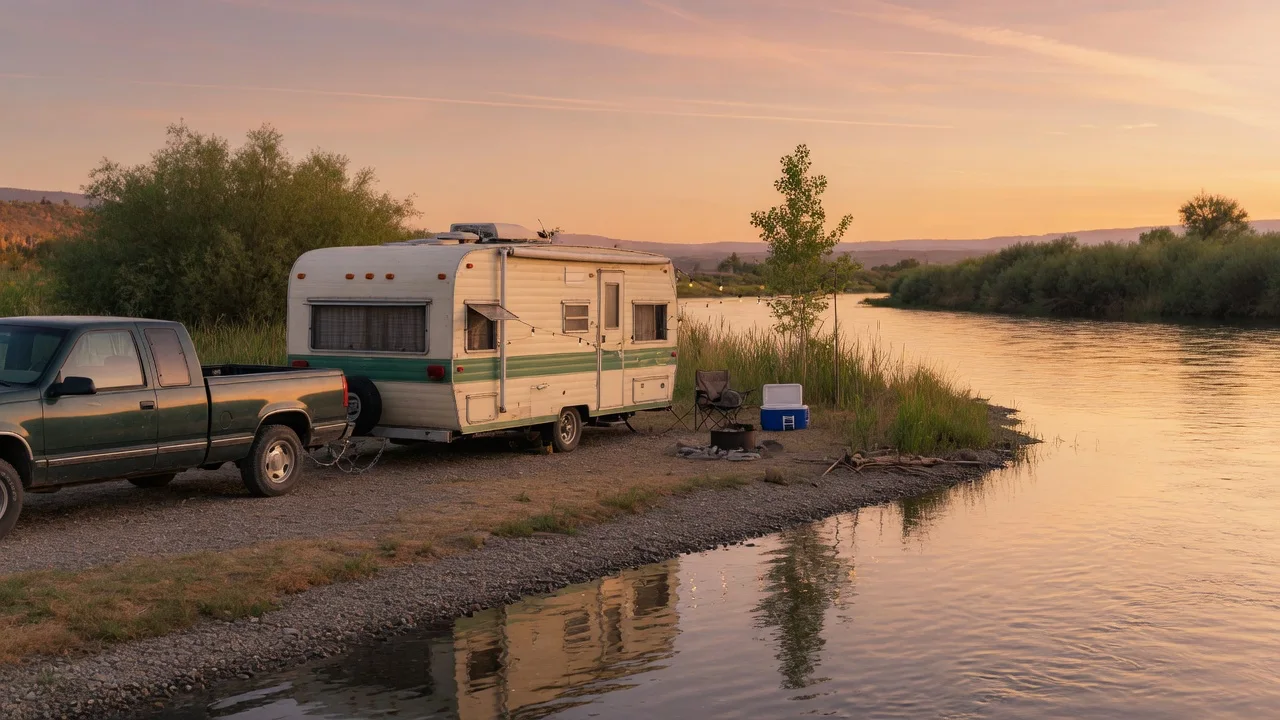


Browse the towable listings
Half-ton OK or HD truck required · WDH + sway control · brake controller verified
Browse towable rentals