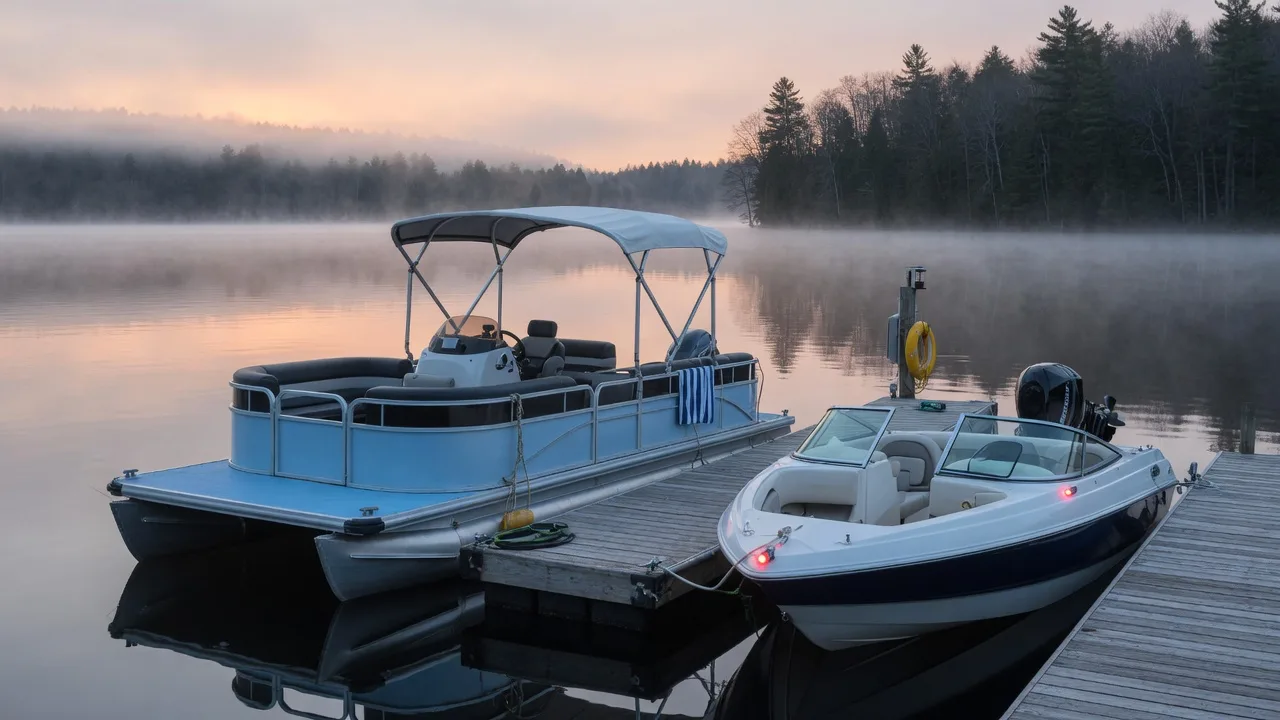
Why a pontoon is the friendliest first boat
A pontoon sits higher than a V-hull, has a wide flat deck for kids and gear, and handles gently. It's slow to tip and slow to surprise you, which is why marinas steer first-timers toward pontoons on calm water.
Before you cast off, do the same pre-trip check a marina would: confirm there's a properly sized, US Coast Guard-approved life jacket for every person aboard, locate the fire extinguisher and sound-signaling device, check the fuel and the engine cut-off (kill-switch) lanyard, and note the local rules and weather. New operators should still complete their state's boater-education requirement where it applies.
Driving: throttle, steering, and reading the water
Pontoons steer from a wheel and accelerate from a throttle lever — but everything happens slower than a car. The boat keeps moving after you pull the throttle back (there are no brakes on the water), and it pivots around its center, so give yourself room and think several seconds ahead.
Attach the engine kill-switch lanyard to yourself so the motor stops if you're thrown from the helm. Make turns gradually, keep a constant lookout for other boats, swimmers, and floating debris, and keep your speed appropriate for traffic and conditions.
- No brakes: ease off the throttle early and let the boat glide.
- Wear the kill-switch lanyard whenever the engine is running.
- Turn gently — pontoons pivot around their center, not their nose.
- Keep a constant lookout for swimmers, buoys, and other vessels.
No-wake zones and right-of-way basics
A no-wake zone means slow to idle speed — the slowest speed that still lets you steer — so your boat throws essentially no wake. These zones protect swimmers, docks, moored boats, and shorelines, and they're common near marinas, ramps, narrow channels, and crowded coves. They're marked with buoys or signs and the limits are enforced.
General navigation rules ('rules of the road' on the water) determine who yields when boats meet. The full rules are detailed and there are real exceptions, so learn them from the official source — your boating-safety course covers them and the Coast Guard publishes the Navigation Rules.
Verify locally: Specific speed limits, no-wake distances from shore, and local navigation rules vary by state and by waterway. Confirm the rules for your specific lake or coast before you go fast.
Docking without drama
Docking is where new operators get flustered, so slow everything down. Approach the dock at a shallow angle and at idle speed, accounting for wind and current pushing you. Have fenders out and dock lines ready before you arrive, brief a passenger on which line goes where, and never put a hand or foot between the boat and the dock to stop it — use the lines.
If your first approach looks wrong, abort and circle around. A calm second attempt beats a rushed first one every time.
- Approach slow and shallow-angle; let idle speed do the work.
- Rig fenders and lines before you reach the dock.
- Account for wind and current pushing the bow or stern.
- Never use your body to fend off — use the dock lines.
Anchoring safely
To anchor, head into the wind or current, stop the boat, and lower (don't throw) the anchor until it reaches the bottom. Then let out enough anchor line — the rule of thumb is several times the water depth (scope) — and back down gently so the anchor sets. Tie the line to a bow cleat, never the stern, since anchoring from the stern can pull a boat under.
Check that you're holding by lining up two fixed points on shore; if they drift, your anchor is dragging and you need to reset. Pick anchorages out of traffic and away from no-wake-zone exits.
When you're ready to get on the water, PickRV groups boats by how you use them — pontoons, jet skis, ski/wakeboard boats, and houseboats — with the governing agency and the local boater-education rule shown on each listing, so you know what you need before you book, not at the dock. The nightly rate you see is the whole nightly rate. At checkout you add one platform fee — a transparent 10% service fee on the rental subtotal — plus any cleaning fee, every line itemized before you pay. Cancel at least 48 hours before pickup on any listing and the rental charges are refunded in full. You bring your own coverage — confirm your personal auto/RV policy covers rentals before pickup.