Cultural heritage
A multi-generational Mexican-American family RV tradition
Three generations, one Class C, a White Sands itinerary, and the meals that hold the trip together.
Reading length
9 min
Long read — settle in
Word count
613 words
Sections
5 parts
Story type
Cultural heritage
Why we are writing this carefully
PickRV has a hard rule on cultural-heritage features: we do not invent communities, we do not exoticize, and we do not use language that flattens a family into a stereotype. This piece is illustrative — a composite plan for what a three-generation Mexican-American family might do on a Southwest RV trip — and it is reviewed by editorial staff for tone before publication. The dishes named below are common across many Mexican-American households; they are not exotic to the people who cook them every week.
If you are a Mexican-American RV traveler who would like to document a real trip with your name, your family, and your photographs, write to support@pickrv.com. We will not invent you.
The shape of a three-generation trip
A Class C in the 25 to 28 foot range sleeps six comfortably: one bed in the cabover (typically the youngest), one queen in the rear bedroom (the grandparents), and a dinette-and-sofa conversion for the middle generation. The trade-off is that nobody has a private door; this is a feature in Spanish-speaking households where the day often ends with everyone in the same room talking, and a quiet problem in households where teenagers prize their bedroom. Decide which household you have before you rent.
Practically, three generations means three cooking habits. The grandparents cook traditional dishes — caldo de pollo, frijoles de la olla, sopa de fideo — that require a 12-quart stockpot. The middle generation does the grilling. The youngest wants cereal. The RV galley has to accommodate all three. A Class C with a residential-style 6-cubic-foot fridge is the realistic floor; anything smaller and you will be running to a supermercado every other day.
- Stockpot floor: 12-quart, fits two standard burners.
- Tortilla space: a 10-inch comal lives on top of the fridge during transit.
- Spice kit: travel-size containers, labeled in Spanish where it matters (achiote, comino).
- Cooler logistics: a 50-quart secondary cooler in the cab carries cold drinks; the galley fridge is reserved for tomorrow's protein.
The route — White Sands to Carlsbad
A common itinerary leaves El Paso, runs north on US-54 to Alamogordo (90 minutes), spends two nights at White Sands National Park (the visitor center campground is reservation-only and small; private campgrounds in Alamogordo are the realistic backup), then east on US-82 across the Sacramento Mountains to Cloudcroft, and south to Carlsbad Caverns. The total is roughly 280 miles of driving — comfortable for an RV — across three distinct ecosystems.
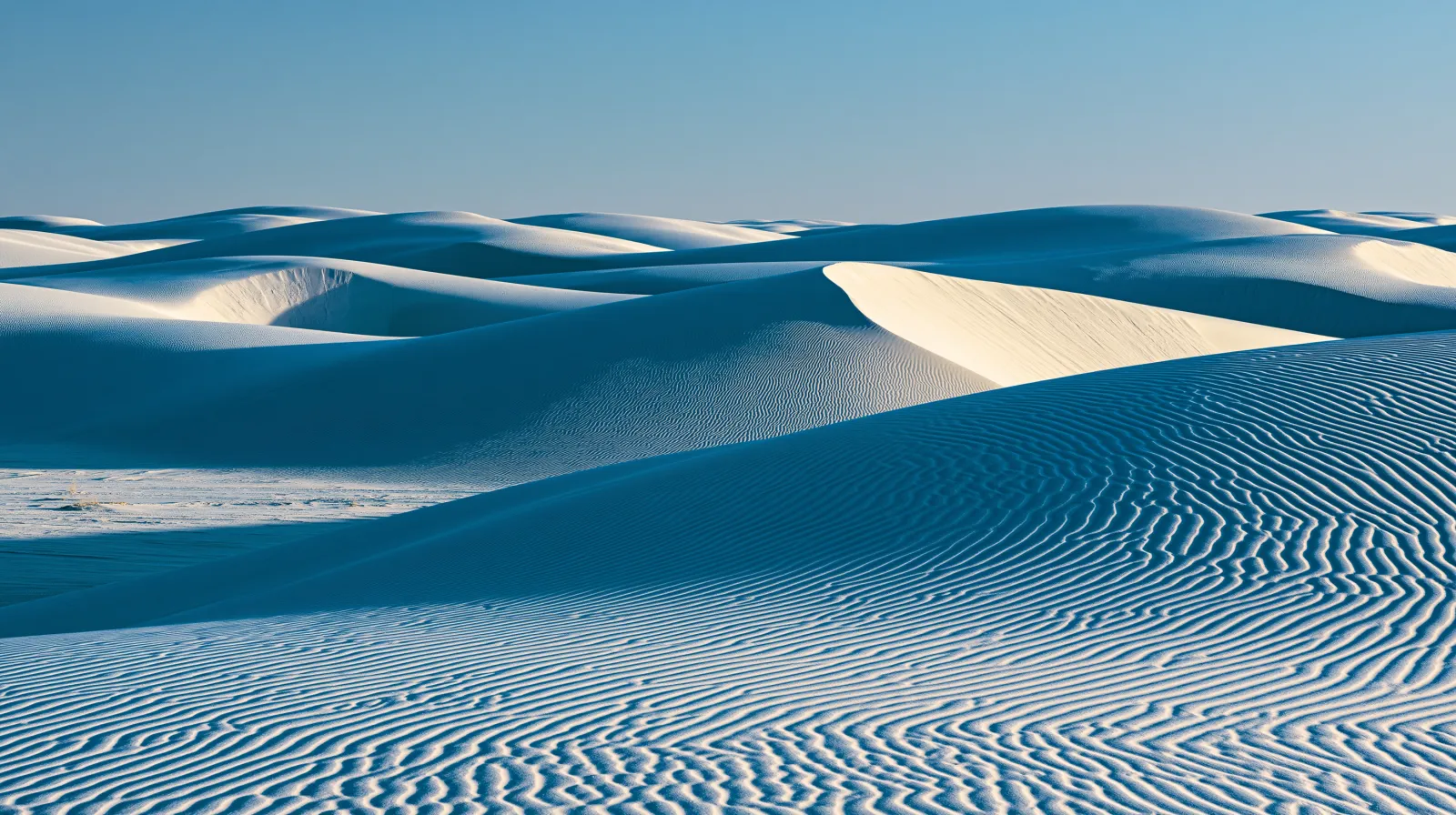
White Sands is gypsum, not silica. It does not retain heat the way ocean-beach sand does, which is why the dunes are walkable at midday in summer. But it reflects sun like a mirror; sunburn is the most common medical event in the park, and small children burn fastest. Carry the wide-brim hats your grandmother already packed.
Decide which household you have before you rent. Three generations means three cooking habits.
Spanish-language signage and night-sky etiquette
Most US National Parks have published Spanish-language safety brochures (in PDF) but the in-park signage is inconsistent. White Sands does well; Carlsbad's amphitheater for the Bat Flight Program does not, and the ranger talk is delivered in English. If your grandparents are more comfortable in Spanish, download the NPS Spanish brochure to your phone before you arrive, because there is no cell service in either park's interior.
On the night sky: Carlsbad is an International Dark Sky Park. Loud talking carries across the desert at night and ranger volunteers will politely ask you to quiet down at the amphitheater before the bat flight begins. This is not a culture-specific request — it is enforced for every visitor — but the social cost of being asked publicly is higher for some families than others, and an English-speaking grandchild can soften the moment.
What we left out on purpose
We did not write a section on "authentic Mexican RV cooking" because there is no such category. There are dishes specific to Sonora, dishes specific to Oaxaca, dishes specific to a single grandmother in Las Cruces. We are not equipped to flatten that. If you want the dishes documented properly, the right resource is your family — and we would publish the family's name and recipes if they offered them to us.
What you won't find elsewhere
Most RV trip guides assume a nuclear family of four. This one is built around the rig math, food logistics, and language considerations of a three-generation household.
Topics
Make it a trip
Rent an RV in New Mexico
The rigs here are owned by local hosts. Browse what fits the trip in this story, or reach New Mexico owners directly.
Browse New Mexico rigsWhat fits this trip
Nearby & related
Keep planning New Mexico
Sourced costs, campground directories, and the places worth a detour — the next layer of New Mexico trip planning.
- New Mexico RV rental costFuel · camping · tax, sourced
- New Mexico RV-friendly campgroundsHookups, rig limits, booking tips
- Campervan & van rentals in New MexicoVan-life routes, rules & rigs
- Fossil sitesDeep-time road stops
- Petroglyph sitesAncient rock-art stops
- Wild-horse rangesMustang-range guides
- RV renter basicsFirst-rental fundamentals
More from PickRV
- Trip plan
Three weeks on the Pacific Coast Highway with an Italian family
Slow travel from Big Sur to the Olympic Peninsula in a Class C, with a refusal to make every day a photograph.
- Cultural heritage
A Civil Rights heritage trail RV journey
Memphis, Selma, Montgomery, Birmingham, Atlanta — the route that costs more than gas to drive honestly.
- Cultural heritage
An indigenous-heritage road trip that does not pretend to be one
Across the Navajo Nation, the Hopi Reservation, and Bears Ears, with the geography acknowledged and the etiquette named.