- Trip length
- 12 months
- Sweet-spot rig
- 30-32ft Class C bunkhouse
- Mailbox service
- Escapees · Traveling Mailbox
- NPS badges
- Junior Ranger · free
Why a 12-month roadschool trip is its own buying decision
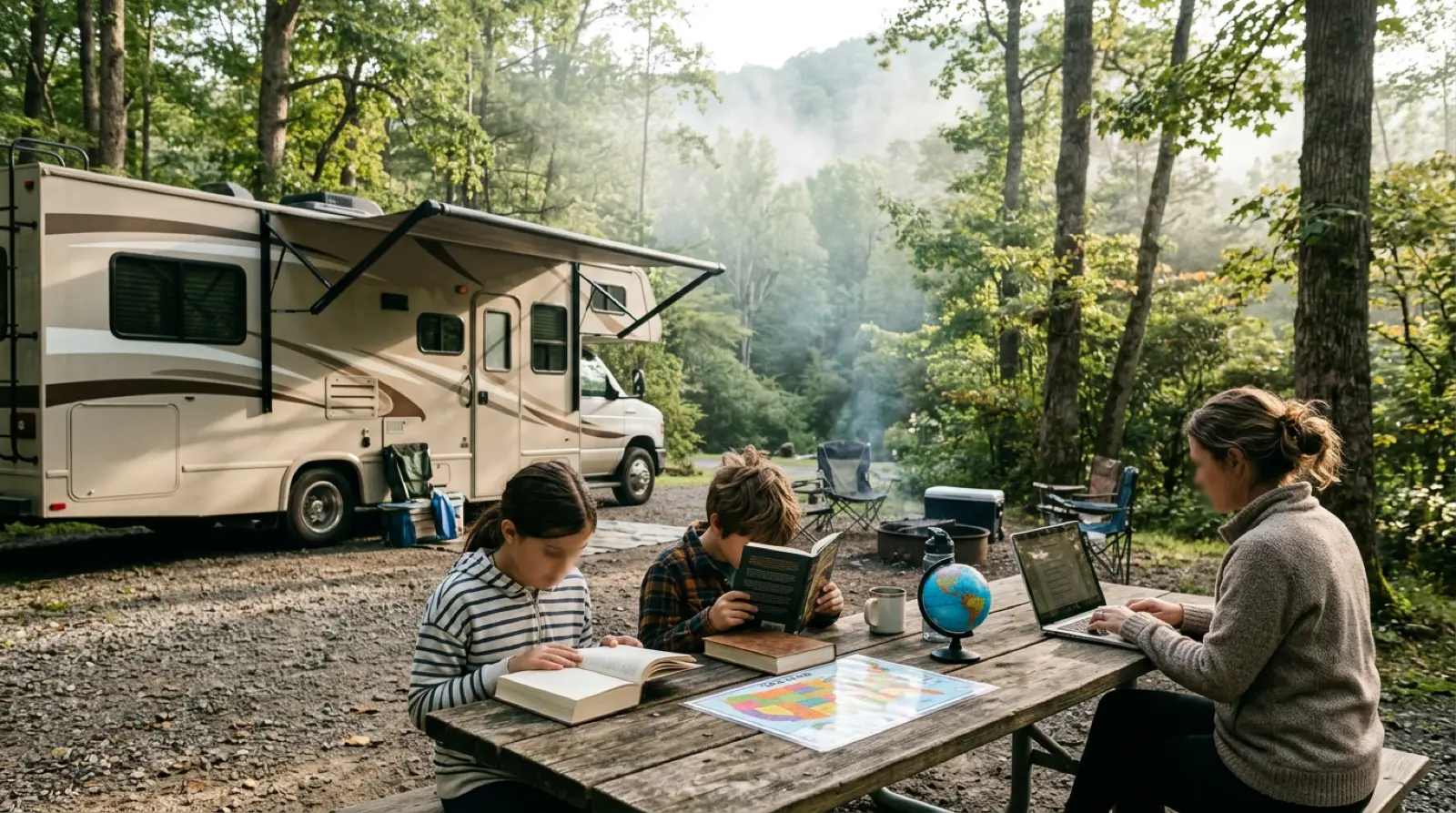
A full year on the road with school-age children is one of the most demanding rental commitments anyone in this marketplace will ever make. The keyword "rv rental for homeschool family year on the road" implies a renter who has already decided the trip is happening and is now hunting for the rig, the curriculum coordination, the connectivity, and the route plan. This page treats all four together because all four interact — the wrong rig, the wrong mailbox provider, the wrong connectivity tier, or the wrong route cadence will quietly break the year by month four.
Rig-class trade-offs that decide month-4 sustainability
Rig class trade-offs decide whether the year is sustainable. Two-parent two-kid families converge on a 30-32ft Class C bunkhouse or a 32-35ft travel trailer towed by a 3/4-ton pickup. The Class C bunkhouse wins on kid-bunk predictability (each child has a fixed personal bunk that doesn't reset every evening) and on the parent-and-kid travel-day separation (kids belted in the rear, parents up front). The travel trailer plus tow vehicle wins on flexibility (the truck becomes the school-day grocery and day-trip vehicle when the trailer is parked at a campground for the week). Class A diesel pushers (38-40ft) give the most living space but cost twice as much per month and limit access to half the in-park NPS campgrounds. Sprinter conversions are romantic for couples but cramped for a school year with kids. The deciding question is whether the kids each need a defined personal bunk or whether the parents need a real walled-off bedroom; both are valid. The wrong answer here is the most-cited reason roadschool years end early.
Curriculum boxes, mailbox services, and domicile state
Curriculum and mail logistics. Most full-time roadschool families use a digital-first curriculum (Outschool, Khan Academy, Time4Learning, BookShark, etc.) plus a mailbox service like Escapees, Traveling Mailbox, or America's Mailbox that scans incoming mail and forwards physical items to a hold-for-pickup address along your route. Curriculum-box shipments (BookShark and similar) arrive in monthly increments; coordinate the next-shipment-address two weeks ahead based on your projected route. State homeschool registration follows your domicile state — not the states you visit. Most full-timers domicile in Texas, Florida, or South Dakota for the lenient combination of (a) low or no state income tax, (b) lenient homeschool reporting, and (c) accepted residency without a physical address. Domicile is a real legal decision; consult a CPA familiar with full-time-RV residency before relying on it.
Starlink + cellular + offline-curriculum redundancy
Connectivity as the daily-school dependency. Starlink RV (now sold as the Roam tier) delivers usable download speeds for live video classes at the great majority of dispersed camp sites that have clear sky view. Where it breaks down is dense tree canopy, deep canyons, and extreme weather — site-dependent rather than regional. The honest planning rule: never schedule a non-reschedulable live class on a travel day, always have a cellular backup hotspot (Verizon or T-Mobile, sometimes both) ready for the day the satellite link drops, and bring a 2nd-tier offline curriculum component (math worksheets, reading, hands-on projects) that survives an internet outage. Build "buffer Fridays" into the school week so the family is not exposed to a critical-Friday connectivity failure.
4-park cluster routing + Junior Ranger badge calendar
Route cadence and the National Park Service Junior Ranger calendar. The NPS Junior Ranger program is free and exists at most of the 400+ NPS units; kids earn a badge or patch per unit completed. A 12-month route that includes 30+ unit visits realistically nets 25-30 earned badges per kid — a tangible portfolio for the year. Plan the route in 4-park clusters per region (the Utah Mighty 5, the Pacific Northwest with Olympic plus Mt Rainier plus North Cascades, the Smokies cluster, etc.) so park visits stack into single weeks rather than scattering across long travel days. The travel-day cap that almost every successful full-timer endorses: no more than 250 miles per travel day, and no more than two travel days in a week. PickRV's role for long-term roadschool families is coordinating long-stay host inventory (monthly-rate rigs); search current inventory for monthly-rate rigs in Texas, Florida, and South Dakota and message hosts directly about your travel window — the fleet grows as more owners list.
12-month cost estimator (your inputs)
Trip cost calculator
Estimate your rental + fuel + per-person split. All inputs are yours.
Enter nights and nightly rate to see your estimate.
Estimates based on user-supplied inputs. PickRV does not verify accuracy. Fuel math ignores terrain, weather, and idle time. Hotel benchmark of $150/night is a national rough average (US ADR, June 2026) — your city and dates will vary.
Family roadschool pack list
Pack-list builder
Pick a trip type, check items off, add your own. Saves to this device.
0 / 10 packed
Frequently asked questions
- What size rig is realistic for a full year of roadschooling?
- Two-parent two-kid families converge on a 30-32ft Class C bunkhouse or a 32-35ft travel trailer towed by a 3/4-ton pickup. Class A diesel pushers (38-40ft) give the most living space but cost twice as much per month and limit campground access. Sprinter conversions are romantic for couples but cramped for a school year with kids. The deciding question is whether the kids each need a defined personal bunk (Class C bunkhouse wins) or whether parents need a real walled-off bedroom (Class A wins). A travel trailer plus dedicated tow vehicle is the most flexible because the truck becomes the school-day vehicle when parked.
- How do families handle curriculum and mail for 12 months on the road?
- Most full-time roadschool families use a digital-first curriculum (Outschool, Khan Academy, Time4Learning, BookShark, etc.) plus a mailbox service like Escapees, Traveling Mailbox, or America's Mailbox that scans incoming mail and forwards physical items to a hold-for-pickup address along your route. Curriculum boxes (BookShark, etc.) ship in monthly increments; coordinate the next-shipment-address two weeks ahead based on your projected route. State homeschool registration follows your domicile state, not the states you visit — most full-timers domicile in TX, FL, or SD for the lenient combination.
- Is Starlink reliable enough for daily online school?
- Starlink RV (now Roam) delivers usable download speeds for live video classes at the great majority of dispersed camp sites with clear sky view. Where it breaks down is dense tree canopy, deep canyons, or extreme weather — not regional but micro-site dependent. The honest planning rule: never schedule a non-rescheduable live class on a travel day, and always have a cellular backup (Verizon or T-Mobile hotspot) ready for the day the satellite link drops. Bring a 2nd-tier offline curriculum component (math worksheets, reading) that survives an internet outage.
- What does the Junior Ranger badge calendar look like for a year?
- The National Park Service Junior Ranger program is free and exists at most of the 400+ NPS units. A 12-month route that includes 30+ unit visits realistically nets 25-30 earned Junior Ranger badges per kid — a tangible portfolio of the year. Plan the route in 4-park clusters per region (e.g. Utah Mighty 5, the Pacific Northwest Olympic + Mt Rainier + North Cascades, the Smokies + Mammoth + Cumberland Gap) so park visits cluster into single weeks rather than scattered across travel days.
Keep exploring
Ready to roll?
Pick a rig. Write the road.
Complete nightly price on every listing — your exact total itemized before you pay · 48h full rental refund. Every rig near you, one checkout.