- Monthly-rate discount
- 15 - 30%
- Sweet-spot rig length
- 28 - 32 ft Class C
- USPS PFS forwarding rate
- $23.90/week (verify)
- Realistic per-night all-in
- 25-40% below nightly rate
60 days is the tech-sabbatical sweet spot
The 60-day RV sabbatical is the sweet-spot duration in the tech-industry sabbatical pattern. It is long enough to drive the country slowly — Pacific Northwest in week 1, Cascades and Rockies in weeks 2-3, Southwest in weeks 4-5, Texas Hill Country in week 6, and the Southeast in weeks 7-8, or any variant — and short enough to keep the home base and the job intact. This page is the honest planning frame: cost math, mail workflow, rig selection, and the domicile-residency footnotes that matter.
Monthly-rate compound math (real numbers)
The cost math first because it determines the rig class. Most hosts offer weekly discounts (5-15% off the nightly rate) and monthly discounts (15-30% off). On a 60-day rental those compound in the renter's favor: the realistic all-in per-night rate often lands 25-40% below the headline nightly rate at the same host. Run a quick comparison: a $180/night Class C at 7 days costs $1,260 base; the same rig at 60 days with a 25% monthly discount costs $180 × 0.75 × 60 = $8,100, or $135/night all-in. Add the standard line items (cleaning, insurance, mileage if you exceed the allowance, tax) and the realistic all-in lands around $9,500 to $10,500 for the 60 days. The calculator below walks through the exact line items.
USPS PFS + package workflow for 60 days on the road
The mail and package workflow. USPS Premium Forwarding Service (Residential) forwards your mail weekly for a flat fee — $23.90 per week as of 2024 pricing, verify the current rate on usps.com. The honest workflow: forward to a friend or family member with a stable address, OR rent a private mailbox service (Mail Boxes Etc, UPS Store) at a campground town along the route. For Amazon and bigger packages, use Amazon Locker pickup at major metros along the route, or arrange to have packages held at the campground office (verify the campground accepts packages BEFORE shipping — many do, some refuse, and the wrong assumption costs real money). Schedule any prescription refills around the trip calendar; most pharmacies will fill a 90-day supply for chronic medications if you bring the request before departure.
Rig class selection — Class C is the sweet spot
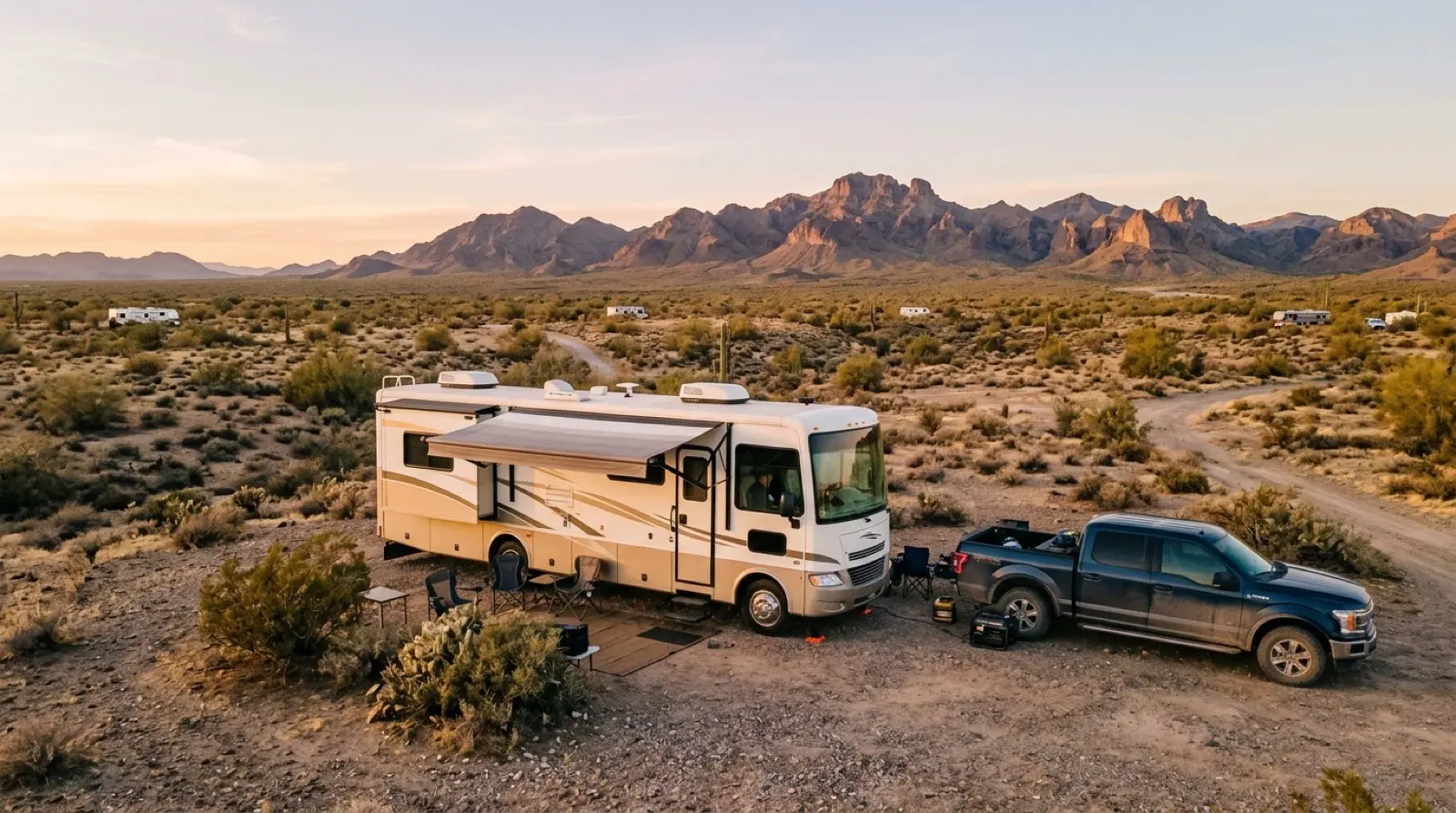
Rig class for a 60-day trip. Class C motorhomes in the 28-32 foot range are the sweet spot — large enough for two adults to live in for 60 days without the rig feeling too small, compact enough to fit at most full-hookup campgrounds, and drivable on any US interstate without the bridge-clearance or weight-station concerns that come with a 40-foot Class A. Sprinter conversions in the 170-inch wheelbase work for a couple comfortable with vanlife and willing to use campground bathhouses (the interior tank capacity on a Sprinter is the limiting factor on 60-day trips with boondocking stretches). Class A motorhomes 32-38 feet work if the trip is mostly long-stay basing rather than constant moves — think two weeks in Asheville, three weeks in Bend, two weeks in Sedona, one week traveling between, rather than a new campground every 2-3 nights. Avoid Class B vans under 22 feet for 60 days unless you have done a 14-day trip in one and liked it; the small-footprint lifestyle wears quickly past three weeks.
Domicile, taxes, residency — what does NOT change at 60 days
Domicile, taxes, and residency. A 60-day trip does NOT change your domicile state — IRS Pub 463 treats it as a temporary trip, not a relocation. A few practical items still matter: file change- of-address paperwork only if you genuinely intend to relocate (otherwise use USPS PFS and keep the domicile address intact); verify the rental car or tow-vehicle insurance covers the full 60 days; confirm health insurance covers out-of-network care in the states you'll cross; and remember that some employer policies require advance notification before extended remote periods. Escapees RV Club's domicile guide is the best free reference if the 60-day trip is a stepping stone toward considering full-time RV life beyond the sabbatical. PickRV's role on a 60-day rental is coordination — surfacing rigs that explicitly offer monthly- rate discounts in the listing description, re-stating the host's mileage allowance and pet policy on the booking confirmation, and flagging hosts who will pre-stock the rig with a sabbatical- length set of consumables (linens, paper goods, propane tanks full) so the first day on the road is not a Walmart run.
Trip cost calculator (60-day monthly-discount aware)
Trip cost calculator
Estimate your rental + fuel + per-person split. All inputs are yours.
Enter nights and nightly rate to see your estimate.
Estimates based on user-supplied inputs. PickRV does not verify accuracy. Fuel math ignores terrain, weather, and idle time. Hotel benchmark of $150/night is a national rough average (US ADR, June 2026) — your city and dates will vary.
Pack-list builder (long-stay pre-set)
Pack-list builder
Pick a trip type, check items off, add your own. Saves to this device.
0 / 10 packed
Frequently asked questions
- What is the per-night cost difference between a 60-day rental and a 7-day rental?
- Significant. Most hosts offer weekly discounts (5-15% off) and monthly discounts (15-30% off). On a 60-day rental that compounds — the realistic all-in per-night rate often lands 25-40% below the nightly rate at the same host. Compare a $180/night Class C at 7 days ($1,260 base) against the same rig at 60 days with a 25% monthly discount: $180 × 0.75 × 60 = $8,100, or $135/night all-in. Run the precise number through the calculator below.
- How do mail and packages work during a 60-day trip?
- USPS Premium Forwarding Service (Residential) forwards your mail to a temporary address weekly for a flat fee ($23.90/week as of 2024 pricing — verify current rate on usps.com). The honest workflow: forward to a friend or family member with stable address, OR rent a private mailbox service (Mail Boxes Etc, UPS Store) at a campground town. For Amazon and bigger packages, use Amazon Locker pickup at major metros along the route or have packages held at the campground office (verify the campground accepts packages BEFORE shipping).
- Which rig classes work for a 2-month trip?
- Class C motorhomes (28-32 feet) are the sweet spot — large enough for two adults to live in for 60 days without going stir-crazy, small enough to fit at most full-hookup campgrounds, drivable on any US interstate. Sprinter conversions (170WB) work for a couple comfortable with vanlife. Class A motorhomes (32-38 feet) work if the trip is mostly long-stay basing rather than constant moves. Avoid Class B vans under 22 feet for 60 days unless you've done a 14-day trip in one and liked it — the lifestyle wears quickly.
- What about domicile, taxes, and residency during a 60-day trip?
- A 60-day trip does NOT change your domicile state (IRS Pub 463 treats this as a temporary trip), but a few practical items matter: file change-of-address paperwork only if you genuinely intend to relocate (otherwise use mail forwarding), verify the rental car insurance covers the full 60-day period, confirm health insurance covers out-of-network care in the states you'll cross, and remember that some employer policies require notification before extended remote periods. Escapees RV Club's domicile guide is the best free reference if you're considering full-time RV life beyond the 60-day window.
Keep exploring
Ready to roll?
Long-stay RV ready to browse.
Complete nightly price on every listing — your exact total itemized before you pay · 48h full rental refund. Every rig near you, one checkout.