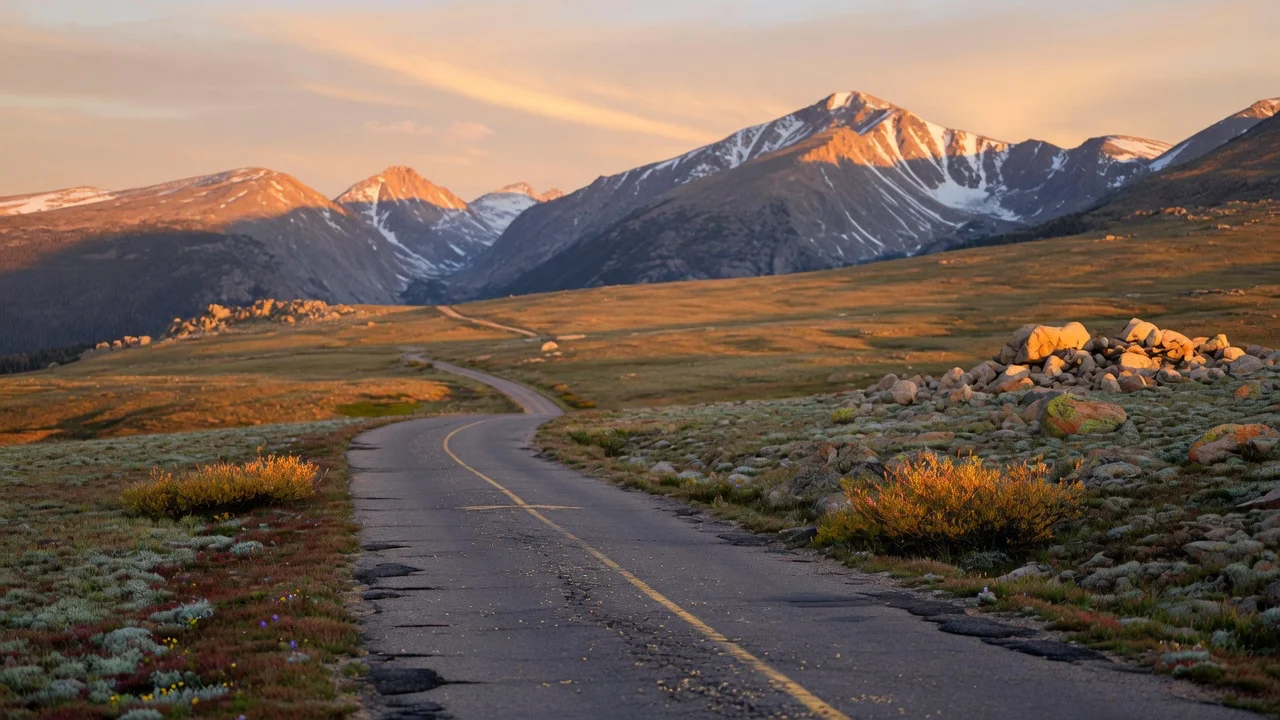
Rocky Mountain National Park covers 265,848 acres (415 sq mi) of Colorado's Front Range, climbing from 7,600ft to 14,259ft at the summit of Longs Peak, with 77 named peaks above 12,000ft.
Official park page confirmed live on July 25, 2026.
More on Rocky Mountain National ParkField notes, rig limits by loop, seasons, what to do, quiet spots
Rocky Mountain National Park covers 265,848 acres (415 sq mi) of Colorado's Front Range, climbing from 7,600ft to 14,259ft at the summit of Longs Peak, with 77 named peaks above 12,000ft. The busy east side is reached through Estes Park (about a 95-minute drive northwest of Denver); the quieter west side sits at Grand Lake. Four campgrounds take RVs, but Moraine Park is the headline rig: freshly rehabbed, it now offers 49 electric sites (20/30/50-amp) in Loops B and C, takes rigs to 40ft, has a dump station, and is the only campground open in winter. On top of a site reservation, day visitors need a 2026 timed-entry permit for the Bear Lake Road corridor (through Oct 19) or the rest of the park (through Oct 13).
The notes below are PickRV's editorial record. Only the figures in the strip at the top of the page, each with its link and date, were re-read on the park's own pages.
Rocky Mountain National Park concentrates more than 60 peaks above 12,000 feet, alpine tundra, and the Continental Divide into a single Colorado high-country corridor. Trail Ridge Road climbs to 12,183 feet — the highest continuous paved road in any U.S. national park — and connects the busier Estes Park side with the quieter Grand Lake entrance.
When to visit
Late June through mid-September keeps Trail Ridge Road open end-to-end; September brings clearer light and elk-bugling season in Moraine Park and Horseshoe Park.
RV access notes
Moraine Park and Glacier Basin accept RVs up to about 40 ft and 35 ft respectively; Timber Creek accepts up to about 30 ft. None of the park campgrounds have hookups, and a timed-entry reservation is required for most summer arrivals.
Source —
What the official site doesn't tell you
PickRV editor's field notes
NPS.gov long said 'no hookups in any RMNP campground,' but that's now outdated for the headline RV site: after the 2025 utility rehab, Moraine Park reopened with 49 ELECTRIC sites (20/30/50-amp) in Loops B and C — the only powered sites in the park. There's still no water or sewer hookup anywhere, so arrive with full fresh tanks and plan to use the dump stations at Moraine Park or Glacier Basin. Second trap: a campground reservation is NOT your entry permit. In 2026 you also need a timed-entry permit — Bear Lake Road corridor through Oct 19, rest of park through Oct 13 — released monthly starting May 1 and gone within minutes. Third: do not point a 40-footer or any towed rig up Old Fall River Road — it's 9.4 miles of one-way gravel that bans vehicles over 25ft and all trailers. Drive your tow vehicle instead. Fourth: Trail Ridge Road is your only east-west crossing and it's closed mid-October to late May, so a west-side Timber Creek booking can mean a multi-hour detour in shoulder season.
Rig limits by loop and road
Length + clearance
·Park-wide, our record: 40 ft
·Moraine Park Campground (Loops B & C): 40 ft — 40ft is the ceiling for an RV or trailer+tow combo; 49 sites carry electric (20/30/50-amp) after the 2025 utility rehab — the only powered sites in the park. Summer is reservation-only, winter (from ~Oct 20) is first-come
·Glacier Basin Campground: 35 ft — 35ft max, dry camping only (no hookups); reservation-only, typically open late May to early September. Dump station on site
·Aspenglen Campground: 30 ft — Rigs over 30ft are NOT permitted; dry camping only, reservation-only, near the Fall River entrance
·Timber Creek Campground (west side, Grand Lake): 30 ft — 30ft max, dry camping only; the only campground on the quieter west side, reservation-only summer season
·Longs Peak Campground: 0 ft — Tents only — no RVs or trailers; first-come, no water available
·No tunnels in RMNP — there is no height limit on Trail Ridge Road or the entrance roads, so tall rigs are fine on the paved routes
·Old Fall River Road: 9.4 miles, one-way uphill, gravel — vehicles over 25ft AND any vehicle pulling a trailer are PROHIBITED. Leave the big rig at camp and drive a tow vehicle
·Trail Ridge Road tops out at 12,183ft (highest continuous paved road in the US) — fine for RVs but no shoulders/few guardrails; expect ~15-20% generator power loss and low cold-morning tire PSI at altitude
Dump + generator
·Dump station: Seasonal RV dump stations at Moraine Park and Timber Creek campgrounds (NPS campground pages) (Included with camping; check current park fees)
·Generators: 7:30am-10:00am and 4:00pm-8:30pm in park campgrounds; quiet hours 10pm-6am
Boondock alternative within 20-40 min — free dispersed sites with no hookups/water; check current USFS fire restrictions and stay limits before relying on it
Arapaho & Roosevelt National Forests dispersed camping outside the park — e.g. along the Peak to Peak Highway (CO-7/72) south of Estes Park
Seasons and closures
Full season:Moraine Park Campground: year-round (summer reservation-only; winter ~Oct 20 onward first-come). Glacier Basin, Aspenglen, Timber Creek: roughly late May through early-to-mid September
Limited access:Trail Ridge Road open late May to mid-October only (closes to through travel for winter); Old Fall River Road usually opens early July and closes for the season in October
Known closures:
·Trail Ridge Road closed to through travel mid-October through late May (the only east-west route across the park) — west side (Grand Lake) becomes a long detour in winter
·Old Fall River Road closed to vehicles roughly October through early July; opening date varies year to year with snowpack
·Glacier Basin, Aspenglen, and Timber Creek campgrounds close for winter; Moraine Park is the only campground open in the off-season
·2026 timed-entry permits required in addition to a camping reservation: Bear Lake Road corridor May 22-Oct 19 (5am-6pm); rest of park May 22-Oct 13 (9am-2pm)
What to do at Rocky Mountain National Park
Trail Ridge Road
Highest continuous paved road in the US, cresting at 12,183ft; open late May to mid-October — drive it in a tow vehicle for the alpine tundra overlooks, RVs are allowed but no shoulders
Bear Lake Road corridor
The park's most popular trailheads (Bear Lake, Glacier Gorge, Sprague Lake); needs the separate Bear Lake timed-entry permit 5am-6pm in 2026 — park the rig at Glacier Basin and ride the free shuttle
Longs Peak (14,259ft)
The park's only fourteener and highest point; the Keyhole Route is a serious non-technical climb — most RVers just take in the view from Longs Peak area pullouts
Alpine Visitor Center (11,796ft)
Highest visitor center in the NPS, at the top of Trail Ridge Road where Old Fall River Road merges in; seasonal, snow-dependent
Hidden — not on the official map
PickRV editor's quiet spots
Timber Creek Campground (west / Grand Lake side)
Far quieter than the Estes side and easier to book; 30ft max, dry camping — but remember Trail Ridge Road closes in winter, leaving a long detour back east
Peak to Peak Highway dispersed camping (USFS)
Free Arapaho-Roosevelt NF dispersed sites along CO-7/72 south of Estes Park — basecamp the big rig free, then drive a toad into the park
Colorado scenery around Rocky Mountain National Park
Landscapes from around Colorado — the country you cross on a Rocky Mountain National Park RV trip.
Weather, air, sky and park alerts right nowLive for Rocky Mountain National Park. Open-Meteo, sunrise-sunset.org, National Park Service alerts.Will my rig fit? Try your lengthChecks a length against the park caps in our record.
This guide is provided for general informational purposes only. PickRV is not an insurer, legal advisor, or vehicle-safety authority. Trip planning, route selection, rig suitability, weather, and emergency decisions are the renter's responsibility. Always consult the rig manufacturer's owner's manual, your insurance provider, the U.S. National Park Service (nps.gov), NOAA / NWS weather alerts (weather.gov), state and local emergency-management agencies, and current local regulations before and during travel. Cost figures, season windows, road conditions, and fee references on this page are estimates as of May 2026 and vary by season, location, rig, carrier, and operator. Mentions of brand names, state-tourism marks, national-park feature names, or third-party programs are informational only and do not imply affiliation, sponsorship, or endorsement.
Colorado rules to know before you rent
Per-state legal callout · CO
Before you rent in Colorado — key local rules
Standard Class R license covers motorhomes under 26,001 lbs
Colorado's ordinary Class R license is defined as any motor vehicle with a GVWR of less than 26,001 lbs as a single unit or in combination (15 or fewer passengers, no hazmat) — so it covers personal-use motorhomes and typical trailer combos. A single vehicle of 26,001+ lbs GVWR requires a Class B CDL; a combination over 26,000 lbs GCWR towing 10,000+ lbs requires a Class A CDL.
Operators 18+; ages 14-17 need a safety certificate; ANS stamp to launch
In Colorado anyone operating a motorboat or personal watercraft must be at least 18, and 14- to 17-year-olds may operate one only after completing and passing a state-approved boating safety course and carrying the certificate. Operators over 17 need no course, though CPW strongly encourages one. Every motorized or trailered boat and sailboat also needs an Aquatic Nuisance Species stamp and a certified ANS inspection before it launches.
Colorado OHV permit $26.25/yr — same price for residents and visitors
Any OHV used on Colorado public land needs a CPW registration or permit for the April 1 to March 31 year. Residents and non-residents both pay $26.25, which includes a $1.25 Search and Rescue surcharge, and the fee cannot be prorated for a partial year. Helmets are required for operators and passengers under 18 on public OHV trails.
0.08% BAC per se; 5 ng THC creates only a permissible inference
Colorado charges DUI per se at a BAC of 0.08 or more, measured at the time of driving or within two hours of it. There is no equivalent per-se charge for drugs: 5 ng/mL or more of active delta-9 THC in whole blood only allows a court to infer that the driver was under the influence, and the driver can rebut that inference. Cannabis is legal for adults 21 and over, but driving impaired is still prosecuted as DUI.