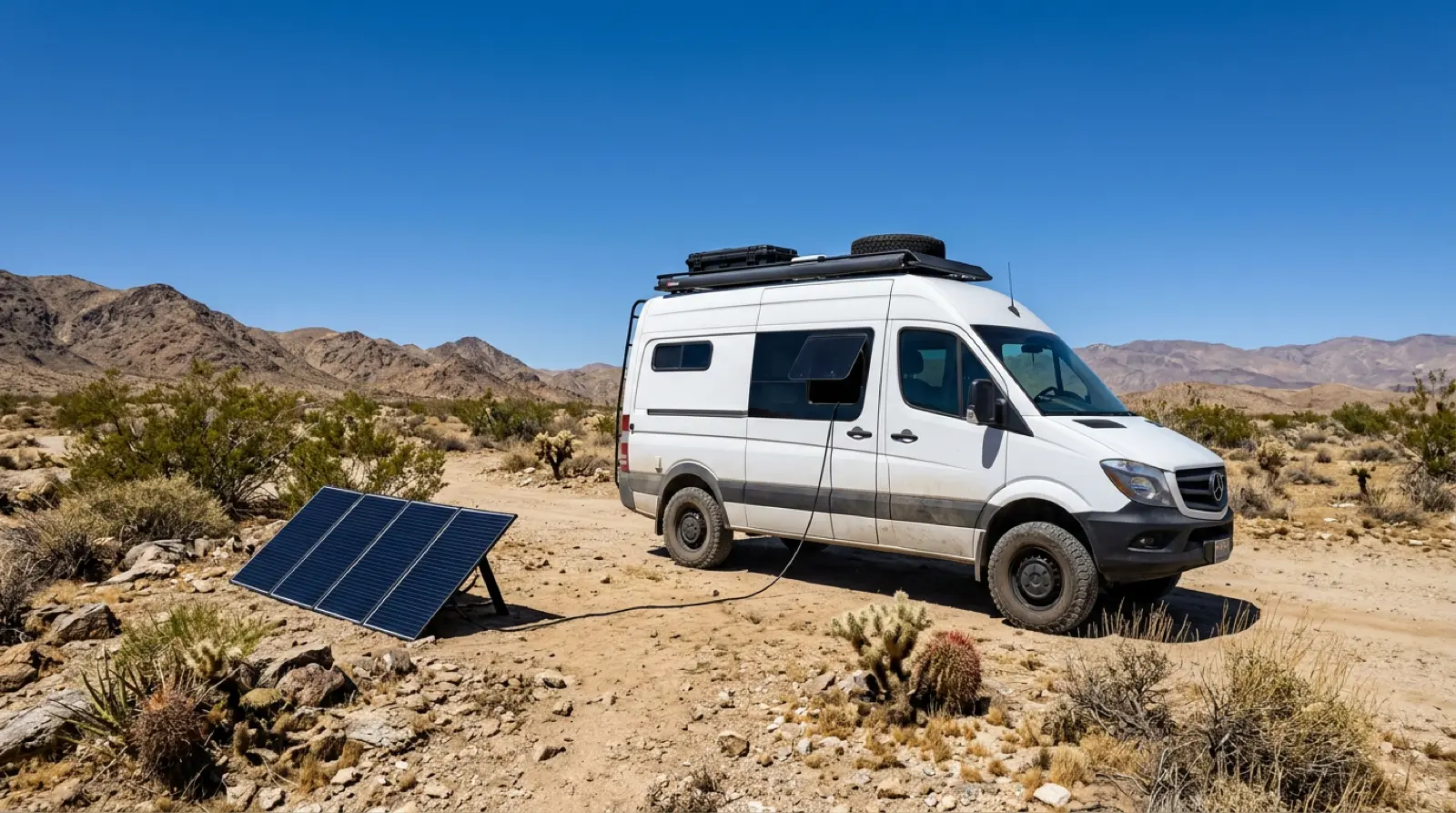
- 200W panel daily harvest
- 0.6-1.2 kWh real-world
- Remote-work daily draw
- 1.0-2.5 kWh typical
- Battery bank pairing
- Bluetti AC180/AC200 · Jackery 1000/1500 · Goal Zero Yeti 1500
- Connection path
- MC4 to power station · OR Zamp port
Why a portable 200W panel is the dry-camping starter kit
Dry camping — staying overnight without electrical hookups — is the single highest-value reason to bring a portable solar panel on an RV trip. The keyword "rv rental with portable solar panel 200w" is a renter who has already decided dry camping is part of their plan and is now hunting for the rig, the panel, and the battery bank that together let them stay off-grid without firing up the gas generator every afternoon. This page is the honest math version of that filter.
Real-world harvest vs brochure rating
What a 200W panel actually generates. A 200W rated panel produces roughly 1.0-1.2 kWh per day in ideal summer conditions (clear sky, panel angled toward the sun, 6-8 hours of useful sun). In real-world dispersed-camping conditions — partial cloud, sub-optimal panel angle, tree shading some hours — expect 0.6-0.9 kWh per day. The rating is the panel's peak output under controlled lab conditions; the daily harvest is meaningfully lower. Plan power budgets around the real-world number, not the brochure number. Two 200W panels deliver roughly double the daily harvest but face diminishing returns due to the same shading and angle problems; three panels is the practical upper end of portable-panel setups before installing a roof-mount system.
Daily power-budget math for common rigs and loads
Daily power-budget math. Approximate daily draws for the most common dry-camping loads: 12V RV refrigerator runs 0.4-0.6 kWh/day (residential 110V fridges 0.8-1.2 kWh/day); Starlink Mini 0.5-1.0 kWh/day depending on usage intensity; laptop charging 0.1-0.2 kWh/day; LED interior lights 0.05-0.15 kWh/day; phone charging negligible. A typical 2-person remote-work day with a 12V fridge runs 1.0-1.5 kWh total; a 4-person family with full Starlink and laptops runs 1.5-2.5 kWh. A single 200W panel covers the low end of the range with margin; multiple panels (two or three) cover the higher demand profiles. The single biggest power consumer in most rigs is the air conditioning, which a portable solar setup cannot realistically run — AC requires generator support or substantial lithium battery bank with a high-output inverter.
Battery bank pairing (Bluetti / Jackery / Goal Zero)
Battery bank pairing. Three product families dominate the rental-friendly portable battery bank market: Bluetti (AC180 at 1152 Wh, AC200 at 2048 Wh, AC500 at higher capacity), Jackery (Explorer 1000 at 1002 Wh, Explorer 1500 at 1534 Wh, Explorer 2000 at higher), and Goal Zero (Yeti 1500 at 1516 Wh, Yeti 3000 at 3032 Wh). The pairing math: the battery should be at least 1.5-2x your daily draw to handle cloudy-day buffer and overnight base load. A 1.5 kWh daily-draw remote-work setup pairs well with a 1500-2000 Wh battery; a 2.5 kWh family-day setup needs 3000+ Wh battery capacity or a willingness to manage power more carefully. The 200W panel charges the battery during sun hours; the battery delivers power overnight and through cloud cover.
Connection paths + what PickRV will and will not promise
Connection paths and what PickRV will and will not promise. Three common connection paths. (1) Direct to a portable power station (Bluetti, Jackery, Goal Zero) using the panel's MC4 or Anderson connectors — the cleanest setup; the rig itself stays separate from the solar gear and the renter takes the power station home after the trip. (2) Through the rig's external 12V solar input port (Zamp port or similar) — many modern RVs have this port specifically for portable panels; check the rig spec before assuming. (3) Direct to the rig's house batteries via a separate charge controller — most rental renters should not attempt this connection mid-trip without prior experience because mis-wiring can damage the rig's electrical system. PickRV's solar-ready filter verifies the rig spec; the solar-included filter verifies the host is providing a compatible panel kit. Search current inventory, filter for solar-ready or solar-included rigs on your dates, and message hosts directly about your window.
Estimate your dry-camping trip cost (your inputs)
Trip cost calculator
Estimate your rental + fuel + per-person split. All inputs are yours.
Enter nights and nightly rate to see your estimate.
Estimates based on user-supplied inputs. PickRV does not verify accuracy. Fuel math ignores terrain, weather, and idle time. Hotel benchmark of $150/night is a national rough average (US ADR, June 2026) — your city and dates will vary.
Frequently asked questions
- How much power does a 200W portable solar panel actually generate per day?
- A 200W rated panel produces roughly 1.0-1.2 kWh per day in ideal summer conditions (clear sky, panel angled toward the sun, 6-8 hours of useful sun). In real-world dispersed-camping conditions — partial cloud, sub-optimal panel angle, tree shading some hours — expect 0.6-0.9 kWh per day. The rating is the panel's peak output; the daily harvest is meaningfully lower. Plan power budgets around the real-world number, not the brochure number.
- What does a daily power budget for dry camping look like?
- Approximate daily draws for the most common dry-camping loads: 12V RV refrigerator runs 0.4-0.6 kWh/day (residential 110V fridges 0.8-1.2 kWh); Starlink Mini 0.5-1.0 kWh/day depending on usage; laptop charging 0.1-0.2 kWh/day; LED interior lights 0.05-0.15 kWh/day; phone charging negligible. A typical 2-person remote-work day with a 12V fridge runs 1.0-1.5 kWh; a 4-person family with full Starlink and laptops runs 1.5-2.5 kWh. A single 200W panel covers the low end; multiple panels (two or three) cover the higher demand profiles.
- How does a portable solar panel hook into the rental RV?
- Three common connection paths. (1) Direct to a portable power station (Bluetti, Jackery, Goal Zero) using the panel's MC4 or Anderson connectors — the cleanest setup; the rig itself stays separate from the solar gear and the renter takes the power station home after the trip. (2) Through the rig's external 12V solar input port (Zamp port or similar) — many modern RVs have this port specifically for portable panels; check the rig spec before assuming. (3) Direct to the rig's house batteries via a separate charge controller — most rental renters should not attempt this connection mid-trip without prior experience.
- Does PickRV have a 'solar-ready' or 'solar-included' filter?
- Yes, available. The filter splits into two tiers. 'Solar-ready' rigs have the external 12V solar input port (Zamp or similar) for plug-and-play portable panel connection. 'Solar-included' rigs include a portable panel kit in the rental, typically a 200W foldable panel plus the connection cable. Search current inventory and filter for solar-ready or solar-included rigs on your dates - the fleet grows as more hosts list.
Keep exploring
Ready to roll?
Pick a rig. Write the road.
Complete nightly price on every listing — your exact total itemized before you pay · 48h full rental refund. Every rig near you, one checkout.