PickRV Academy · For hosts
Host 101 — Listing your first vehicle on PickRV
- Total time
- 60 min
- Lessons
- 4
- Difficulty
- Beginner
By PickRV · published April 19, 2026 · 945 words
What you will learn
- Determine whether your vehicle is eligible to list on PickRV.
- Assemble the documentation PickRV requires for verification.
- Photograph the rig at a quality bar that will not be rejected.
- Set a price that survives a 90-day market check.
- Complete the first booking handshake with confidence.
Prerequisites
None — beginner-friendly.
What this course teaches that others don't
This course tells you what fails in the application — wrong insurance class, expired registration, photos with personal items visible — instead of pretending every host gets through on the first try.
Lessons
- 1
Eligibility and documents
12 minWalkthrough (text-only for now). Video coming after launch — the written lesson below is the authoritative version today.
PickRV's host application has five gates. We list them in order so you can stop early if one is going to fail. First, the vehicle must be titled in the name of the host or an LLC controlled by the host; co-titled vehicles (joint title with a spouse, a parent, or a financing company) are accepted but require a notarized consent form from the second party. Second, the vehicle must carry current commercial RV rental insurance — not a personal RV policy. Personal policies almost always exclude commercial use, and a renter accident on a personal policy means the host pays out of pocket. PickRV does not endorse or solicit a specific insurance product; coverage must come from a licensed third-party carrier whose policy explicitly covers commercial rental use. The host's existing broker or a state-licensed commercial RV insurance specialist can confirm which carriers in that state write rental-class policies.
Third, the vehicle's title must be current. A 30-day-past-renewal title is a rejection. Fourth, the host must complete Stripe Connect Express KYC; this is a third-party process operated by Stripe, not PickRV, and it requires a government-issued ID, an SSN or EIN, and a US bank account. Fifth, the host must complete identity verification through Stripe Identity — also a third-party process, also unrelated to listing approval but required for payout.
If any of the five gates fail, the application is paused, not rejected. PickRV's outbound concierge will email the specific gate and the documents required to clear it. We have run roughly 130 applications through this process so far and the most common single failure is gate two: a personal policy that the host believed covered rental use.
Lesson checklist
- Title in your name (or LLC), current within 30 days.
- Commercial RV rental insurance — policy declarations page on hand.
- Stripe Connect Express KYC documents: government ID, SSN/EIN, bank routing.
- Stripe Identity verification scheduled.
- Vehicle VIN, year, make, model, current odometer reading.
- 2
Photographing the rig
14 minPhoto walkthrough (text-only for now). Video coming after launch — the written lesson below is the authoritative version today.
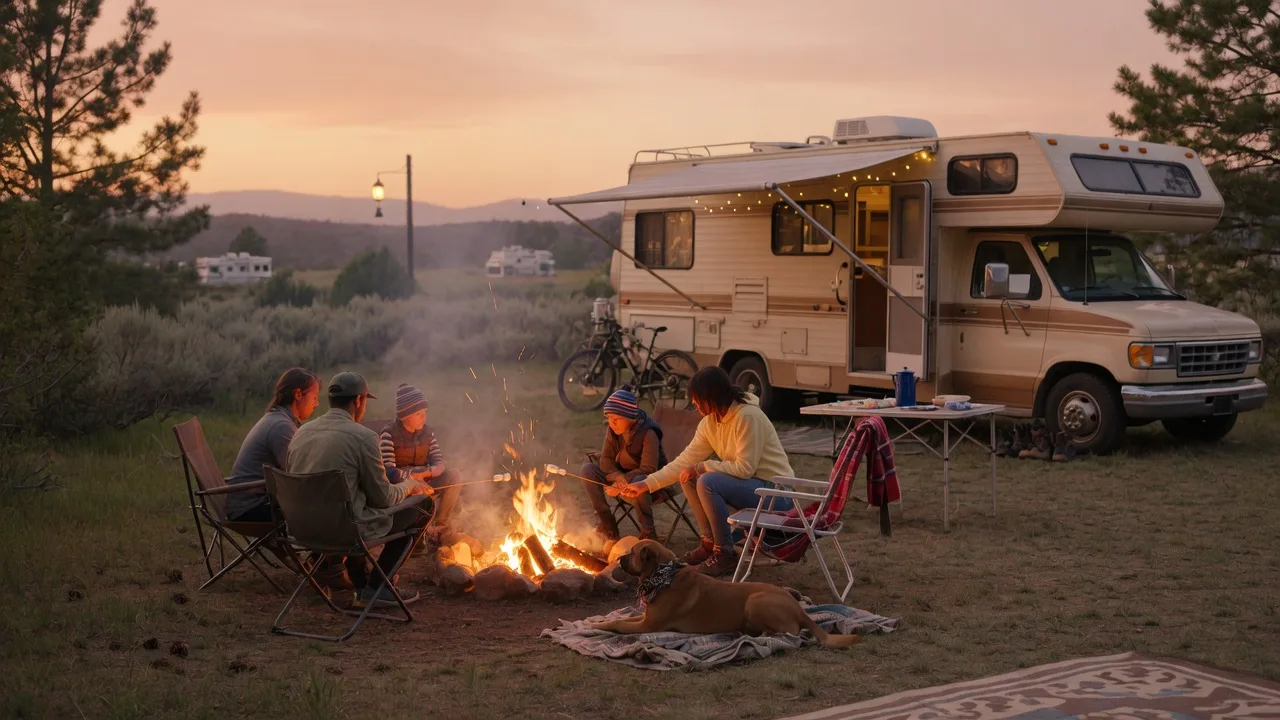
The most-rented vehicles on every marketplace have one thing in common: their photo set tells a renter what they are about to drive home. The minimum set for a PickRV listing is twelve photos. Exterior: front three-quarter, rear three-quarter, both sides, roof (taken from a ladder, not from across the parking lot). Interior: driver's seat from outside the cab, kitchen galley with appliances visible, dinette or living area, bed area made up, bathroom, every storage cabinet open. The roof photo is non-negotiable; renters look for AC unit count, solar panel presence, and antenna position, and a missing roof photo correlates with longer time-to-first-booking.
Lighting is the second variable. The honest answer is that golden-hour exterior photos sell better than overcast or midday photos, by roughly 15% in our early-stage data. If you cannot schedule a golden-hour session, an overcast day is the second-best choice; midday direct sun creates harsh shadows that read as amateur. Interior photos should be taken with the windows open and the curtains drawn — natural light makes the rig look larger than it is.
What to remove from the frame: personal items (toothbrushes, family photos, a half-finished puzzle on the dinette), branded competitor gear, anything with the host's last name written on it, and any item the host would not want a stranger to ask about. The rig in the photos should look like the rig at handoff.
Lesson checklist
- Exterior: 4 angles + roof from elevated position.
- Interior: galley, dinette, bed, bath, every cabinet open.
- Golden hour or overcast lighting (avoid midday direct sun).
- Windows open and curtains drawn for interior shots.
- Personal and competitor-branded items removed.
- 3
Pricing the first 90 days
11 minThe temptation is to price the rig at the marketplace average for its class. The reality is that a new host without a review history competes at roughly 15% to 25% below the equivalent rig from a host with a verified review history. We say this clearly because the alternative — pricing at the average and watching the calendar stay empty for six weeks — is the cause of most new-host frustration.
Our recommended first-90-day curve: weeks 1–4 at 80% of market, weeks 5–8 at 90%, weeks 9–12 at market. After the first three completed rentals with positive reviews, you can raise to a 10% premium over market without losing booking velocity. The PickRV vendor dashboard publishes a market-comparable card for each class in each state; it is computed from real listed prices on the marketplace, not from a national average.
The second variable is the nightly minimum. Two-night minimums fill faster than three-night; three-night minimums fill faster than five. The trade-off is wear-and-tear — a host who only rents three-night blocks does more handoffs and more cleanings than a host who only rents seven-night blocks. The right answer depends on the rig: a Class A motorhome wears at handoff more than a Class B and benefits from longer minimums; a Class B campervan wears at handoff less and benefits from short minimums.
Lesson checklist
- First 4 weeks: 80% of market for your rig class + state.
- Weeks 5–8: 90% of market.
- Weeks 9–12: full market.
- After 3 positive reviews: experiment with 10% premium.
- Nightly minimum: 2-night for Class B, 3-night for Class C, 5-night for Class A.
- 4
The handoff
13 minThe handoff is the moment your rental either becomes a five-star experience or generates a dispute. Every PickRV host walkthrough should hit four sections: (1) drive controls and dash, including the location of any aftermarket cruise control, the engine-mode selector if diesel, and any tow/haul switches; (2) house systems, including water heater (electric vs. gas mode), refrigerator (LP vs. 12V vs. shore power), generator start sequence, and waste valves; (3) safety, including the first-aid kit location, the fire extinguisher mounting, the CO and smoke detector test, and the location of the propane shutoff; (4) the renter's first move, which is a five-minute supervised parking-lot drive.
Record the handoff with the renter's permission. The host's phone camera is sufficient; a 10-minute video is the right length. The video is the host's protection against "the AC never worked" disputes and the renter's reference for the thing the host explained at minute 7. Both parties benefit; PickRV will publish a standard handoff video format after launch.
The renter's first move on the lot is critical. A renter who has never driven a Class C will, on the first attempt, misjudge the right-side mirror or forget about the rear overhang. A supervised drive on the host's property prevents the first failure from happening in traffic.
Lesson checklist
- Drive controls + dash review.
- House systems: water, fridge, generator, waste.
- Safety: first aid, extinguisher, CO/smoke detectors, propane shutoff.
- Renter's first move: 5-minute supervised parking-lot drive.
- Record video of the handoff with renter's permission.
End-of-course quiz
5 questions. Answer honestly. The questions exist to be useful at handoff or pickup — not to be a vanity score.
Q1.Which insurance type does PickRV require for hosts?
Q2.What is the minimum number of photos required for a PickRV listing?
Q3.What is the recommended pricing strategy for a new host's first 4 weeks?
Q4.Why does PickRV recommend recording the handoff?
Q5.What is the recommended nightly minimum for a Class A motorhome?
Completion and credentials
Your quiz answers are saved in this browser only. There is no account-level completion tracking, and no certificate is issued. Nothing in this course is a regulatory credential, and it does not replace state licensing, DOT, or insurance requirements.
Your next step
Put this course to work on a real listing.
You set your own price, calendar and rules — you keep 100% of that price and PickRV's 15% markup goes on top of it, reflected in the price renters see. Listing costs nothing and nothing is charged until a booking is paid.
Continue learning
For renters
Trip planning — from itinerary to reservations
The 90-day curve, the reservation cadence, and the buffer day you forgot to build.
For renters
Off-grid systems — power, water, waste
The mechanical truth behind the rig's tank gauges, the propane regulator, and the inverter.
For renters
Boondocking 101 — off-grid camping basics
Free dispersed camping, water rationing, the solar question, and the rule that protects the next camper.