PickRV Academy · For renters
Boondocking 101 — off-grid camping basics
- Total time
- 50 min
- Lessons
- 4
- Difficulty
- Intermediate
By PickRV · published May 3, 2026 · 666 words
What you will learn
- Identify legal dispersed camping locations and rules.
- Ration fresh water and gray-water for multi-day off-grid stays.
- Decide whether the rig's solar setup is realistic for your trip length.
- Leave the site better than you found it (the rule).
What this course teaches that others don't
This course names the next-camper rule — the practice that protects dispersed-camping access from being closed by overuse — instead of romanticizing the off-grid lifestyle.
Lessons
- 1
Legal dispersed-camping locations
12 minDispersed camping — boondocking — is legal on most Bureau of Land Management (BLM) land, most US Forest Service (USFS) land, some state-managed land, and some Native American tribal land with the tribe's permission. It is almost never legal on private property without explicit permission, on city streets except in specific RV-friendly municipalities, in National Park boundaries (which require campground reservations), or in National Monument boundaries except at designated sites.
The BLM and USFS each publish dispersed-camping maps for their districts. The Free Roam app and the Campendium site aggregate these maps with user reviews. Standard BLM rule: 14-day maximum stay at any one site, then a required 25-mile move. The 14-day limit is enforced; rangers patrol popular boondocking areas.
The honest note: the most-photographed boondocking locations on Instagram are often the most-degraded. Alabama Hills (CA), Valley of the Gods (UT), and Cathedral Wash overlook (AZ) have all been closed or restricted at various points due to overuse. If your trip depends on a specific photographed site, plan a second-choice site within 20 miles.
- 2
Water rationing
12 minAn off-grid RV consumes water faster than its tanks suggest. A 60-gallon fresh tank with a family of four lasts about 3 days of normal use; rationing extends it to 4 to 5 days. The biggest single consumer is the shower. A 60-second navy shower (wet, off, soap, on, rinse) uses 1.5 to 2 gallons; a 5-minute standard shower uses 12 to 15 gallons. The math is obvious.
Gray-water rationing matters as much as fresh-water rationing. A 40-gallon gray tank fills before the fresh tank empties if you wash dishes with the tap running. The fix: a wash-rinse-dry cycle with a single basin of soapy water and a single rinse, not running water. The flow rate of an RV galley faucet at 3 GPM means a one-minute dish wash uses 3 gallons.
Tank-management rules: dump gray before black; flush both at the dump station; carry an extra 5-gallon water jug for emergency top-up. The water-rationing math is non-romantic but it is the single biggest constraint on a boondocking trip length.
Lesson checklist
- Navy shower: 1.5–2 gallons.
- Wash-rinse-dry dish basin, not running water.
- Dump gray before black at the dump station.
- Carry an emergency 5-gallon water jug.
- 3
Solar and batteries — the realistic version
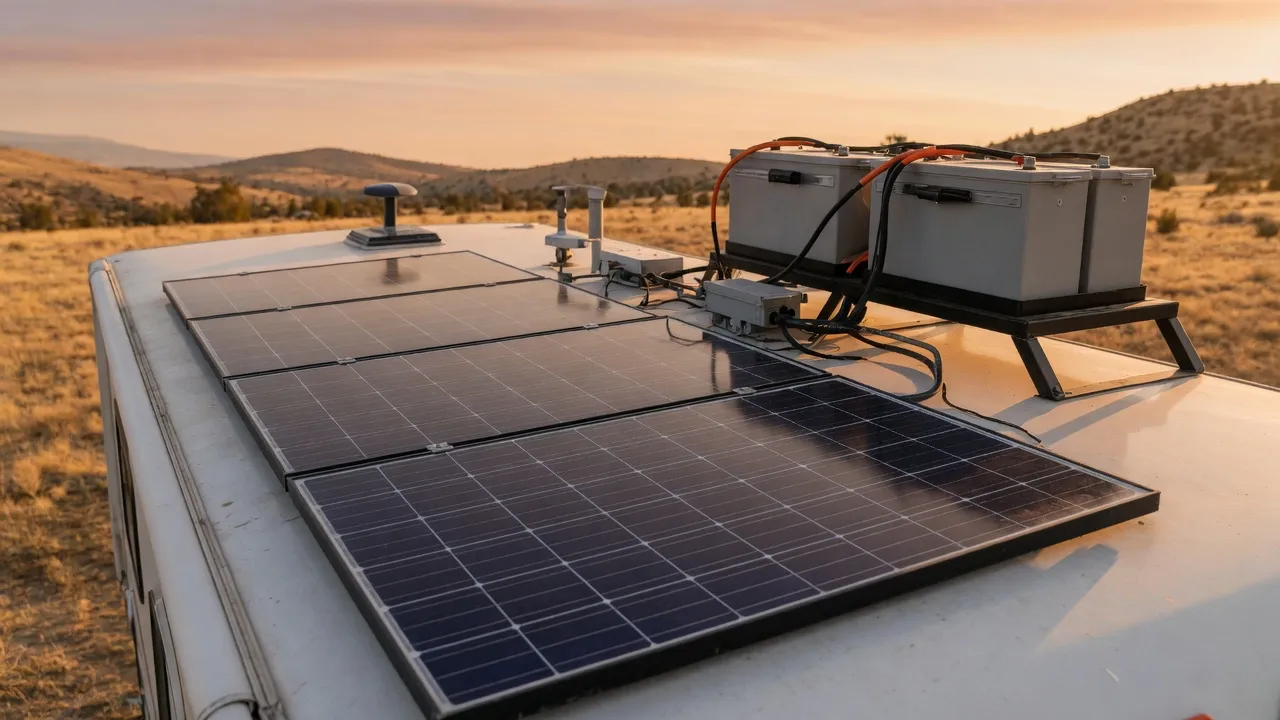
12 minMost rental RV solar installations are decorative. A typical 100W panel on a Class C generates roughly 400 Wh per day in good summer conditions, less in clouds, less in winter. A typical fridge running 24/7 consumes 400–600 Wh per day. The math: the solar covers the fridge in summer and nothing else.
The realistic solar setup for genuine multi-day boondocking is 400W+ of panel and 200Ah+ of lithium battery storage. This is not most rental rigs. PickRV listings publish the solar wattage and battery capacity; if the listing says 100W solar / 100Ah AGM battery, plan to run the generator daily.
Generator etiquette is non-negotiable in dispersed-camping areas. Most BLM districts enforce a 9pm-to-9am quiet hour. The Honda EU2200i and equivalent Onan models are quiet enough that they do not bother neighbors during permitted hours; older inverter-less generators are not, and using one will get you asked to move.
- 4
The next-camper rule
11 minThe rule: leave the site cleaner than you found it. This is not aspirational; it is the practical defense against the closure of every dispersed-camping site that has been closed in the last 20 years. The closures happen because overuse without cleanup overwhelms the BLM or Forest Service's maintenance budget for the area.
Concrete actions: pack out every piece of trash including micro-trash (twist-ties, plastic shards, cigarette butts). Pack out toilet paper if you use a tree (yes, that means a sealed bag; cathole-and-bury is technically permitted in BLM areas but Leave No Trace recommends pack-out in arid environments). Disperse fire ash only if a fire is permitted and you completely extinguish; otherwise pack the ash in foil.
Camp on durable surfaces (gravel, sand, rock, established pads), never on vegetation. Park trucks and RVs on the same pad you camped on; do not create a new track in undisturbed ground. The Forest Service rule is "camp on an existing site" and the rule exists because new sites become permanent through repeated use.
Lesson checklist
- Pack out micro-trash.
- Pack out toilet paper in arid environments.
- Disperse or pack out fire ash; never bury hot ash.
- Camp on existing durable surface; do not create new tracks.
- Refill any holes (cat-holes for waste, anchor points).
End-of-course quiz
5 questions. Answer honestly. The questions exist to be useful at handoff or pickup — not to be a vanity score.
Q1.What is the BLM maximum stay at a single dispersed-camping site?
Q2.What does a 100W solar panel generate per day in good summer conditions?
Q3.How much water does a 60-second navy shower use?
Q4.What is the next-camper rule?
Q5.Why pack out toilet paper in arid environments?
Completion and credentials
Your quiz answers are saved in this browser only. There is no account-level completion tracking, and no certificate is issued. Nothing in this course is a regulatory credential, and it does not replace state licensing, DOT, or insurance requirements.
Your next step
Now do it on an actual trip.
Boondocking 101 — off-grid camping basics is the theory. The part it is written for is a real rig on a real week — here is the honest state of finding one on PickRV today.
What you'll see there
Nothing is bookable on PickRV yet — the search page says so in those words. What it shows instead are labelled sample rigs, so you can see what a listing looks like before there is one to book.
What you'd pay
The complete price sits on every listing, and the exact total is itemized before you pay — nothing appears at the last step.
If plans change
Full rental refund 48h+ before pickup on every booking, in every state.
Tell us when you want to go.
Nothing is bookable today. Dated requests are what we take to owners, so give us the window you actually want — you get one email the day a rig covers it, and nothing else.
Continue learning
For renters
Trip planning — from itinerary to reservations
The 90-day curve, the reservation cadence, and the buffer day you forgot to build.
For renters
Off-grid systems — power, water, waste
The mechanical truth behind the rig's tank gauges, the propane regulator, and the inverter.
For renters
Driving an RV the first time
Mirror discipline, the parking-lot drill, mountain passes, and the move every first-timer regrets.