PickRV lifehack guide
EU traveler's first US RV trip — the playbook from your first ESTA to your first dump-station
- Sections
- 5
- Cited sources
- 5
- Depth
- In-depth
PickRV
Published by PickRV
EU traveler's first US RV trip — ESTA + LHD + sizing (2026)
European travelers arriving for a US RV trip face a stack of unfamiliar logistics: ESTA approval, RV sizes that don't exist in Europe, LHD driving from RHD home countries (UK, IE), the tipping economy, distances measured in miles + fuel measured in gallons. Below is a working pla
- ESTA vs visa — what you actually need
- LHD driving from RHD home — the 90-minute adjustment
- RV size shock — Class A vs European motorhome
- Fuel + tipping + cultural notes
ESTA vs visa — what you actually need
Visa Waiver Program (VWP) countries (most EU + UK + Switzerland + Norway + Australia + Japan + South Korea) need only an ESTA — Electronic System for Travel Authorization. Apply online at esta.cbp.dhs.gov (the only official site — beware lookalike scam sites that charge 5-10× the official $21 fee).
Apply at least 72 hours before flight; most approvals are instant but allow up to 72 hours. ESTA is valid for 2 years or until passport expires. Each visit can be up to 90 days. Approval lets you board the flight; admission is determined by CBP at port of entry.
- Apply at esta.cbp.dhs.gov ONLY (official US government site)
- $21 fee — anything more is a scam intermediary site
- Valid 2 years or until passport expires
- Each entry: up to 90 days
Caveat: If you've visited Iran, Iraq, Libya, Somalia, Sudan, Syria, Yemen, North Korea, or Cuba since March 2011, ESTA does NOT apply — you need a B1/B2 visa via US embassy. Same applies to dual nationals of those countries.
LHD driving from RHD home — the 90-minute adjustment
UK + Irish + Maltese + Cypriot travelers drive on the left at home and shift to the right in the US. The mechanical adjustment is fast — the cognitive load is the issue. Plan a 90-minute first-drive adjustment in low-traffic conditions (rural state highway or quiet morning) before tackling Interstate driving.
The two highest-risk moments: (a) the first turn out of a parking lot after a pause (default-side error), and (b) the first overtake (instinct to pass on the wrong side). PickRV recommends an LHD orientation session with the pickup host for UK/IE travelers, available on most flagship-hub listings.
- First 90 minutes: rural state highway or quiet morning, no Interstate
- Highest-risk turns: parking-lot exits, fuel-stop exits, any post-pause re-entry
- Highest-risk overtakes: rural two-lane passes — accept slower pace, don't overtake until comfortable
- Roundabouts: always counterclockwise in the US (opposite of UK)
RV size shock — Class A vs European motorhome
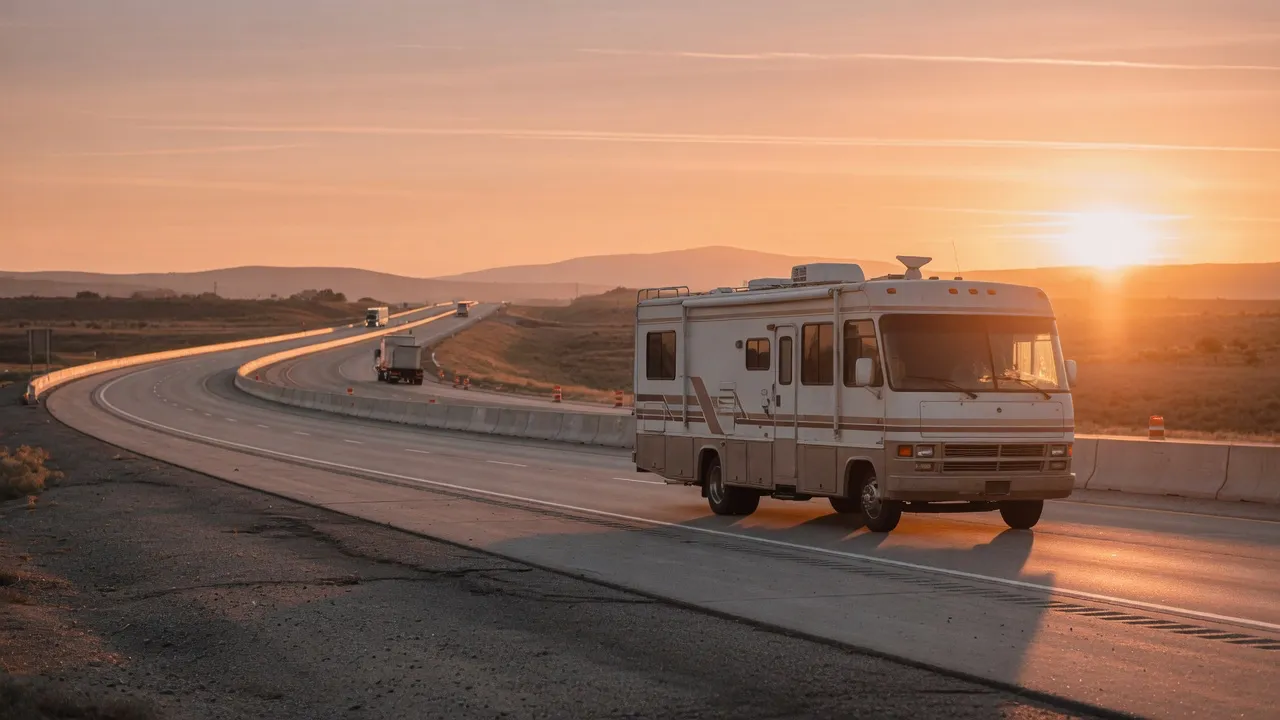
European motorhomes top out at 7-8 m (23-26 ft) and weigh 3.5 tonnes. US Class A motorhomes commonly reach 40 ft + 30,000 lb. For EU travelers, Class B campervan (Sprinter-based, ~19-22 ft) is the closest analog to a German Bürstner or Italian Adria — and the most appropriate first US RV.
Class C motorhomes (24-32 ft) are the second tier — more space than a campervan, more manageable than Class A. Skip Class A for first US trips unless you're a confident large-vehicle driver from your home country.
- First US trip from EU: Class B campervan (19-22 ft, Sprinter-based) — closest to European motorhomes
- Second-trip US: Class C (24-32 ft) — more space, still manageable
- Class A (32-40 ft): commit to 200 mi minimum-experience day before any city driving
- 5th wheel + travel trailer: avoid for first US trip unless you have tow + reverse experience
Fuel + tipping + cultural notes
Fuel is sold by the gallon (1 US gallon = 3.785 L). Gas station tipping is not expected. Restaurant tipping IS expected: 18-22 % of pre-tax bill is the modern standard (used to be 15 %, now 20 % is baseline). Bars: $1-2 per drink at sit-down, or 20 % of bar tab. Hotel housekeeping: $3-5 per night, left daily.
RV rental pickup-hub tipping: not expected for standard pickups but appreciated for help with hookup setup, towing instruction, or after-hours assistance ($20-50 typical).
- Fuel: USD per gallon (× 3.785 to compare to L price)
- Restaurant tip: 18-22 % of pre-tax total
- Bar: $1-2 per drink OR 20 % of tab
- Hotel housekeeping: $3-5/night, left daily
- RV pickup: not expected, but $20-50 appreciated for orientation help
Distance + time — the US-vs-EU calibration shift
The continental US is approximately 4,800 km coast-to-coast — about Madrid to Moscow + half again. EU travelers consistently underestimate US driving distances. The classic mistake: 'we'll do California + Yellowstone + Mt Rushmore in 10 days.' That's 4,500 km of driving alone, leaving zero time at any destination.
Realistic 10-day pace: one regional cluster (e.g., Utah's five national parks, or California Pacific Coast Highway, or Florida Keys + Everglades). Pack lighter, drive less, see deeper.
- 10 days = one regional cluster, NOT a coast-to-coast
- 21+ days = two clusters with a one-way drop-off
- 30+ days = realistic coast-to-coast
Sources + citations
Continue your trip planning