PickRV lifehack guide
Eclipse 2026-2028 RV booking strategy (NASA-sourced)
- Sections
- 4
- Cited sources
- 5
- Depth
- In-depth
PickRV
Published by PickRV
Eclipse 2026-2028 RV booking strategy — NASA-sourced paths
Three notable solar eclipses fall in the next three years on or near the continental US viewing range: a total solar eclipse August 12 2026 (path of totality crosses Greenland + Iceland + Spain — partial in northern US/Canada), the August 2 2027 total eclipse (the longest land to
- What's actually visible in continental US 2026-2028 (NASA path data)
- Why centerline isn't always the best basecamp
- Dark-sky basecamps to combine with any partial eclipse
- Booking lead-time for eclipse-adjacent dates
What's actually visible in continental US 2026-2028 (NASA path data)
Per NASA Eclipse Bulletin for 2026-2028: the 2026-08-12 total eclipse delivers partial coverage to the US (highest in Maine + New Hampshire at ~40-50%); the 2027-08-02 total eclipse delivers narrow partial to the eastern seaboard (10-25%); the 2028-07-22 total eclipse delivers minimal coverage to Hawaii only (~70-90% in Hilo + Honolulu).
None of these will rival the April 8 2024 totality. But all three offer educational, photographic, and family-trip-worthy experiences when paired with dark-sky basecamps.
- 2026-08-12 total (partial in US): partial ~40-50% in Maine + NH + northern VT + northern NY
- 2027-08-02 total: partial ~10-25% on US East Coast (peak in southeastern US)
- 2028-07-22 total: partial ~70-90% in Hawaii (Hilo + Honolulu)
Caveat: Eclipse coverage percentages are highly location-specific. Always check NASA's interactive eclipse map (timeanddate.com is the most accessible aggregator) for your specific lat/lon.
Why centerline isn't always the best basecamp
Conventional wisdom says 'get on the centerline for maximum totality duration.' For partial eclipses, this is irrelevant — you're not getting totality regardless of where you stand. Instead, optimize for: (a) cloud probability, (b) horizon clarity, (c) low light pollution for surrounding stargazing, (d) RV-friendly basecamp infrastructure.
For 2026-08-12 from northern New England: book Acadia (ME), Mount Washington Valley (NH), or the Adirondacks (NY) for the partial + the dark-sky bonus on either side.
- 2026-08-12 partial: Acadia ME, White Mountains NH, Adirondacks NY
- 2027-08-02 partial: low-light-pollution coastal SC + GA
- 2028-07-22 partial: Hawaii Volcanoes NP (Big Island) — combines with active volcanic photography
Dark-sky basecamps to combine with any partial eclipse
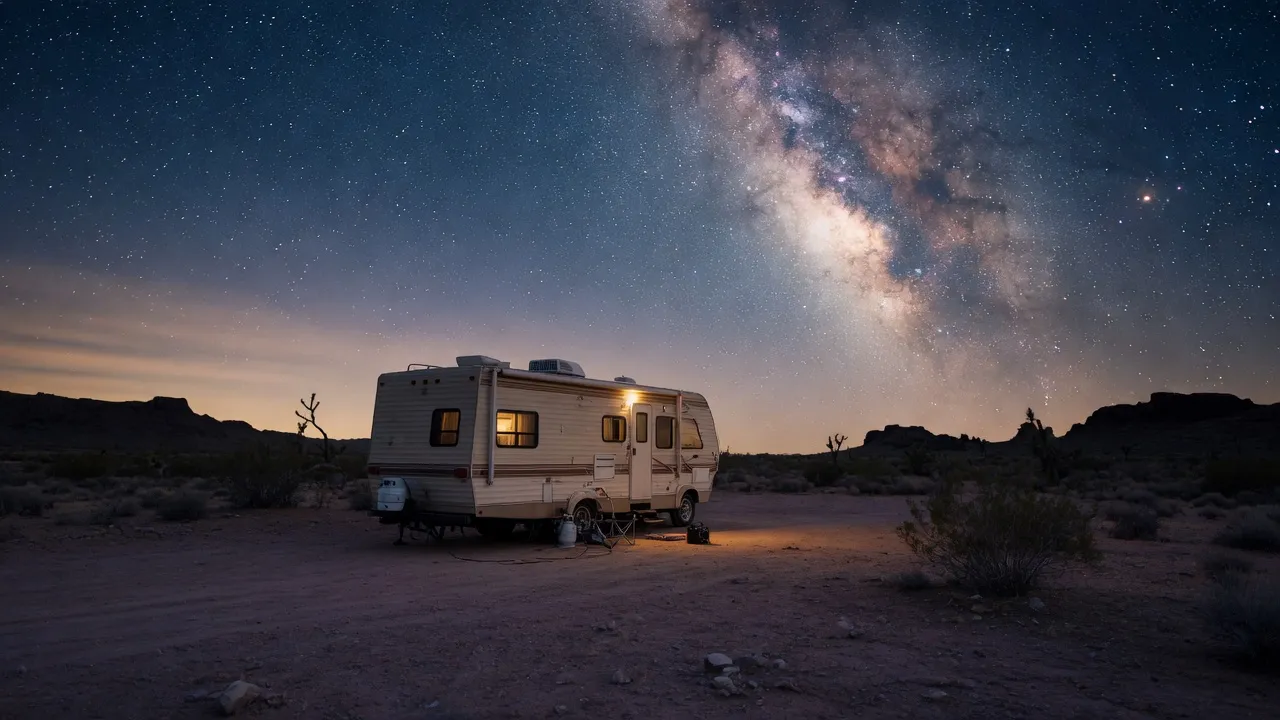
If you're going to drive 6 hours for a partial eclipse, make the trip about the stars overall. International Dark Sky Park (IDA) designations identify the genuinely dark sites — light pollution there is regulated by local ordinance + measured annually.
IDA Gold-tier US Dark Sky Parks (NPS-affiliated): Great Basin NP (NV), Capulin Volcano NM (NM), Big Bend NP (TX), Chaco Culture NHP (NM), Cherry Springs State Park (PA), Death Valley NP (CA — also Gold-tier).
- Great Basin NP (NV): darkest sky in the contiguous US per IDA
- Big Bend NP (TX): IDA Gold-tier, easy RV access
- Chaco Culture NHP (NM): IDA Gold-tier, archaeological + dark-sky combo
- Cherry Springs State Park (PA): the only PA IDA Gold-tier, eastern-US accessible
- Death Valley NP (CA): IDA Gold-tier, winter-only viable for RVs
Booking lead-time for eclipse-adjacent dates
2024 totality lessons: book at least 6 months ahead for centerline locations, 3 months for off-path basecamps. For the 2026-2028 partial windows, book 2-3 months ahead — demand will be elevated near peak partial-coverage zones but nowhere near 2024 totality levels.
For the long-game August 2045 NA totality (the next NA totality after 2024), serious eclipse chasers should already be researching basecamps; but rental booking 19 years ahead is not realistic and most rental fleets don't even publish that far out.
Caveat: Eye safety: never look at the sun directly during any eclipse phase except brief totality. Use ISO 12312-2 certified eclipse glasses. PickRV does not provide eclipse glasses with rentals — purchase from AAS-approved sources only.
Sources + citations
Continue your trip planning