Trip plan
A first-time houseboat charter family on Lake Powell
70 feet of floating cabin, three days of canyon water, and the orientation a marketplace ought to publish before you book.
Reading length
8 min
Medium read
Word count
628 words
Sections
5 parts
Story type
Trip plan
Why this trip is different from a houseboat brochure
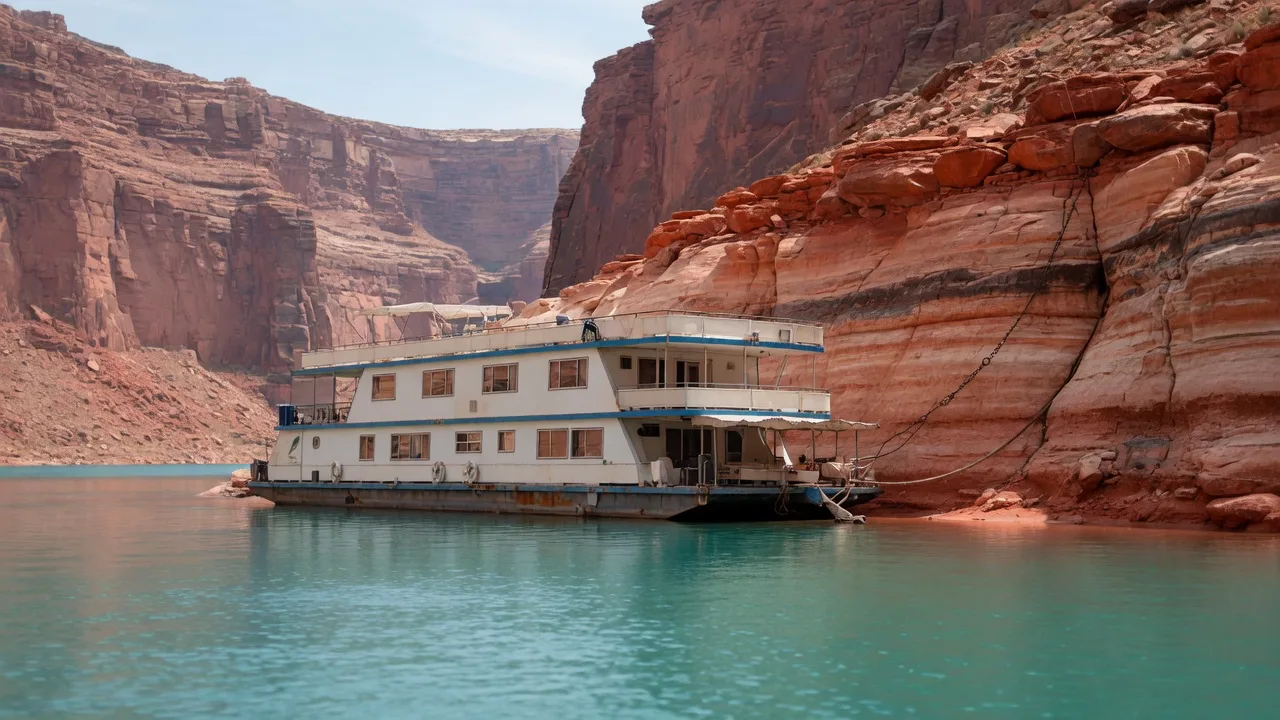
Lake Powell is a reservoir, not a lake, and the water level has been the headline geological story of the American Southwest for a decade. The reservoir's full pool is 3,700 feet of elevation; at the time of this writing, it is 100 to 150 feet below that, which means most launch ramps that the marketplace's photography references are partially or fully closed. The realistic departure point is Wahweap Marina at the south end of the lake. Antelope Point Marina, the second-most-photographed launch, has had repeated closures since 2022.
This piece is illustrative — composite, not testimonial — and reflects the lake conditions of spring 2026. A real family who has chartered and wants to document the trip with their own name should write to support@pickrv.com.
The houseboat as a vehicle
A modern Lake Powell houseboat is 60 to 75 feet long, 16 to 18 feet wide, sleeps 10 to 14 people, and is powered by twin gasoline outboards in the 90 to 150 hp range. It cruises at 8 to 12 mph and consumes 4 to 6 gallons of fuel per hour at cruise. A 70-foot houseboat with a 200-gallon fuel tank therefore has a realistic range of 30 to 40 hours of cruising, or roughly 250 to 350 miles. Lake Powell is 186 miles long. A three-day charter does not exhaust the fuel range; a seven-day charter, if you cruise hard, can.
Operating one without prior boat experience is legal — the National Park Service does not require a license to operate a recreational vessel on Lake Powell — and reasonable, because the charter company runs a pre-departure orientation that covers throttle, anchoring, beaching, generator, and waste handling. The orientation is typically 90 minutes. The marketplace that does not require this orientation is the marketplace that does not understand a 70-foot rental.
- Typical fuel range: 30–40 hours at cruise.
- Typical cruising speed: 8–12 mph.
- Pre-departure orientation: 90 minutes, mandatory on every PickRV-listed houseboat.
- Realistic three-day range: 100–150 miles of cruising, leaving margin for return.
Anchoring on a sand beach
Houseboats are typically beached for overnight stays, not anchored in deep water. The standard technique is to drive the bow gently onto a sand beach (3 to 5 mph at the moment of contact), set the stern anchors at 45-degree angles, and run a bow line to a buried bag anchor or a tied-off boulder. A first-time crew does this for the first time at the orientation and then again on day one of the charter; it does not become trivial until charter four or five.
The realistic risk is wind shift overnight. A houseboat beached with a south wind feels secure; a north wind at 3am pushes the stern into the canyon wall. Modern houseboats have an overnight anchor watch protocol that includes a single crew member sleeping in the bow cabin (where the wind shift is audible first). The marketplace that does not document the protocol on the listing is the marketplace that hopes you won't ask.
The realistic risk is wind shift overnight. A first-time crew does not anticipate the 3am alarm.
What the marketplace owes the family
Three things, on the listing, before booking: the current water level (refreshed weekly from the Bureau of Reclamation API), the published fuel range for the specific vessel, and the orientation requirements. PickRV's houseboat listings publish all three. If a vessel's photography is dated more than 24 months and shows water levels that no longer exist, we mark the listing accordingly.
We do not show artist's renderings of "how the lake used to look." The lake is what it is today. The marketplace that pretends otherwise is the marketplace that is selling a memory.
The honest moment
A houseboat on Lake Powell is a particular kind of American vacation. It is also a particular kind of geological story — the reservoir is part of the Colorado River basin's long-running water-allocation drama, which has measurable effects on every western state. A family who books the trip will learn this whether they want to or not. The orientation, the launch ramp closures, and the water level on the visible canyon walls all tell the same story.
What you won't find elsewhere
A Lake Powell houseboat piece that admits the reservoir is not at full pool and that the trip is a real navigation experience for an inexperienced crew.
Topics
Make it a trip
Rent a boat in Arizona
The rigs here are owned by local hosts. Browse what fits the trip in this story, or reach Arizona owners directly.
Browse Arizona rigsWhat fits this trip
Nearby & related
Keep planning Arizona
Sourced costs, campground directories, and the places worth a detour — the next layer of Arizona trip planning.
- Arizona RV rental costFuel · camping · tax, sourced
- Arizona RV-friendly campgroundsHookups, rig limits, booking tips
- Campervan & van rentals in ArizonaVan-life routes, rules & rigs
- RV rentals in ArizonaPickRV Wiki · 6 min read
- National grasslandsWide-open prairie drives
- LighthousesCoast-road waypoints
- Sand dunesDune fields worth the climb
- Deep trip guidesLong-form seasonal playbooks
More from PickRV
- Trip plan
Three weeks on the Pacific Coast Highway with an Italian family
Slow travel from Big Sur to the Olympic Peninsula in a Class C, with a refusal to make every day a photograph.
- Cultural heritage
A Civil Rights heritage trail RV journey
Memphis, Selma, Montgomery, Birmingham, Atlanta — the route that costs more than gas to drive honestly.
- Cultural heritage
An indigenous-heritage road trip that does not pretend to be one
Across the Navajo Nation, the Hopi Reservation, and Bears Ears, with the geography acknowledged and the etiquette named.