Clearance + restrictionCited official sources
US mountain passes — 10,000+ ft paved RV reference
When you're crossing the Rockies in an RV, altitude is the constraint. This is the list.
US mountain passes over 10,000 feet are concentrated in Colorado and California. At these elevations, gasoline engines lose 30% of sea-level power, brakes overheat on descent, and tire pressure shifts measurably. This reference lists the 10,000+ ft paved passes RV travelers encounter, with RV-relevance notes per pass.
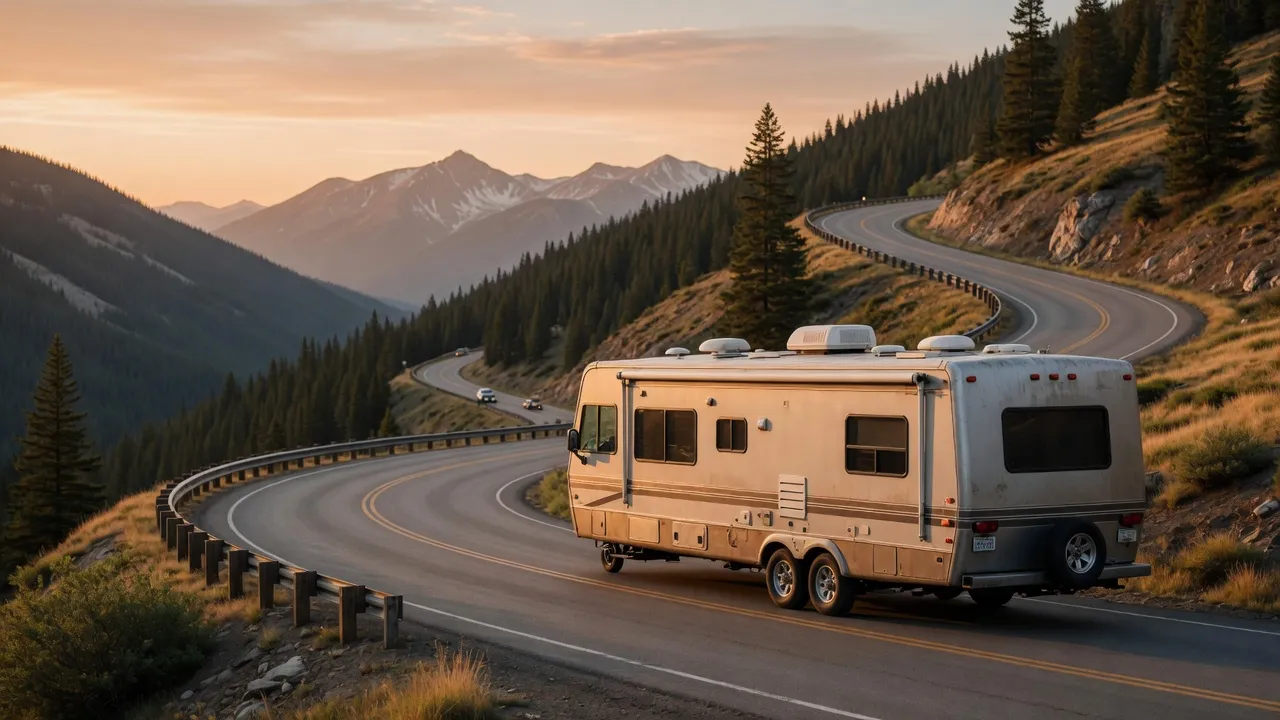
Frame: a general RV subject photograph — not a place on this route.
- Tier
- Clearance + restriction
- Sources
- Cited official (.gov / .org)
What is the highest paved mountain pass an RV can drive in the US?
Without length restrictions: Beartooth Pass on US-212 (Wyoming/Montana) at 10,947 ft is the highest RV-friendly pass. With restrictions: Trail Ridge Road in Rocky Mountain NP reaches 12,183 ft. Mount Evans (Mount Blue Sky) Byway reaches 14,265 ft with a 30-ft length limit. Pikes Peak Highway reaches 14,115 ft with brake-inspection requirements.
- Beartooth Pass 10,947 ft (highest RV-friendly)
- Trail Ridge Road 12,183 ft (NP timed entry)
- Mount Blue Sky 14,265 ft (30-ft limit)
- Pikes Peak 14,115 ft (brake inspection)
- Independence Pass 12,095 ft (35-ft limit)
10,000+ ft passes reference
Independence Pass CO-82: 12,095 ft
35-ft length limit. Summer only.
Trail Ridge Road US-34: 12,183 ft
RV-friendly. NP timed entry.
Beartooth Pass US-212: 10,947 ft
No length limit. Summer only.
Red Mountain Pass US-550: 11,018 ft
Million Dollar Highway. Class B + small Class C only.
Loveland Pass US-6: 11,990 ft
Year-round. Hazmat detour route.
Pikes Peak Highway: 14,115 ft
Toll. Brake inspection. Most RVs OK to 35 ft.
Mount Blue Sky / Mount Evans: 14,265 ft
30-ft length limit. Reservation required.
Tioga Pass CA-120: 9,945 ft
Highest CA. RV-friendly.
Sonora Pass CA-108: 9,624 ft
30-ft length limit. 26% grade. RV-discouraged.
Beartooth Pass MT/WY: 10,947 ft
Sister to US-212 entry.
Real warnings at altitude
Engine power loss
Gas engines: 30% loss at 12,000 ft. Diesel: 15-20%. Plan slow climbs.
Brake fade
Use engine braking on sustained descents.
Tire pressure shift
Cool-tire pressure rises with altitude. Verify with TPMS.
Altitude sickness in passengers
Headache, nausea, fatigue. Common above 10,000 ft.
What RV manufacturer + altitude engine documentation doesn't tell you
RV manufacturer documentation rarely addresses altitude performance directly. Diesel manufacturers are slightly better. Cat / Cummins / Mercedes-Benz Sprinter engines have published altitude derating curves.
For practical purposes, plan slower climbs and aggressive engine braking on descent above 10,000 ft. Don't push the engine. Don't ride the service brakes.
Frequently asked questions
- Will my RV overheat at altitude?
- Possible on sustained climbs. Watch coolant temperature. Pull over if approaching red.
- Are diesel RVs better at altitude?
- Generally yes — less power loss. Diesel engines retain more power than gas engines at high altitude.
Authoritative sources
Verify current conditions with state DOT 511 systems before departure. RV restrictions may change. Weather may close roads.
Planning an RV trip along US mountain passes?
Was this guide helpful?