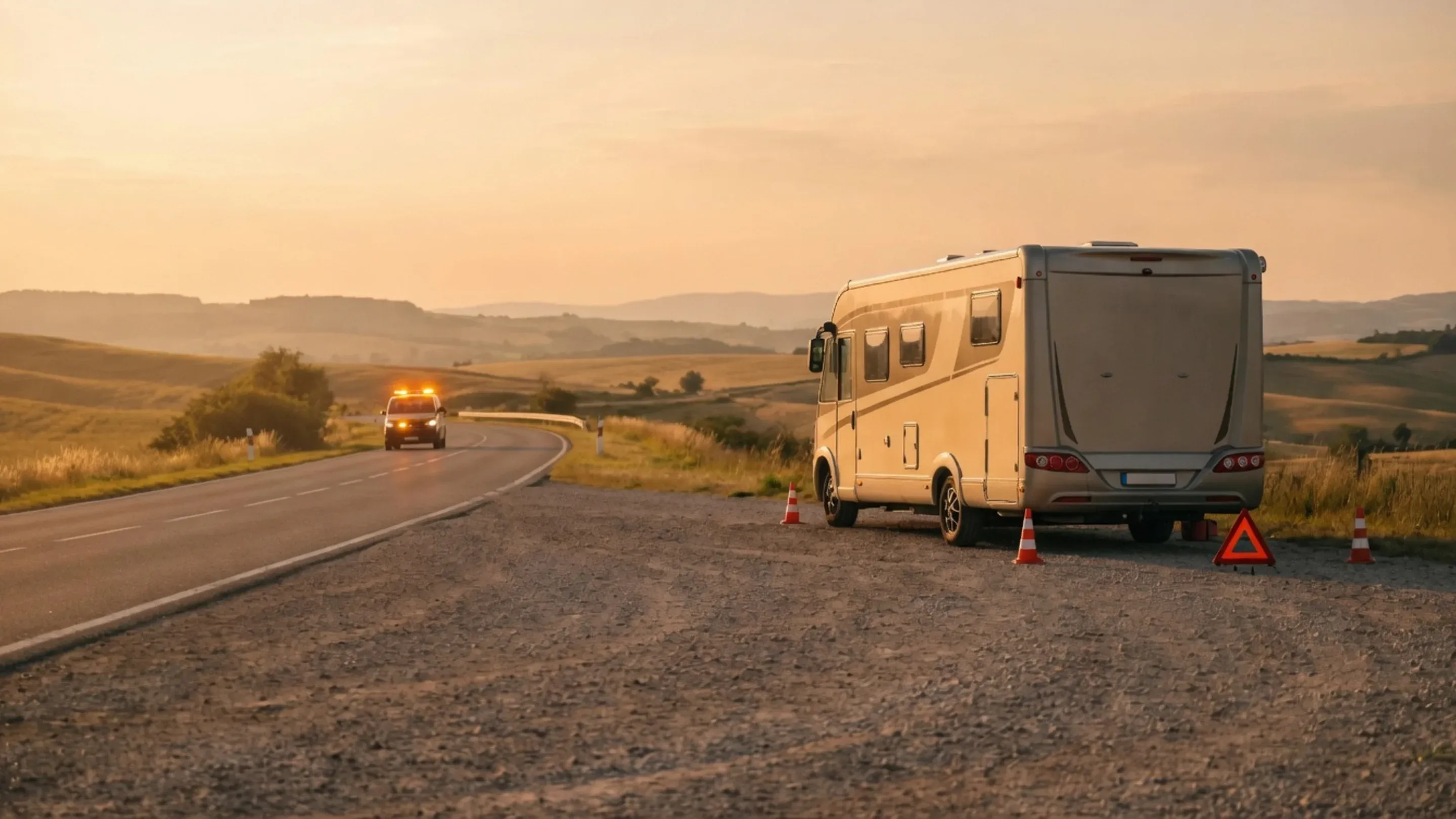
Renter scenarios
I Caused an Accident in a Rental — What Happens Now?
Educational only · not insurance advice. PickRV is not an insurance broker, agent, producer, or carrier. Coverage varies by carrier and policy. Verify any decision with a licensed insurance professional in your state.
TL;DR
Causing an at-fault accident in a rental puts the host's commercial policy and your own coverage in play — PickRV provides no coverage. You owe any applicable deductible. Damages above the policy limit fall to your personal auto liability, personal umbrella, or personal assets. The worst-case is a serious-injury accident with state-minimum host coverage and no personal umbrella.

The boundary
Where this coverage stops

Covered
5- The host's commercial liability paying third-party damages up to its policy limit.
- The host's commercial collision coverage paying for damage to the rig (subject to deductible).
- Renter-arranged supplemental liability (if purchased from an insurer) extending the cap.
- Personal auto policy liability — if it extends to the rental class.
- Personal umbrella — if it covers peer-to-peer or marketplace rentals.
Not covered
4- Damages above all applicable policy limits.
- Acts excluded by the policy (intoxication, unauthorized driver, off-road).
- Punitive damages, in most states.
- Personal financial loss not tied to insured damages.
In practice
Real-world examples

Anonymized composite scenarios illustrating typical outcomes.
Renter at-fault, $215K total claims — personal umbrella covered the gap
A renter at-fault in a multi-vehicle accident faced $215,000 in combined claims. The host's commercial liability limit was $300,000 — fully within limit. The renter's personal umbrella was unnecessary in this case but provided peace of mind during the year-long claims process.
Outcome: Renter personal exposure: zero. The host's commercial policy paid all damages. Lesson: confirm the host's coverage limit before the trip; do not assume it is state-minimum. PickRV provides no coverage.
The money
Cost ranges

Industry-typical pricing from published carrier and industry sources. Actual quotes vary by state, vehicle, and driver history.
Industry-typical CDW deductible after at-fault loss.
Depends on damage severity; serious-injury claims routinely reach mid-six to seven figures.
Fine print
What insurance companies don't say

Industry insider knowledge surfaced for educational transparency.
Payment order: rental policy first, personal policies second
At-fault accidents put the host's commercial policy in play as primary. Your personal auto policy (if it extends) is secondary. Your personal umbrella stacks on top. Personal assets are the final layer of exposure.
Pre-existing conditions of injured parties affect settlements
If the injured party has pre-existing conditions, their damages may be reduced ('eggshell skull' doctrine notwithstanding). The reverse is also true — pre-existing conditions can be aggravated by your accident, increasing damages. Adjusters review medical histories.
Punitive damages are usually not insurable
Most states prohibit insurance from covering punitive damages (awarded for malicious or reckless conduct). If a court awards punitives, they come from personal assets even when compensatory damages are insured.
FAQ

Who pays for the other driver's medical bills?
Your liability — through the host's commercial policy first, supplemental if you purchased it, your personal auto policy if it extends, and your umbrella if applicable. Damages above all limits fall to your personal assets.
Will the rental policy increase my personal auto rates?
Depends. Some carriers consider rental claims when re-rating personal auto; some do not. The rental claim does not appear on your personal auto policy directly, but it may surface in a CLUE database lookup.
Do I have to pay the deductible?
Yes — the renter owes the CDW deductible on at-fault loss. The host can charge the deductible to your card on file.
Can I be sued personally?
Yes, if damages exceed all applicable insurance limits. Plaintiffs sue to access personal assets. This is why higher limits + umbrella matter.
What if I caused the accident but the other driver is also partially at-fault?
Comparative negligence rules in most states apportion fault. Your liability pays only the percentage attributed to you.
When to consult a broker

Talk to a broker BEFORE a trip if you have any uncertainty about your personal liability stack. Talk to an attorney (personal-injury defense) AFTER a serious at-fault incident — adjusters represent the carrier, not you. An attorney represents you specifically.
Sources
- [1]III — Auto Insurance Basics — Auto insurance basics
- [2]NAIC — Auto Insurance Buyer's Guide — Auto insurance coverage explained
- [3]III — Rental Car Insurance — Rental vehicle coverage
- [4]III — Facts + Statistics — RV / recreational vehicle industry stats
- [5]NAIC — Consumer Insurance Search — Consumer regulator + complaint portal
Your next step
Now the thing you were going to insure
Coverage only makes sense against a specific rig and a specific week — the deductible on a 30-foot Class C is not the deductible on a towable. Start from what you would actually drive.
What you'll see there
Nothing is bookable on PickRV yet — the search page says so in those words. What it shows instead are labelled sample rigs, so you can see what a listing looks like before there is one to book.
What you'd pay
The complete price sits on every listing, and the exact total is itemized before you pay — nothing appears at the last step.
If plans change
Full rental refund 48h+ before pickup on every booking, in every state.
Tell us when you want to go.
Nothing is bookable today. Dated requests are what we take to owners, so give us the window you actually want — you get one email the day a rig covers it, and nothing else.