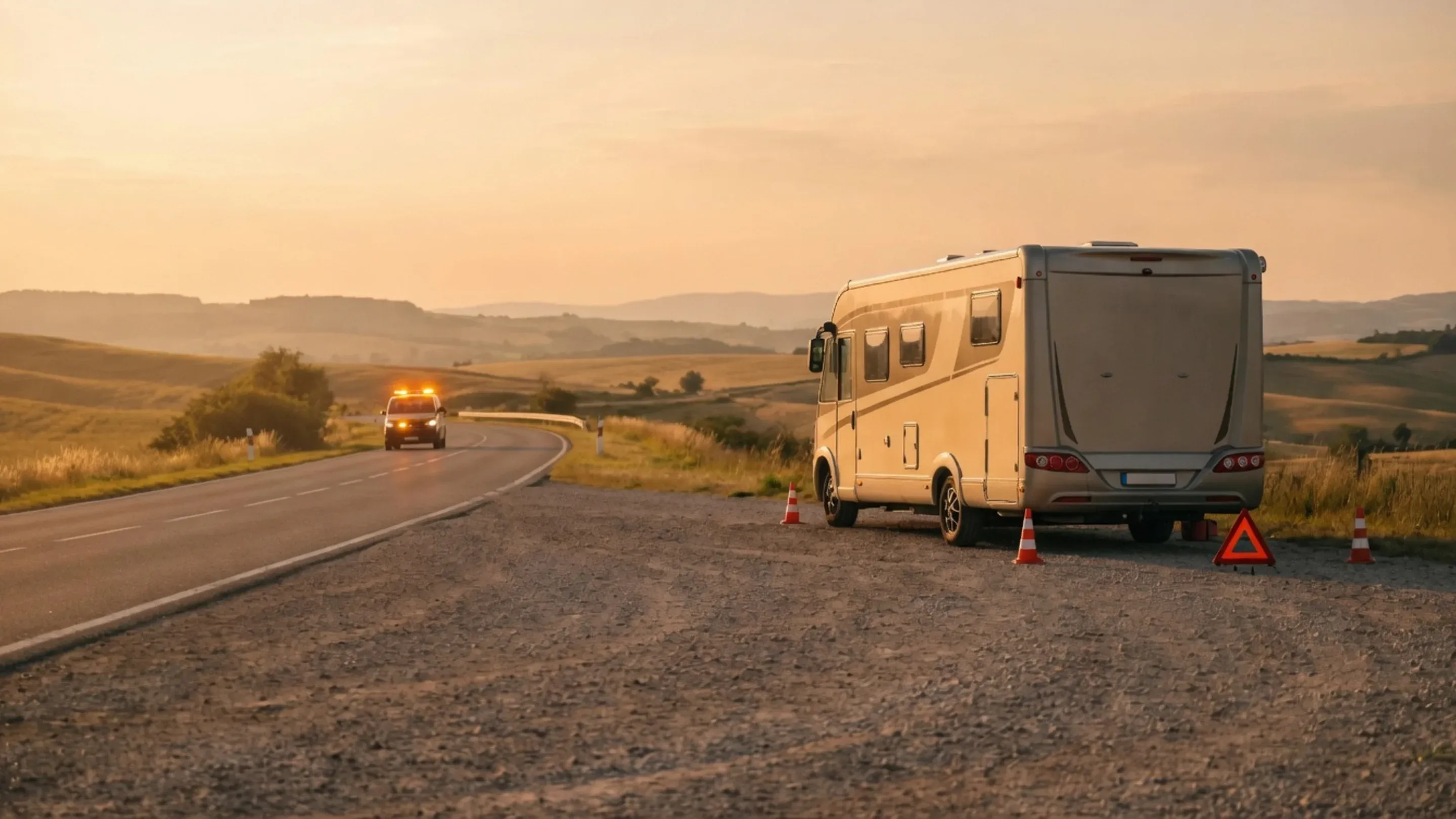
Renter scenarios
Mechanical Breakdown — When Insurance Pays and When It Doesn't
Educational only · not insurance advice. PickRV is not an insurance broker, agent, producer, or carrier. Coverage varies by carrier and policy. Verify any decision with a licensed insurance professional in your state.
TL;DR
Mechanical breakdown — engine, transmission, electrical, plumbing, appliance failure — is NOT covered by standard rental insurance (collision, comprehensive). It is a separate product (Mechanical Breakdown Insurance, MBI) or a manufacturer warranty. Renters with rig failures should escalate to the host for repair or replacement at no renter cost; renters who cause mechanical damage may be liable.

The boundary
Where this coverage stops

Covered
4- Mechanical Breakdown Insurance (separate product) covering engine, transmission, electrical, plumbing.
- Manufacturer warranty for newer rigs still under coverage.
- Host responsibility for pre-existing or unrelated mechanical failures.
- Some marketplaces offer 'mechanical assurance' coverage as an add-on.
Not covered
4- Standard collision and comprehensive — these are physical-damage products, not mechanical.
- Wear and tear, gradual deterioration.
- Renter-caused mechanical damage (low oil, fuel contamination, overheating).
- Mechanical failures during prohibited use (off-road, commercial).
In practice
Real-world examples

Anonymized composite scenarios illustrating typical outcomes.
Engine overheated on grade — host responsibility (pre-existing coolant leak)
A renter on a long climb in Colorado experienced engine overheating in a Class C. Tow back to the host's facility; diagnostic showed a pre-existing coolant leak the host had not disclosed. The host accepted responsibility, refunded the remainder of the rental, and arranged a substitute vehicle.
Outcome: Renter out-of-pocket: zero. Refund issued for unused days. Lesson: pre-existing mechanical issues that the host knew or should have known about fall to the host, not the renter.
Renter put gasoline in diesel tank — $8K liability
A renter at a fueling station added gasoline to a diesel tank by mistake. The diesel injection system was destroyed. Repair: $8,400. Renter responsibility: full amount per the rental contract (fuel choice is a renter responsibility).
Outcome: Renter out-of-pocket: $8,400. Lesson: confirm fuel type at every fueling. Modern fuel-station nozzles are different sizes but mistakes happen at busy stations.
The money
Cost ranges

Industry-typical pricing from published carrier and industry sources. Actual quotes vary by state, vehicle, and driver history.
Specialty product for owners of RVs out of manufacturer warranty.
Industry-typical engine rebuild for diesel pusher motorhomes.
For Class C and Class A automatic transmissions.
Fine print
What insurance companies don't say

Industry insider knowledge surfaced for educational transparency.
Insurance is for events; warranties are for failures
Insurance covers sudden events (collision, theft, fire, hail). Warranties and mechanical-breakdown products cover failures of components. The two are categorically different. Renters who assume 'I have insurance' covers a failed transmission are mistaken.
Host responsibility is the renter's first line
For pre-existing mechanical issues, the host is responsible. Renters should escalate first to the host through the marketplace, not file an insurance claim. The host can replace the rig, refund the trip, or arrange repair without involving the insurance carrier.
Renter-caused mechanical damage has explicit lines
Low oil, fuel contamination, overheating from blocked radiator, generator damage from running without oil — these are renter-responsibility issues per most rental contracts. The renter pays out of pocket; insurance does not cover.
FAQ

Will insurance pay if the engine fails on my trip?
Probably not — engine failure is a mechanical breakdown, not an insurable event. Talk to the host first; they may have MBI on the rig or warranty coverage.
Who pays for tow when the rental breaks down?
Roadside assistance (if included or purchased) covers the tow. The repair itself comes from the host's MBI, warranty, or out-of-pocket — depending on the cause.
What if the AC stops working mid-trip?
Inconvenience only; safety not at stake. Host responsibility for repair, replacement rig, or partial refund. Document the issue with photos and time-stamped messages.
What about pre-trip walkthrough issues I missed?
If a defect was noted on the walkthrough form, it is host responsibility. If undocumented and the renter has been operating for days, the line is fuzzier.
Should I buy MBI on a rental?
Rental-side MBI is rare. If offered, it covers mechanical breakdown during the rental — useful for long trips on older rigs.
When to consult a broker

MBI is more of a vehicle-owner question than a renter question. Renters should focus on the host relationship and the rental contract terms for mechanical issues — they trump insurance for most scenarios.
Sources
- [1]III — Facts + Statistics — RV / recreational vehicle industry stats
- [2]NAIC — Auto Insurance Buyer's Guide — Auto insurance coverage explained
- [3]III — Collision and Comprehensive Coverage — Collision and comprehensive explainers
- [4]NAIC — Consumer Insurance Search — Consumer regulator + complaint portal
Your next step
Now the thing you were going to insure
Coverage only makes sense against a specific rig and a specific week — the deductible on a 30-foot Class C is not the deductible on a towable. Start from what you would actually drive.
What you'll see there
Nothing is bookable on PickRV yet — the search page says so in those words. What it shows instead are labelled sample rigs, so you can see what a listing looks like before there is one to book.
What you'd pay
The complete price sits on every listing, and the exact total is itemized before you pay — nothing appears at the last step.
If plans change
Full rental refund 48h+ before pickup on every booking, in every state.
Tell us when you want to go.
Nothing is bookable today. Dated requests are what we take to owners, so give us the window you actually want — you get one email the day a rig covers it, and nothing else.